
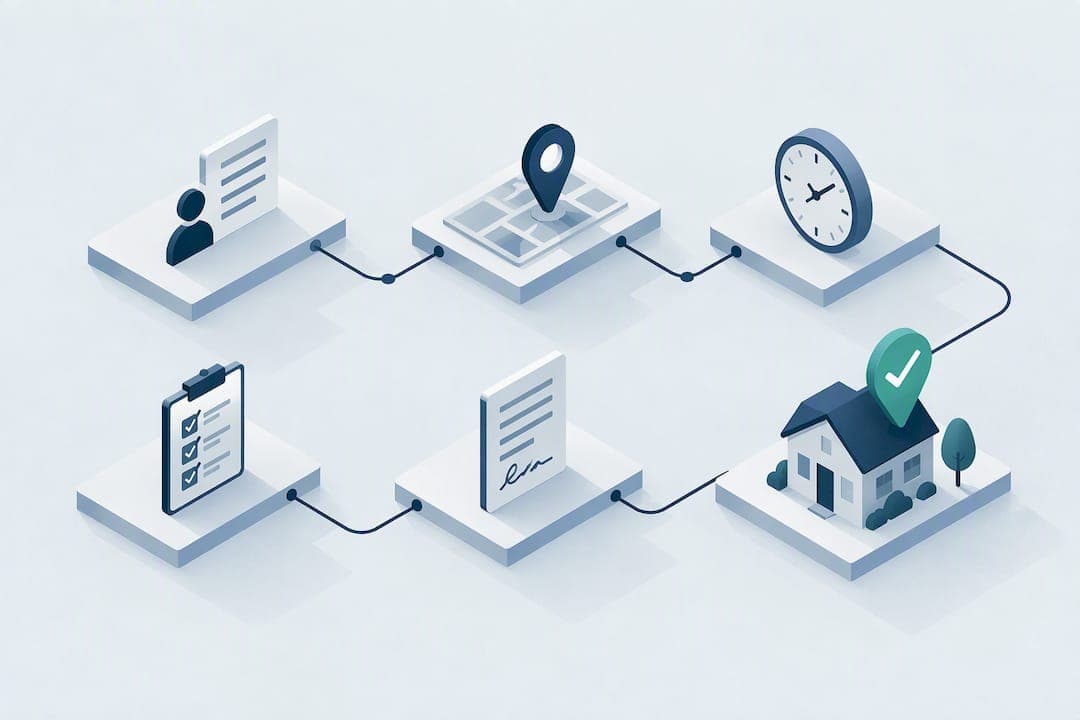
Field visit verification, now largely synonymous with Electronic Visit Verification (EVV), confirms that an in-home care visit actually happened by capturing six required data points: service type, recipient, date, location, caregiver identity, and start and end times. States and managed care plans use these records to validate Medicaid claims, which means a missing or mismatched record can delay payment or trigger an audit.
TL;DR:
- State requirements set vendor models, submission formats, and exception rules; family caregivers residing with recipients may receive different treatment, so verify scope before rollout.
- Mobile apps verify arrival with GPS, while landline IVR feels less invasive but offers weaker location evidence when a payer questions a visit.
- Pair a mobile app with IVR or offline queuing in weak signal areas, because delayed uploads can create timing gaps during claims matching.
- Review flagged visits daily to correct missed clock outs, wrong service codes, and hospital stays that were not reflected in schedules before claims go out.
- Pilot with one team and test geofence radii between 50 and 150 meters against real visit patterns to limit false exceptions at shared addresses.
Table of Contents
- What EVV is and the six required data elements
- CMS deadlines, state responsibilities, and payment risk
- How EVV can be collected: technology options and trade-offs
- Privacy, identity verification, and compliance best practices
- Operational impact: billing, claims matching, and mitigations
- Clock-Me perspective: a checklist for a compliant, low-friction rollout
- EVV versus traditional field visit verification methods
- Common challenges in field visit verification and how to address them
- Best practices for integrating EVV with existing workforce platforms
- How EVV affects workforce productivity and compliance beyond billing
- Geofencing in field visit verification: how it works and why it helps
- Real-world patterns in successful EVV implementation
- Editorial perspective: balancing program integrity with client dignity
- Clock-Me solutions: practical support for your EVV needs
- FAQ
- Sources
What EVV is and the six required data elements
Electronic Visit Verification exists because of a specific federal mandate. Section 12006 of the 21st Century Cures Act requires states to confirm that Medicaid-funded personal care and home health visits actually took place, and it specifies exactly what that confirmation must include. According to CMS guidance, every compliant system must capture:
- The type of service performed during the visit.
- The individual receiving the service.
- The date the service occurred.
- The location where the service was delivered.
- The individual providing the service.
- The time the service visit began and ended.
Most personal care services (PCS) and home health care services (HHCS) funded through Medicaid fall under this requirement. Some categories, such as care delivered by a live-in family caregiver, may be handled differently under state policy, so it is worth checking how your state defines in-scope services. States also vary in how they label service types in their systems, often mapping EVV categories to existing program billing codes. If you operate across state lines, expect to adjust your intake workflow for each program's terminology rather than assuming one configuration fits every contract.
CMS deadlines, state responsibilities, and payment risk
The federal timeline gave states a clear runway: personal care services needed compliant EVV by 2020, and home health care services followed by 2023. States that fell behind could request a limited, one-year "good faith effort" exemption if they could show real progress despite unavoidable delays, as described in CMS's EVV guidance.
- Missing the deadline without an approved exemption exposes a state to incremental FMAP (Federal Medical Assistance Percentage) reductions.
- States can pursue outcomes-based certification, which sets operational readiness benchmarks instead of a single rigid technical standard.
- A state's choice of aggregator model, provider-choice system, or verification organization (VO) structure directly shapes what providers must submit and how.
For agencies, this means your obligations are set at the state level, not the federal one. Always confirm the specific EVV vendor model, submission format, and exception rules your state program requires before assuming a system is plug-and-play.
How EVV can be collected: technology options and trade-offs
States generally permit a handful of capture methods, and each comes with real operational trade-offs worth understanding before you commit to one.
- Mobile apps with GPS and geofencing capture all six data elements cleanly and support offline queuing in low-signal areas, though agencies should watch for fake-GPS spoofing apps and build in device checks.
- Telephony or IVR systems using a landline are less invasive from a privacy standpoint but capture less location detail, which can limit audit defense if a visit is questioned.
- Fixed devices at a client's home work well for consistent, single-location care but add deployment and maintenance overhead, plus the burden of auditing multiple hardware units.
- Batch or offline upload workflows help in areas with unreliable connectivity, but delayed syncing can create timing gaps that complicate real-time claims matching.
Not every state permits every method, and some restrict how granular location data can be, particularly for community-based visits. Check your state's EVV guidance before selecting a capture method, since a system that works in one program may not satisfy another.
Pro Tip: Pair a primary mobile app with an IVR fallback for caregivers working in connectivity dead zones, so a bad signal never turns into a missed visit record.
Privacy, identity verification, and compliance best practices
Beneficiaries sometimes misread EVV as constant surveillance rather than visit-specific confirmation, a concern UCSF research found affects adoption and trust. Clear communication from providers measurably improves acceptance.
- Favor event-based location captures (clock-in, clock-out) over continuous tracking streams to limit what you collect and reduce the sense of being watched.
- Use identity-proofing approaches suited to the task: in-person verification for onboarding, remote attended checks for ongoing visits, and biometric methods only where state policy permits and the benefit clearly outweighs the added data sensitivity, consistent with NIST's identity-proofing guidance.
- Give beneficiaries a plain-language notice explaining what is collected and why, and train staff to answer questions about it before the first visit.
Our guide to GPS privacy covers how to structure event-based location capture so you collect only what compliance requires.
Operational impact: billing, claims matching, and mitigations
States and payers match EVV records against submitted claims, and an unmatched visit is a flag for further review, sometimes leading to recoupment. A New York state audit found significant mismatches between paid claims and EVV records, along with oversight gaps where visits were paid despite having no corresponding verification entry.
- Short or incomplete visits often trigger exceptions when a caregiver forgets to clock out; train staff to close every visit before leaving the location.
- Unsuspended hospitalizations can cause a scheduled visit to appear as a no-show in the system; build a process to flag and pause schedules promptly.
- Manual entry errors, like a wrong service code, create claims that cannot reconcile with EVV data; use pre-claim verification checks before submission.
- Unresolved exceptions pile up and slow billing cycles; assign a daily review owner and retain documentation in case of audit.
Our exception management workflow walks through a four-step process for closing these gaps before they reach a claim.
Clock-Me perspective: a checklist for a compliant, low-friction rollout
A staged pilot beats a full rollout on day one. Start with one team, set geofences between 50 and 150 meters, and layer in randomized check-ins to deter buddy punching without overcorrecting into false exceptions.
- Bind devices to individual caregivers and require photo or ID capture at clock-in to reduce fraud risk.
- Build a clear beneficiary notice and a defined SLA for resolving flagged exceptions.
- Export clean, audit-ready timecards directly into payroll to shorten the path from visit to payment.
Pro Tip: Run your pilot with mixed capture modes, mobile app plus a fallback option, so a single connectivity issue never stalls a whole team's records.
See how a mobile time clock deploys in days for field teams, or review our solutions page for configuration details.
EVV versus traditional field visit verification methods
Traditional verification relied on paper timesheets, phone call-ins logged manually, or a supervisor's spot-check visit. These methods depend heavily on trust and after-the-fact review, which makes them slow to catch errors and nearly impossible to audit at scale.
Paper-based timesheets, for instance, offer no independent confirmation that a caregiver was actually at the client's location. A New York state EVV resource notes that web-based electronic timesheets without auditable location or independent verification are generally insufficient on their own to meet federal EVV requirements, because they still rely on self-reported data with no outside check.
Electronic verification changes the sequence. Instead of reconciling timesheets weeks later, location and time data post automatically at the moment of service, which lets billing teams catch mismatches before a claim goes out rather than after a payer flags it. The trade-off is that electronic systems require upfront setup, caregiver training, and ongoing device management, costs that paper processes never carried but that pay off in faster claims cycles and fewer disputes down the line. For agencies still running manual processes, the shift is less about adding technology for its own sake and more about closing the verification gap that paper left open for years.

Common challenges in field visit verification and how to address them
Connectivity gaps are one of the most frequent obstacles, especially for caregivers working in rural areas or inside buildings with weak signal. Offline queuing and IVR fallback options help close this gap without forcing a caregiver to delay logging a visit.
Caregiver adoption is another recurring friction point. Staff unfamiliar with mobile apps may resist a new process, particularly if they fear it tracks them outside of work hours. Clear training that explains event-based capture, rather than continuous tracking, tends to ease this resistance faster than a one-time policy memo.
Data accuracy issues, like mismatched service codes or incomplete visit records, often stem from rushed data entry rather than system failure. Building a short daily review step into a supervisor's routine catches these before they reach a claim.
Finally, multi-unit housing and shared addresses can confuse geofence-based verification, generating false exceptions when a caregiver is legitimately on-site but outside a tightly drawn boundary. Testing geofence radii against real visit patterns before a full rollout, rather than relying on a default setting, reduces this friction considerably.
Best practices for integrating EVV with existing workforce platforms
Integration works best when EVV data flows directly into the systems your team already relies on for scheduling and payroll, rather than sitting in a separate silo that someone has to reconcile by hand. Look for a platform that exports clean timecards into your existing payroll process without requiring manual re-entry.
Map your state's required data elements to your existing employee and client records before go-live, so the system recognizes service codes, caregiver IDs, and client identifiers correctly from day one. Mismatched reference data is one of the most common causes of failed claims matching after a new system launches.
Keep your exception workflow visible to the same team that already manages scheduling conflicts and attendance issues, instead of creating a separate compliance silo. This keeps corrections fast and ensures the people closest to daily operations are the ones resolving flagged visits.
Finally, pilot the integration with a single team or region before extending it system-wide. A small-scale test surfaces configuration issues, like incorrect service type mappings, while the stakes are still low.
How EVV affects workforce productivity and compliance beyond billing
EVV's most visible effect is on claims accuracy, but its reach extends further into daily operations. Verified clock-ins reduce time spent manually reconciling timesheets, freeing office staff to focus on scheduling and client care coordination instead of chasing paperwork.
Supervisors gain real-time visibility into which visits are happening on schedule, which lets them respond to a missed or delayed visit the same day rather than discovering it weeks later during a billing review. That immediacy also supports better care coordination, since a caregiver who clocks in late or not at all can trigger a prompt check-in call to the client.
On the compliance side, accurate time records support labor law adherence, including proper break documentation and overtime calculation, which matters in jurisdictions with strict wage and hour rules. A workforce platform that captures verified time data once and applies it across billing, payroll, and compliance reporting reduces the duplicate data entry that otherwise invites errors in all three.
Geofencing in field visit verification: how it works and why it helps
Geofencing draws a virtual boundary around a client's address and checks whether a caregiver's device is inside that boundary at clock-in and clock-out. It is one of the more direct ways to confirm a visit's location without requiring constant location tracking throughout the shift.
Setting the right radius matters more than it might seem. A boundary that is too tight generates false exceptions when a caregiver's device reports a slightly imprecise GPS position, which is common near large buildings or dense multi-unit housing. A boundary that is too loose undermines the entire purpose by allowing a clock-in from down the street. Testing radii in the 50 to 150 meter range against real visit data before a full rollout helps agencies find a setting that fits their service area.

Geofencing also supports randomized check-ins during longer visits, an added layer that discourages buddy punching without requiring continuous monitoring. Because the check happens only at defined moments rather than as a constant stream, it limits the privacy concerns that beneficiaries have raised about EVV in general. Our guide to geofence sizing and randomized check-ins covers how to calibrate these settings for different service environments.
Real-world patterns in successful EVV implementation
Agencies that roll out EVV successfully tend to follow a similar sequence: a small pilot, a clear beneficiary communication plan, and a defined process for handling exceptions before scaling to the full caregiver roster. Skipping the pilot stage is one of the most common reasons a rollout generates friction, since unresolved configuration issues surface all at once across an entire workforce instead of a single test group.
State audit findings offer a useful cautionary pattern here. The New York OSC audit found that inadequate pre-claim reviews allowed payments for visits with no matching EVV record, a gap that a structured exception-review step would likely have caught before claims went out. Agencies that build a daily or weekly reconciliation habit into their billing process tend to avoid this exact failure mode.
Connectivity planning also separates smoother rollouts from rocky ones. Teams that pair a mobile app with an IVR or offline fallback from the start rarely experience the billing disruptions that hit agencies relying on a single capture method. Our 30-day deployment guide outlines a staging approach that mirrors this pattern, moving from a single team pilot to a phased expansion once exception rates stabilize.
For a broader operational view, this field service app comparison outlines deployment patterns that apply beyond home care, useful context if you are evaluating capture methods against other field-based industries.
Editorial perspective: balancing program integrity with client dignity
EVV done right protects both sides: transparent limits on data collection and solid caregiver training build trust, while faster, cleaner claims reduce disputes for everyone involved.
— Clock-me
Clock-Me solutions: practical support for your EVV needs
Rolling out EVV does not have to mean months of setup or a steep learning curve for your caregivers. Our platform is designed around a one-tap clock-in, GPS-verified location capture, and geofencing that confirms a visit without constant tracking.
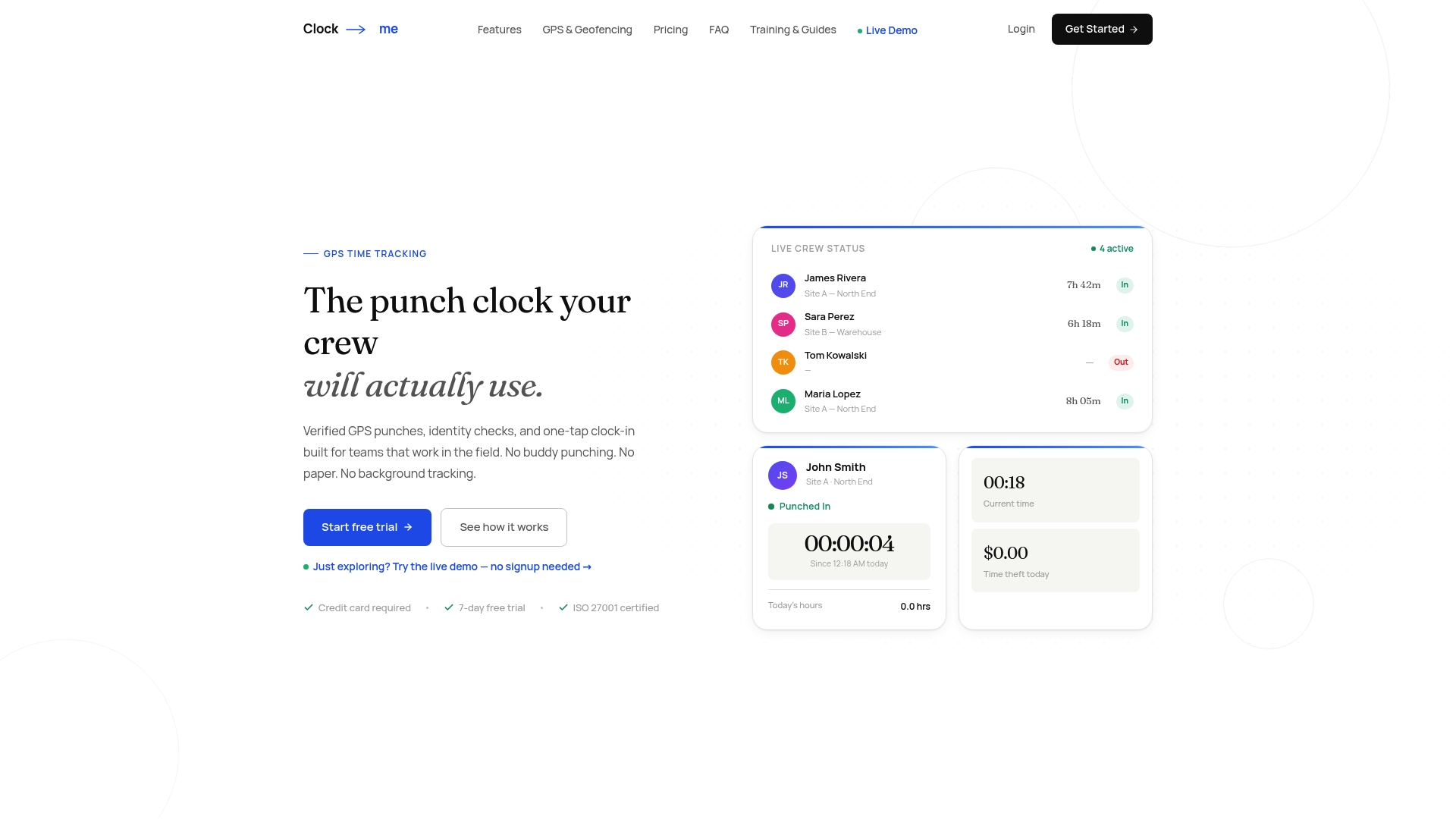
- Identity verification and device binding to reduce fraud risk at clock-in.
- Randomized check-ins and configurable geofences sized to suit service areas.
- Reporting that exports cleanly into payroll.
Visit our solutions page to see plan details and request a pilot for your team.
FAQ
What is the purpose of electronic visit verification?
Electronic visit verification confirms that a Medicaid-funded personal care or home health visit actually occurred by recording six required data points: service type, recipient, date, location, caregiver, and visit times. States use these records to validate claims and reduce improper payments, as outlined in CMS's EVV guidance.
What is the best EVV system for home care?
There is no single system that fits every state program, since requirements vary by aggregator model and permitted capture methods. Agencies generally do best with a system that captures all six required data elements reliably, supports offline or fallback modes, and exports clean records for billing and payroll. We built our platform with GPS verification, geofencing, and identity checks aimed at meeting those needs; see our solutions page for plan details.
What does EVV call out mean?
An EVV "call out" or exception typically refers to a flagged visit record, one that is missing a required data element, falls outside a geofence boundary, or does not match a scheduled service. Providers generally need to review and resolve these exceptions before submitting the related claim to avoid payment delays.
Do all provider agencies use the same EVV system?
No. States choose their own EVV model, which may be a state-sponsored aggregator, a provider-choice system where agencies select their own vendor, or a managed care organization's designated system. Because of this, the technology and submission process an agency uses can vary significantly even within the same state's broader Medicaid program.
Sources
- Electronic Visit Verification | Medicaid
- Impact of Electronic Visit Verification (EVV) on Personal Care Services Workers and Consumers in the United States
- Medicaid Program: Provider Compliance With the Electronic Visit Verification Program (NY OSC audit)