

Stopping time theft comes down to three moves: put your rules in a standalone written policy, replace manual clock punches with verified time capture, and run scheduled audits with consistent enforcement. A 2025 survey found 67% of American workers admitted to at least one form of time theft at their current job, so this isn't a rare-exception problem. The rest of this guide breaks each move into a 30-day plan, backed by a policy template approach and tools like Clock-Me for verified GPS tracking.
TL;DR:
- Automated GPS clock-ins and identity verification effectively eliminate buddy punching and falsified shifts, providing a tamper-proof audit trail.
- A clear, standalone time theft policy that employees acknowledge reduces misunderstandings and ensures consistent enforcement of rules.
- Regular audits based on comparing schedules, location data, and timecard edits detect patterns of deliberate time theft early.
- Limiting manual edit permissions to trained managers and documenting every change minimizes manipulation and legal risks.
- Building trust through transparency, involving staff in scheduling norms, and communicating openly about monitoring foster voluntary compliance.
Table of Contents
- What Is Time Theft and Who Does It Affect?
- What Are the Most Common Types of Time Theft?
- How Do You Detect and Uncover Time Theft?
- How Do You Prevent Time Theft in the Workplace?
- How Should You Handle Audits and Discipline Without Legal Risk?
- What Does a 30-Day Time Theft Prevention Plan Look Like?
- How Does Employee Trust Reduce Time Theft?
- Why Do Education and Awareness Programs Matter?
- How Does This Fit Into Broader Productivity Management?
- Clock-Me's Perspective: Prevention Built on Fairness
- How Clock-Me Maps to Every Prevention Step Above
- Sources
- FAQ
What Is Time Theft and Who Does It Affect?
Time theft is paid time an employee doesn't actually work, whether that's clocking in early and grabbing coffee for twenty minutes or logging eight hours while doing errands. Not every instance is fraud. A forgotten clock out or a miscounted lunch break is an honest mistake, and treating it like deliberate theft erodes trust fast. The line matters: intent and pattern separate a slip from a scheme.
The scale is bigger than most managers assume. With two out of three workers admitting to some form of it, the survey data suggests every team has exposure, not just the ones with an obvious problem employee. Serious or repeated cases can cross into legal territory, particularly when falsified hours affect payroll records or federal contracts. If you suspect fraud rather than sloppiness, loop in legal counsel before you act.
What Are the Most Common Types of Time Theft?
Recognizing the pattern is half the battle. Most cases fall into a short list of familiar behaviors:
- Buddy punching: one employee clocks in for an absent coworker, often flagged by identical or suspiciously close timestamps from the same device or terminal.
- Padded timesheets: rounding up hours worked, usually visible as a consistent bias toward the same rounding direction every week.
- Extended breaks: a 15-minute break that regularly runs 30, caught by comparing scheduled versus actual break durations.
- Personal tasks on the clock: running errands, browsing, or side work during paid hours, hardest to detect without activity or location data.
- Ghost shifts: clocking in without showing up, spotted when GPS or badge data shows no presence at the job site.
- Cyberloafing: excessive personal internet use during work hours, often invisible without device or network monitoring.
- Falsified overtime: claiming hours never worked, usually surfacing as overtime unsupported by output or supervisor sign-off.
A single late punch looks accidental. A pattern repeating across weeks, especially clustered around the same employee or shift, points toward something deliberate.
How Do You Detect and Uncover Time Theft?
Detection starts with comparing data sources that should agree but often don't: schedules, clock in and clock out records, GPS logs, badge swipes, activity logs, and output metrics. When a field technician's GPS shows they never left the truck yard but their timesheet claims a full day on-site, that gap is your signal.
Watch for these red flags:
- Repeated manual edits to the same employee's timecard, especially without a documented reason.
- Identical or near-identical timestamps across multiple employees' punches.
- Unexplained overtime that doesn't match project deadlines or supervisor requests.
- Frequent missed punches that always seem to round in the employee's favor.
- Clock-ins from locations outside the assigned job site or geofence.
Build a simple audit workflow around this: establish a 30-day baseline of normal patterns, set automated alerts for anomalies outside that baseline, keep a permanent log of every timecard edit, and require employees to acknowledge manual changes in writing. That log becomes your defense if a dispute ever escalates.
Pro Tip: Don't wait for a complaint to start auditing. It catches drift before it becomes a habit.
How Do You Prevent Time Theft in the Workplace?
Prevention works only when policy, culture, and technology reinforce each other. Skip one, and the other two carry the load, research on prevention frameworks consistently shows technology alone isn't enough.
Start with a standalone time theft policy, separate from your general employee handbook. It should define what counts as an offense, what personal use of company time is acceptable, how breaks work, how timecard edits get requested and approved, and what progressive discipline looks like. Require every employee to sign an acknowledgment. A policy buried in a 40-page handbook gets ignored; a two-page standalone document gets read.
Frame monitoring as fairness, not surveillance. Tell your team the goal is protecting honest workers from carrying extra load for someone padding hours, and from disputes over who worked what. That framing changes how the policy lands.
Match technology to your actual risk. A few categories to consider:
- Automated time capture removes manual entry errors and rounding disputes entirely.
- GPS and geofencing confirm field employees clocked in where they say they did, closing the phantom-shift gap with minimal friction when paired with a one-tap clock-in.
- Identity verification (photo or biometric) stops buddy punching at the source.
- Idle and activity detection suits remote or desk-based roles where location data doesn't apply.
None of these substitute for management follow-through. Set clear rules on who can approve edits, what triggers an alert, and who holds admin rights to change records.
Pro Tip: Limit timecard edit permissions to one or two trained managers per location. Too many people with edit access makes your audit trail worthless.
How Should You Handle Audits and Discipline Without Legal Risk?
Every disciplinary step needs a paper trail: time-stamped records of the anomaly, the conversation that followed, and a signed acknowledgment from the employee. Without documentation, even a clear-cut case turns into a "he said, she said" dispute if challenged later.
Progressive discipline works better than a single dramatic firing. A verbal warning, then written warning, then suspension or termination for repeat offenses shows consistency, and inconsistent enforcement is what undermines detection technology more than any single bad actor does. Letting a minor infraction slide for one employee while disciplining another for the same thing invites a discrimination claim.
Some cases cross from a workplace violation into fraud. Thresholds vary by jurisdiction, and serious time and attendance fraud can escalate to civil or criminal charges depending on the dollar value and intent involved. Never deduct pay to recover suspected stolen time on your own initiative. Small business HR guidance is clear that unilateral deductions create their own legal exposure. Document, follow your policy, and consult counsel before anything beyond standard discipline.
What Does a 30-Day Time Theft Prevention Plan Look Like?
Rolling out prevention works better as a sequence than a single announcement. A practical rollout order looks like this:
- Week 1: Draft the standalone policy, get legal review, and communicate intent and privacy safeguards to your team.
- Week 2: Collect a baseline of current timecard and schedule data before making any changes.
- Week 3: Configure technology (GPS, geofencing, identity verification) matched to your risk areas, and train managers on consistent enforcement.
- Week 4: Run your first audit against the baseline, calibrate alert thresholds, and adjust based on what you find.
Track discrepancy rates, edit frequency, and overtime variance as your core metrics. Many organizations that combine a clear policy with automated monitoring see measurable reductions in payroll discrepancies within the first month.
| Week | Focus | Key output |
|---|---|---|
| 1 | Policy and legal review | Signed policy acknowledgments |
| 2 | Baseline data collection | 30-day pattern snapshot |
| 3 | Technology configuration | GPS/geofence/ID setup, manager training |
| 4 | First audit and adjustment | Alert thresholds calibrated |
This includes GPS clock-ins, geofencing, and identity verification that support week 3, with live dashboards providing the audit view needed for week 4 without building a spreadsheet from scratch.
How Does Employee Trust Reduce Time Theft?
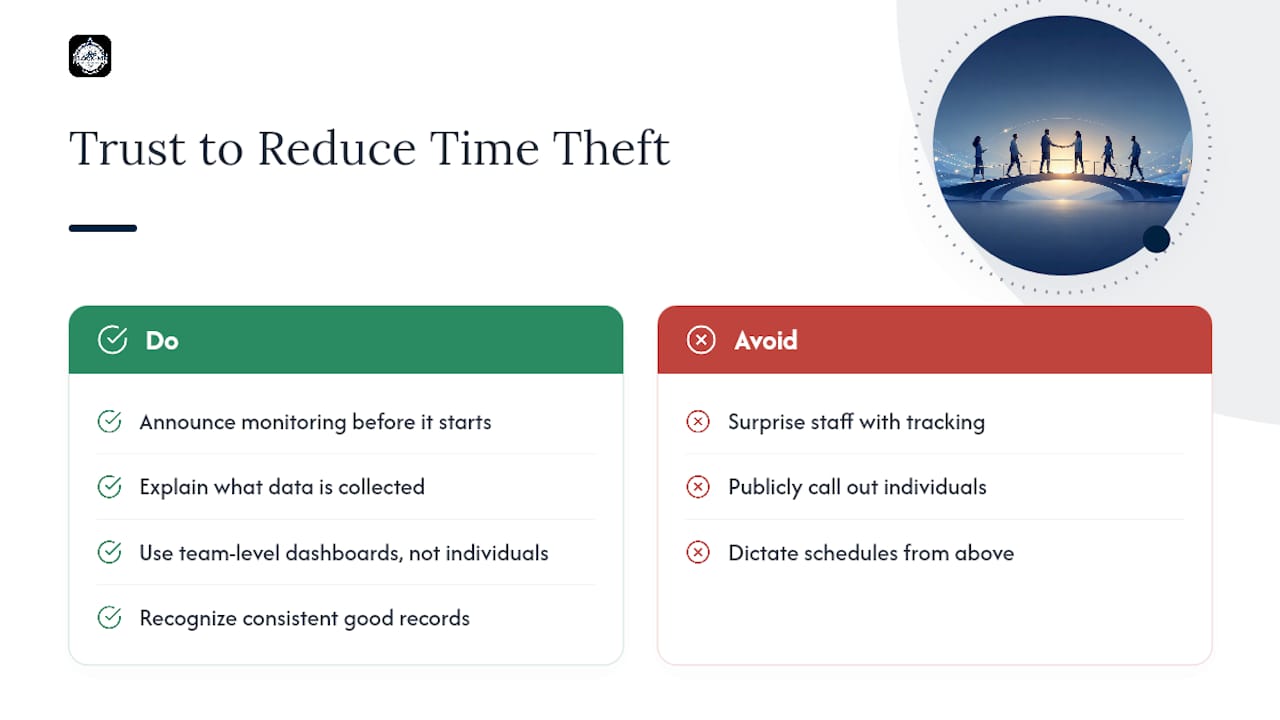
A team that trusts its manager polices itself far more than any dashboard can. Employees who believe hours are tracked fairly, and that the same rules apply to everyone, have less incentive to game the system, and less resentment when they get corrected for an honest error.
Trust breaks down fastest when monitoring feels one-sided. If employees learn about GPS tracking or timecard audits after the fact, they read it as suspicion rather than process. Announce changes before they happen, explain what data gets collected and why, and let your team ask questions. A dedicated policy paired with visible, team-level dashboards reframes monitoring as a shared fairness tool rather than a punishment system, and that reframing is what actually increases voluntary compliance.
Give something back, too. Publish aggregate team punctuality or overtime trends, not individual call-outs, so employees see the data works in their favor: it protects the person who shows up on time from carrying the slack of the person who doesn't. Recognize the employees who never trigger an anomaly alert. A quiet, consistent good record deserves acknowledgment as much as a bad one deserves discipline.
Involve frontline supervisors in setting break and schedule norms rather than dictating them from above. When employees have a say in how workload gets distributed, they're less likely to see clocking in ten minutes late as a victimless shortcut. Trust isn't a soft add-on to prevention. It's the mechanism that makes every policy and every dashboard actually work day to day.
Why Do Education and Awareness Programs Matter?
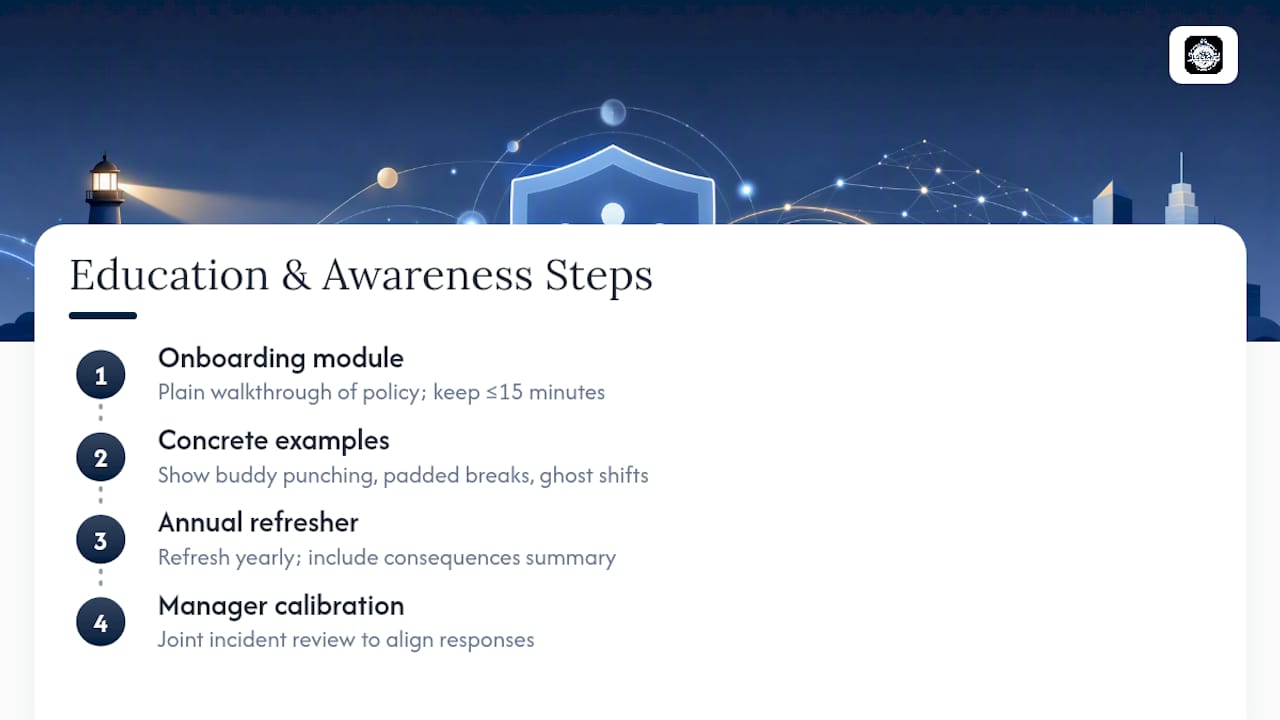
A policy nobody understands might as well not exist. Employees often don't realize that rounding their timesheet up "just this once" or running a personal errand during a paid break counts as time theft at all. That gap in understanding, not malice, causes a meaningful share of infractions.
Build a short onboarding module that walks through your time theft policy in plain terms: what counts, what doesn't, and what happens if the rules get broken. Keep it under fifteen minutes. Nobody retains a dense compliance lecture, but a handful of real examples (buddy punching, padded breaks, ghost shifts) sticks.
Refresh the training annually, not just at hiring. Norms drift, new hires join, and a policy that felt clear in January can feel forgotten by the following year. Pair the refresher with a plain summary of consequences: what a first warning looks like, what triggers termination, and why enforcement stays consistent across the team.
Make managers part of the education, not just the enforcement. A manager who understands why the policy exists, and how to talk about it without sounding accusatory, defuses far more conflict than one who just cites the handbook. Consider a short calibration session where managers review the same sample incidents together, so two supervisors don't respond to the identical infraction two different ways. Consistency across managers is often where awareness programs quietly succeed or fail.
How Does This Fit Into Broader Productivity Management?
Time theft prevention shouldn't live in its own silo, separate from how you manage performance and productivity generally. The same data that flags a suspicious pattern (output against hours logged, overtime against project timelines) also tells you which teams are overloaded, which processes waste time, and where your best performers actually spend their day.
Treat your time tracking data as a performance management input, not just a fraud filter. If a crew consistently logs more hours than the job requires, that's worth investigating whether it's time theft or a scheduling and workload problem your team hasn't flagged yet. The two explanations call for different fixes, but you won't know which applies without the same underlying data.
Build your review cadence to serve both goals at once. A monthly audit that checks for anomalies can also surface efficiency trends: which sites run ahead of schedule, which shifts consistently need more staff than budgeted, where output per hour has dropped. That dual purpose makes the audit easier to justify to your team, since it's clearly about running the operation well, not just catching bad actors.
Performance reviews should reference the same standards your time theft policy sets. If punctuality and accurate reporting are policy requirements, they belong in the same conversation as output and quality, not treated as a separate compliance checkbox. Employees read mixed signals quickly: if attendance data never comes up in a review except when something's wrong, they'll assume it only matters as a punishment tool.
Clock-Me's Perspective: Prevention Built on Fairness
We believe monitoring only works when it's built on fairness, not suspicion. Verified tracking protects your honest employees from carrying someone else's slack and protects your payroll from disputes nobody can resolve after the fact.
Configure any tracking tool to respect privacy and your local labor laws, and tell your team exactly what's being collected before you turn it on. Transparency is what turns a monitoring rollout into a trust builder instead of a morale problem.
— Clock-me
How Clock-Me Maps to Every Prevention Step Above
The platform is built specifically for the controls this guide recommends, not as a general add-on to a payroll system. GPS-verified clock-ins close the buddy punching gap by confirming who clocked in and where, replacing manual punches that anyone can fake with a one-tap check that can't.
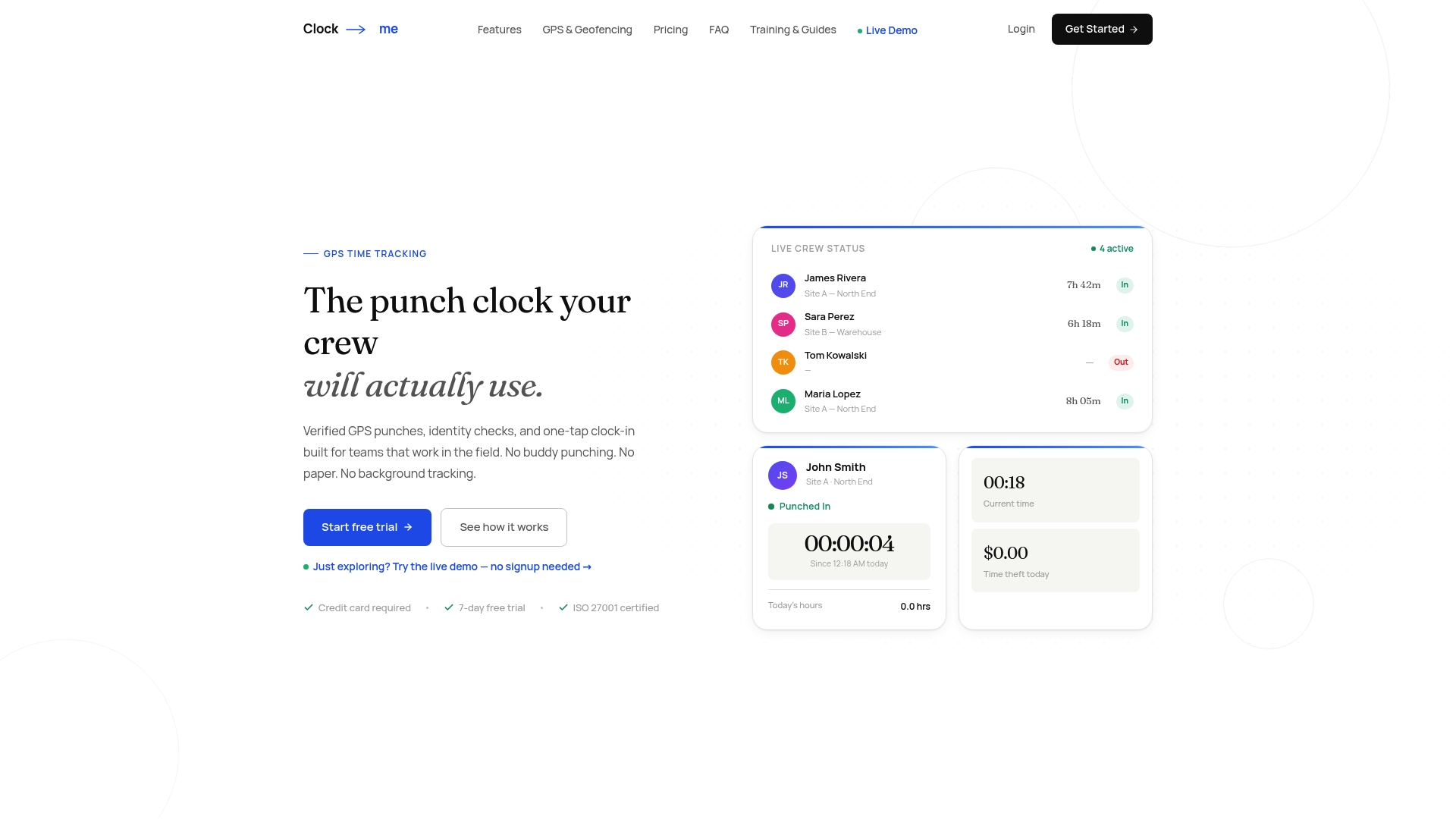
Identity verification stops a coworker from clocking in for someone who isn't there, and geofencing confirms field employees are actually on-site when the clock starts running. Live dashboards provide the audit view called for in a 30-day plan without building a spreadsheet from raw punch data, and every manual edit gets logged automatically, which creates the tamper-resistant trail needed if a disciplinary process ever gets challenged.
If you manage field teams and you're ready to move past manual timesheets, the GPS time tracking setup guide walks through configuration in minutes, and the solutions overview breaks down which features solve which specific prevention gap.
Sources
- Workplace theft study statistics
- Time Theft Prevention Guide | eMonitor
- Frequently asked questions about time and attendance fraud
- Time Theft at Work: What It Is and How to Prevent It | FirstHR
FAQ
Can an Employee Be Terminated for Time Theft?
Yes, time theft is generally grounds for termination, especially when it's documented and repeated after a warning. Most employers use progressive discipline first (verbal warning, written warning, then termination) unless the incident is severe enough to warrant immediate dismissal.
What Is the 7-Minute Rule for Employees?
The common timecard rounding practice refers to rounding clock-ins or clock-outs within a small window of a scheduled shift time to that shift, while anything beyond that window rounds to the next quarter hour. It's meant to keep rounding fair in both directions, not just in the employer's favor.
Is It Hard to Prove Time Theft?
Proving isolated incidents can be difficult without data, but a pattern is much easier to establish with GPS logs, badge swipes, or activity records compared against schedules. Tools like Clock-Me that log every clock-in with location verification make the evidence trail far more defensible than relying on manual timesheets alone.
What Are Some Examples of Time Theft?
Common examples include buddy punching, padded timesheets, extended breaks, running personal errands on the clock, ghost shifts where no work happens, and falsified overtime claims. Each leaves a different data footprint, which is why comparing multiple data sources works better than relying on any single record.