

Federal law permits rounding employee time to the nearest 5, 6, or 15 minutes, but only if the method is neutral over time and never shorts workers on pay. California and other states have narrowed that permission through court rulings, so employers with the technology to capture exact minutes should document a policy, retain raw timestamps, and run regular neutrality audits before trusting any rounding scheme.
TL;DR:
- Rounding methods must be regularly tested for neutrality, especially in states like California where courts scrutinize the practice more closely than federal law requires.
- Using smaller increments, such as six-minute rounding, significantly reduces wage exposure and the risk of systematic underpayment across large workforces.
- Employers should retain raw timestamps and detailed correction logs as vital evidence to defend against wage claims, especially if audits reveal potential underpayment issues.
- Exact-minute tracking with GPS verification and raw timestamps offers a clearer, more compliant alternative to rounding that is increasingly seen as best practice in 2026.
Table of Contents
- What Federal Law Actually Says About Time Clock Rounding Rules
- The Math Behind 5, 6, and 15-Minute Rounding
- Where Rounding Gets Risky: State Law and Recent Court Rulings
- Recordkeeping That Holds Up in an Audit
- A Rounding Policy Checklist HR Can Use Today
- Why We Think Exact-Minute Tracking Beats Rounding in 2026
- Try Clock-Me for Exact-Minute, Auditable Time Tracking
- Sources
What Federal Law Actually Says About Time Clock Rounding Rules
The Department of Labor's own regulation permits rounding to the nearest 5, 6 (one-tenth hour), or 15 minutes, but attaches one hard condition: the rounding has to average out so employees are fully paid for time actually worked. This rule exists because of what regulators once called "industrial realities." Punch clocks used to be mechanical, workers lined up, and exact-minute precision wasn't realistic on a factory floor in the 1960s.
That justification has aged badly. Modern software timestamps to the second, which is part of why courts now scrutinize rounding more closely than they did decades ago.
Underneath the rounding rule sits a bigger legal principle: the "suffered or permitted" doctrine. The DOL's Hours Worked Advisor makes clear that employers must pay for any work they know about or should reasonably know about, and rounding is treated as an administrative shortcut, not a loophole for shaving pay. The burden of proof sits with the employer, not the worker.
A few things to keep straight when you're building policy:
- Federal law sets a floor, not a ceiling. States can be stricter, and several are.
- Rounding is optional. Nothing forces an employer to round at all.
- Any rounding method must be tested for neutrality, not just assumed to be fair.
The Math Behind 5, 6, and 15-Minute Rounding
Payroll systems typically use one of three increments, and the math behind each one determines how much wage exposure you're carrying.
- 15-minute rounding (the 7-minute rule). Punches from 1 to 7 minutes past the quarter-hour round down; punches from 8 to 14 minutes round up. A clock-in at 8:07 becomes 8:00. A clock-in at 8:08 becomes 8:15, according to the DOL's Fact Sheet 53.
- 6-minute rounding (one-tenth of an hour). The breakpoint sits at 3 minutes. This is common in industries that already bill in tenths of an hour, like legal and consulting services.
- 5-minute rounding. The breakpoint sits at 2.5 minutes, rounded per your system's convention (up or down at the midpoint).
Smaller increments mean smaller swings. A 15-minute system can shift a single punch by up to 7 minutes in either direction, while a 5-minute system caps that swing at roughly 2.5 minutes. Legal analysis of rounding compliance confirms that smaller increments meaningfully reduce the odds of a neutrality failure piling up across thousands of punches a year. If you're choosing a rounding increment for the first time, 6-minute rounding is usually the safer middle ground between administrative simplicity and legal exposure.
Where Rounding Gets Risky: State Law and Recent Court Rulings
Federal permission doesn't mean state courts agree, and California has been the epicenter of rounding litigation for over a decade. Two cases matter here. Camp v. Home Depot and Donohue v. AMN Services both pushed California courts toward a position that, when technology can capture the exact minute worked, rounding that shorts even a fraction of pay becomes legally indefensible.
Meal breaks carry their own layer of risk. Several states treat meal-period rounding differently from clock-in and clock-out rounding, since even a few minutes of a shortened unpaid break can trigger separate premium pay obligations.
Practical takeaways for multi-state employers:
- Build jurisdictional carve-outs into your policy rather than applying one rounding rule everywhere.
- Treat California employees as exact-minute by default unless your legal counsel says otherwise.
- Revisit any rounding policy adopted before your current timekeeping software, since old justifications may no longer hold up.
Recordkeeping That Holds Up in an Audit
Raw, unrounded timestamps are your best evidence if a wage claim ever surfaces. Employer guidance on rounding compliance is blunt about this: discarding original punch data is a tactical mistake, because it's the only record that proves your rounding method didn't systematically underpay anyone.
A defensible audit trail includes:
- Raw timestamps for every punch, stored separately from the rounded figure used for payroll.
- Correction logs showing who edited a time entry, when, and why.
- Supervisor or employee sign-off on any manual adjustment.
- Exportable reports that show rounded totals next to exact totals for the same pay period.
Pro Tip: Run a quarterly variance report comparing total rounded hours against total exact hours across your whole workforce. If rounded totals consistently come in lower than exact totals, your policy has a neutrality problem, not a rounding problem.
A Rounding Policy Checklist HR Can Use Today
Before you touch payroll settings, decide the basics in writing.
- Decide if you're rounding at all. If your software captures exact minutes reliably, ask whether rounding solves a real problem or just adds risk.
- Pick one increment and one algorithm. Write the exact breakpoint (7 minutes for 15-minute rounding, 3 minutes for 6-minute rounding) into the policy document, not just the software settings.
- Add jurisdictional carve-outs. Name California and any other state where rounding is legally shaky, and default those employees to exact-minute pay.
- Handle meal breaks separately. Don't apply your clock-in rounding logic to unpaid break periods without checking state-specific rules first.
- Set an audit cadence. Quarterly neutrality checks, documented and dated, are the minimum standard most 2026 HR templates recommend.
- Train employees on the policy. Workers should know exactly how their punches get adjusted, not discover it on a paycheck.
A sample policy line you can adapt: "Time punches are rounded to the nearest six minutes using a standard rounding method applied uniformly to all clock-ins and clock-outs, except where state law requires exact-minute payment." Pair that written policy with structured employee training on clocking in and submitting timesheets so the rule doesn't just live in a policy binder nobody reads. For payroll teams juggling multi-state compliance, a dedicated payroll processing and compliance service can also catch jurisdictional gaps before they become claims.
Why We Think Exact-Minute Tracking Beats Rounding in 2026
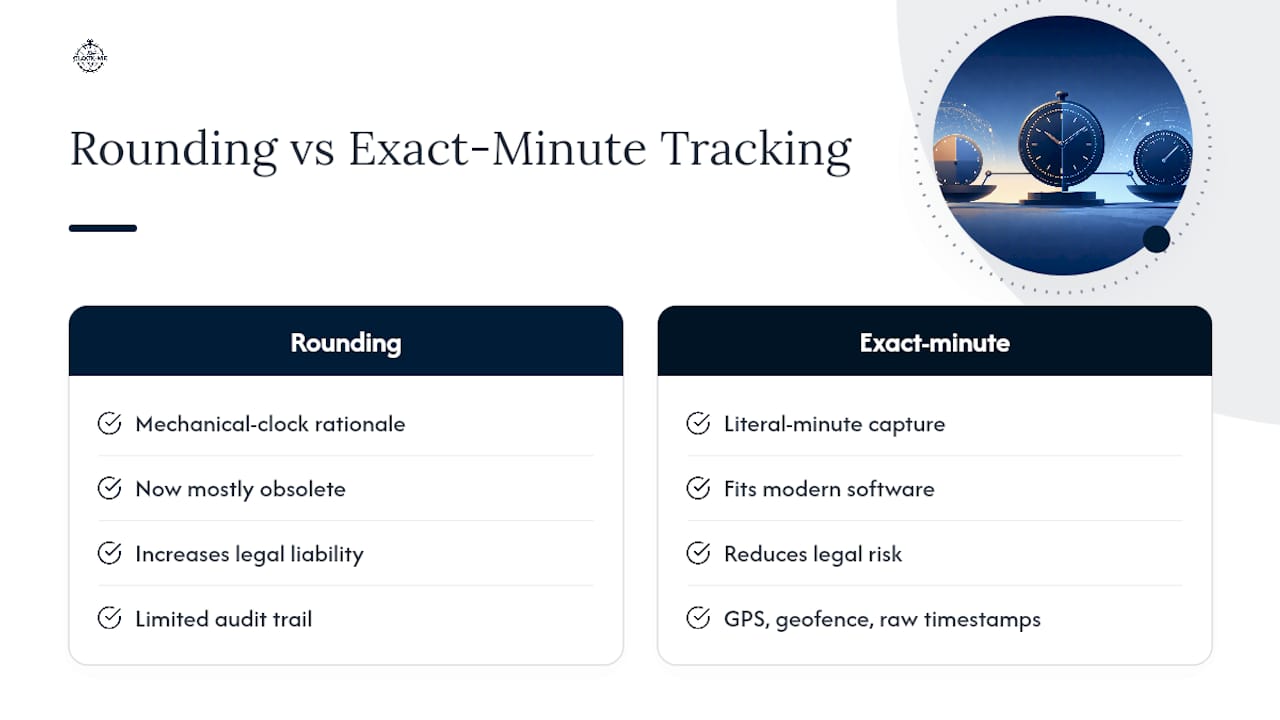
Rounding made sense when clocks were mechanical and workers queued at a single machine. That justification has largely evaporated. Once your software can capture the literal minute someone clocked in, rounding stops being a convenience and starts being a liability you're choosing to carry.
Exact-minute systems with GPS verification, geofencing, and raw-timestamp storage give you the audit trail regulators and courts actually want to see. If you're going to round at all, do it as a documented, audited exception, not your default.
— Cristiano
Try Clock-Me for Exact-Minute, Auditable Time Tracking
Some modern time tracking solutions capture the exact minute a crew member clocks in, verified by GPS and geofencing, so there's no rounding math to defend in the first place. Each punch can be tied to a verified location and identity, reducing issues such as buddy punching and the need for manual reconstruction of arrival times, avoiding rounded figures between time worked and payroll.
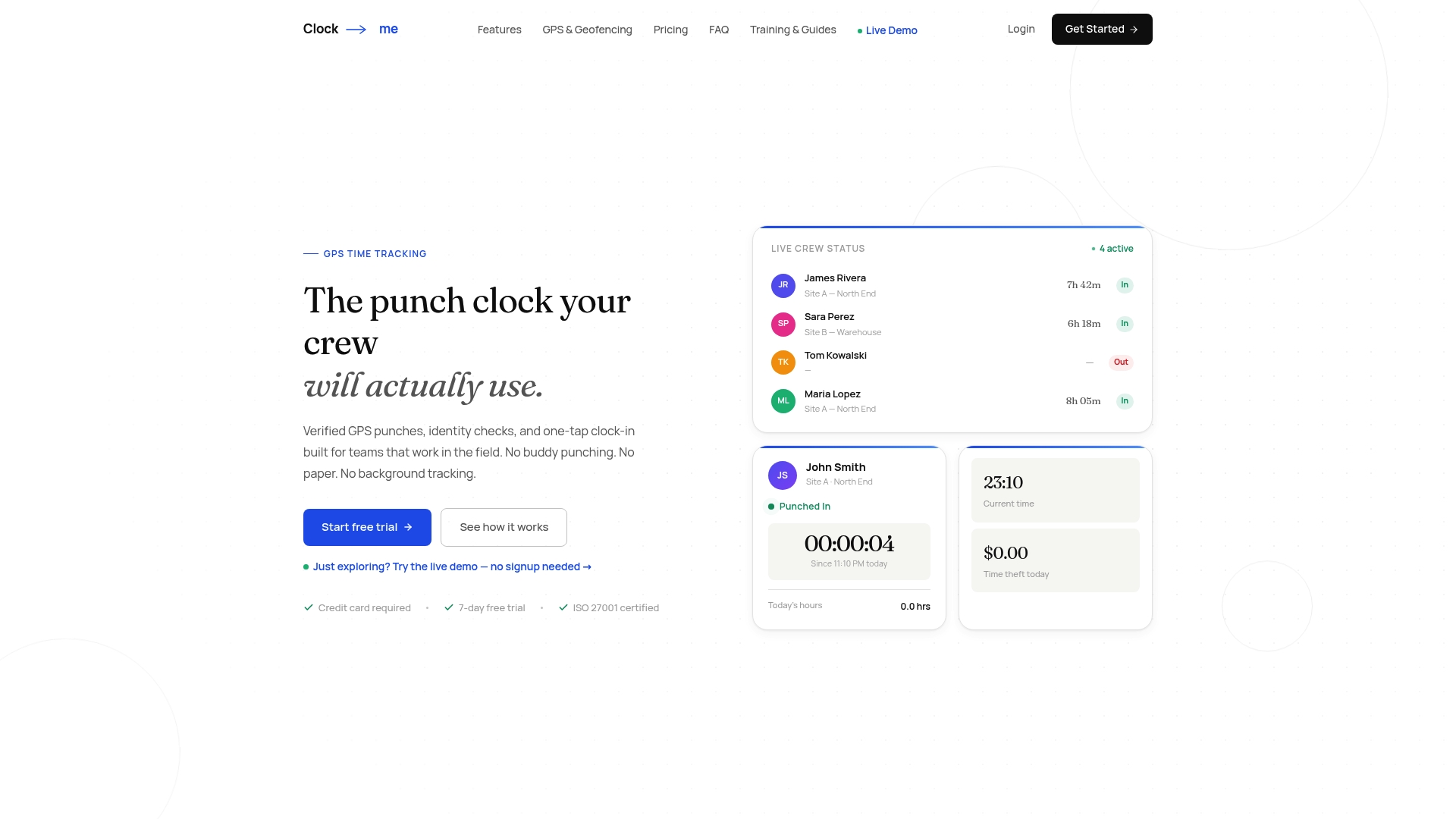
Live dashboards can give supervisors a real-time view of who's on-site, while exportable reports provide payroll teams with exact totals instead of rounded estimates. If you manage field crews across multiple states, that raw-data trail is exactly what you'd want on hand during an audit, and Clock-Me's data retention practices are built with that in mind. See it running on your own crew with a live demo and setup walkthrough, no signup required to look around first.
Sources
Keep the DOL's Fact Sheet 22 and 29 CFR §785.48 on hand for the federal baseline, and check your state's wage-and-hour agency page directly, since rulings like California's continue to shift faster than most guides can track.
This article is general information, not a substitute for advice from a qualified lawyer. Consult a qualified legal professional about your own circumstances before acting on anything here.
- 29 CFR §785.48 — Use of time clocks (eCFR)
- FLSA Hours Worked Advisor (elaws / DOL)
- Fact Sheet 53 — The Health Care Industry and Hours Worked (DOL)
- How Does Time Clock Rounding Work? Rules & Compliance (LegalClarity)