

Stop buddy punching with three moves at once: a written policy that names it as time theft, identity-verified clock-ins (photo, biometric, or GPS-tied), and a routine exception audit that catches what slips through. In the next week, update your time clock policy, turn on photo or GPS verification (a kiosk works too), and schedule your first exception review. Some systems are built to handle the identity and location pieces automatically.
TL;DR:
- Implementing both identity verification and location tracking significantly reduces buddy punching, especially when layered with consistent managerial enforcement.
- A clear policy that defines buddy punching as theft, includes progressive discipline, and offers anonymous reporting encourages proper enforcement.
- Biometric and photo verification are suitable for fixed sites, while GPS and geofencing best protect mobile or field crews; combining them enhances accuracy.
- Training managers on exception review and employee onboarding on system use are critical for sustainment; tracking resolution KPIs helps ensure enforcement.
- Regularly monitoring exception rates, payroll edits, and location mismatches allows ongoing detection of fraud and system performance issues.
Table of Contents
- What Buddy Punching Is and Why It Hurts Your Payroll
- How to Detect Buddy Punching: Signals and Steps
- Policy and HR Controls That Prevent Buddy Punching
- Technology Options: Identity Verification and Location Controls
- Rolling Out Verification Tech Without Losing Employee Trust
- Manager Training and Ongoing Enforcement
- What to Monitor: Metrics, Alerts, and Audit Cadence
- A Field-Team Example: GPS Plus Identity Verification in Practice
- Balancing Accountability With Trust
- Try Clock-Me for Your Next Pay Period
- Sources
What Buddy Punching Is and Why It Hurts Your Payroll
Buddy punching happens when one employee clocks in or out for another, usually with a shared badge, a memorized PIN, a paper time card, or someone's phone left unlocked at a job site. It sounds minor. It isn't.
On a $2 million payroll, that's $44,000 a year, quietly, for something a $20 kiosk or a phone app could catch on day one; learn how to optimize payroll accuracy and prevent leakage at hospitality businesses through streamlined bookkeeping at Hospobase.
The damage spreads past the paycheck itself:
- Payroll runs on bad data, so overtime calculations and tax withholdings get skewed.
- Client billing goes wrong when field hours don't match hours actually worked on site.
- Honest employees notice the gap, and trust in supervisors erodes fast once they do.
How to Detect Buddy Punching: Signals and Steps
Buddy punching leaves a paper trail even when it's digital. You just need to know where to look.
- Pull the time report and scan for patterns. Identical clock-in timestamps across two employees on the same day, repeated short intervals (someone clocking in, then a "correction" minutes later), or a cluster of edits approved by the same supervisor are all red flags.
- Cross-check the data sources you already have. Compare photo logs against badge access records, GPS coordinates against known job sites, and supervisor notes against the schedule. A punch that shows an employee on-site but a badge scan that puts them somewhere else is a real signal worth investigating.
- Document everything before you act. Screenshot the anomaly, note the timestamp discrepancy, and record which manager approved the shift. This protects you if the case goes to discipline or a wage dispute later, and it's the same record-keeping discipline the Department of Labor's Fair Labor Standards Act guidance expects employers to maintain anyway.
- Correct payroll immediately once confirmed. Don't wait for the next cycle. Fix the hours, note the correction, and move to the policy step.
Policy and HR Controls That Prevent Buddy Punching
Technology stops the mechanics of buddy punching. Policy stops the incentive. You need both, but the policy costs nothing to write and should go first.
A workable anti buddy punching policy names the practice as theft, spells out the discipline ladder, and gives people a way to report it without fear. That structure, defining the offense clearly and pairing it with progressive discipline, is what makes these policies enforceable rather than symbolic.
Build the policy around these pieces:
- A clear definition of buddy punching, with examples specific to your industry.
- An explicit statement that it is prohibited and treated as time theft, not a minor infraction.
- Progressive discipline: written warning, then suspension, then termination for repeat or serious cases.
- A reporting channel employees can use, including an anonymous option.
- A signed acknowledgment collected during onboarding, so nobody can claim they didn't know the rule.
Managers carry the enforcement load. That means a weekly exception review, a pre-payroll sign-off on hours, and a habit of writing down what happened and when. Consistency matters more than severity. If one supervisor lets it slide and another fires someone for the same thing, the policy stops meaning anything.
Pro Tip: Put the reporting channel in writing during onboarding, not buried in an employee handbook nobody reads. A one-page acknowledgment with a signature line does more for enforceability than a 40-page manual.
Technology Options: Identity Verification and Location Controls
Policy tells people the rule. Technology makes breaking it harder. Here's how the main options stack up.
Biometrics (fingerprint or facial recognition) tie a punch to a physical trait that can't be handed to a coworker. They work best at fixed sites where hardware installation makes sense, a warehouse floor, a manufacturing line, a retail back office. The catch is cost and legal exposure. Fingerprint scanners run into biometric privacy laws that vary sharply by state and country, and some approaches carry meaningfully higher legal risk than photo-based alternatives, mostly around consent and data retention requirements.
Photo and selfie verification through a phone app or kiosk camera gets you nearly the same fraud protection with less legal weight and no dedicated hardware to buy. For many small and mid-sized employers, this is the practical sweet spot: a supervisor glances at the photo, confirms it's the right person, and moves on.
GPS and geofencing solve a different problem entirely. They prove where a punch happened, not who made it. That distinction matters for field and mobile crews, construction, landscaping, home health, delivery, where the real question isn't identity but whether someone was actually on-site when they claim to be.
Statistic Callout: Employers using biometric or GPS-based verification report fewer time disputes and fewer manual payroll edits compared with manual sign-in sheets, with biometrics performing best for fixed locations and GPS/geofencing performing best for crews that move between sites.
The strongest setup layers both: identity verification confirms who, location verification confirms where. A short decision checklist:
- Fixed site, budget for hardware, low legal risk tolerance needed → biometrics.
- Fixed site or mixed team, want fast rollout → photo/selfie verification.
- Field or mobile crew → GPS and geofencing, paired with a photo step if possible.
Rolling Out Verification Tech Without Losing Employee Trust
How you introduce this matters as much as what you introduce. Frame it as an accuracy fix, not a surveillance program, and say so directly in your rollout announcement: "This protects everyone's hours from being underpaid or misreported, including yours."
Privacy has to be baked in from day one, not patched in after complaints:
- Collect only what you need. A photo confirms identity; you rarely need a full biometric fingerprint template for that.
- Set a retention limit and state it in writing. Don't keep photo or location data longer than payroll and audit needs require.
- Store data securely and restrict who inside the company can access it.
- Get signed consent or acknowledgment before the system goes live, and keep that record.
If you're deploying fingerprint or facial recognition biometrics anywhere, get a quick legal review first. Biometric privacy laws differ enough by jurisdiction that a policy fine in one state can create liability in another. Reviewing your data handling against a documented data safety summary before rollout is a reasonable check to run alongside that legal review.
Manager Training and Ongoing Enforcement
A system without an owner drifts back to the old behavior within a few pay cycles. Training and follow-through are what make prevention stick.
- Train supervisors on the exception report before launch. They should know what a flagged anomaly looks like and what to do with it, not learn it live during the first payroll run.
- Give employees a two-minute onboarding walkthrough. Show them exactly how to clock in correctly, what the photo or GPS check confirms, and where to report a problem.
- Follow a fixed enforcement workflow every time: document the anomaly, escalate to HR if it's confirmed, correct the payroll entry, then apply the discipline step the policy specifies.
Regular training paired with a documented escalation path is consistently what separates employers who fix the problem from ones who just install software and hope.
Pro Tip: Track two manager KPIs: exception closure rate (how many flagged punches get resolved within a week) and time-to-resolution. If closure rate drops, the policy is decorative, not enforced.
What to Monitor: Metrics, Alerts, and Audit Cadence
Four numbers tell you most of what you need: exception rate, payroll edits per cycle, identical-timestamp clusters, and GPS location mismatches.
- Run a light exception review every week.
- Do a full audit monthly, checking for repeat offenders and slow-closing cases.
- Adjust alert sensitivity quarterly as your workforce and sites change.
A Field-Team Example: GPS Plus Identity Verification in Practice
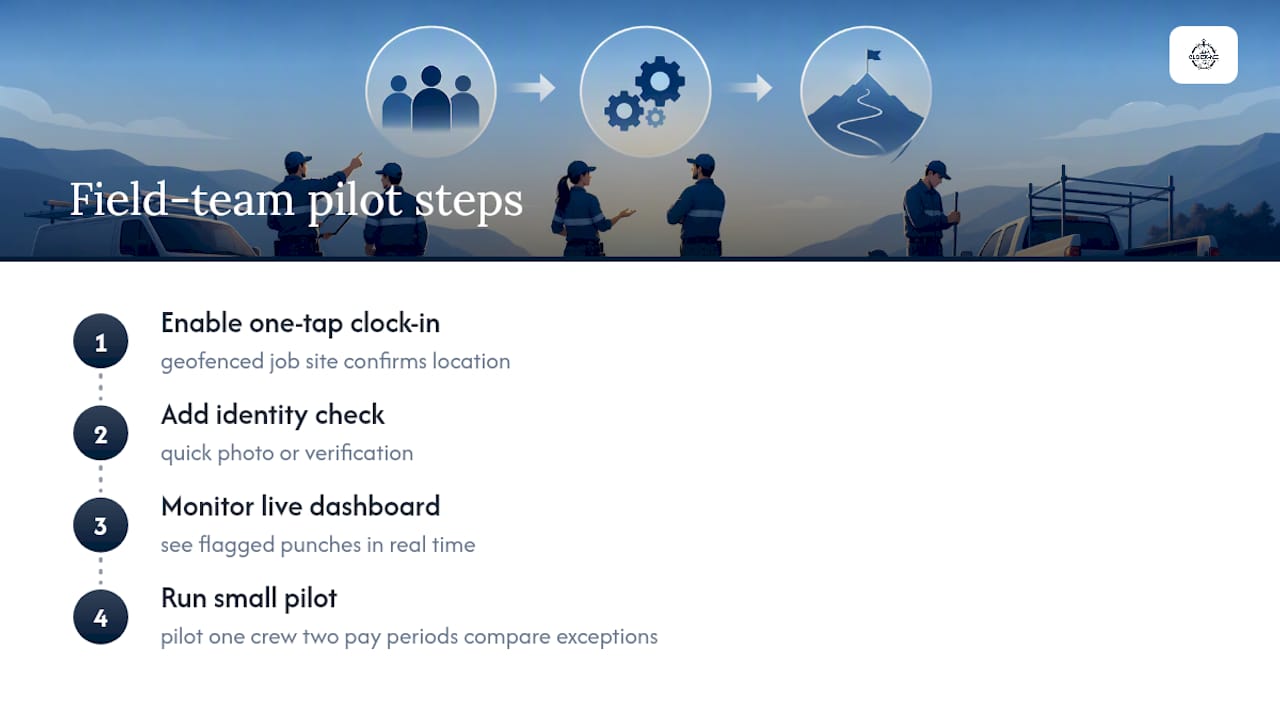
Here's how the layered approach plays out for a crew that never sits at one desk. A one-tap clock-in tied to a geofenced job site confirms location the moment someone punches in. Add a quick photo or identity check, and you've closed both gaps at once: presence and person.
A live dashboard turns this from a monthly headache into a five-minute morning check. Instead of pulling reports and cross-referencing badge logs by hand, a manager sees flagged punches as they happen and resolves most of them same-day.
If you're testing this for the first time, keep it small: pick one crew, turn on geofencing and photo verification, run it for two pay periods, and compare the exception rate against the crew you didn't change. The feature set that supports this kind of pilot is built specifically for that side-by-side comparison.
Balancing Accountability With Trust
Verification technology only works long term if employees believe it's protecting fairness, not hunting for reasons to fire people. That distinction lives in how you talk about it, not in the software's specs.
Roll it out with your team, not on them. Involve a supervisor from each crew in testing before company-wide launch, and answer the "why" question honestly before anyone asks. Most operational questions get easier once people see it catch an honest mistake, like a missed geofence ping, as fairly as it catches an intentional one.
— Cristiano
Try Clock-Me for Your Next Pay Period
Some workforce management platforms offer layered features including GPS-verified punches, geofencing, one-tap clock-in, and identity verification in a single system, rather than relying on separate tools and manual photo checks.
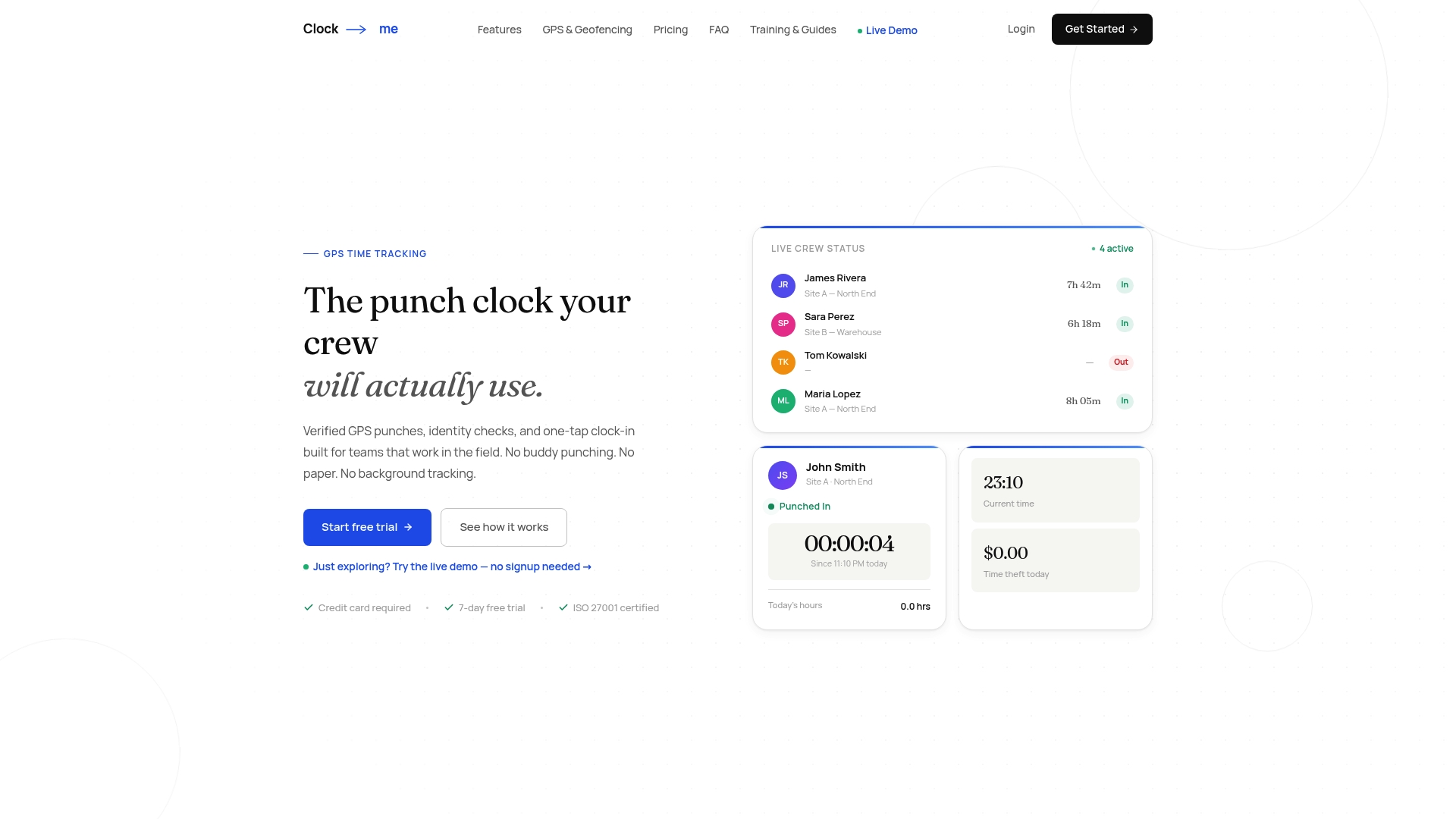
If you run field crews, the practical path is a small pilot: pick one crew, turn on geofence and photo verification, run it across two pay periods, and compare the exception rate against a crew still using the old method. The live dashboard surfaces mismatches as they happen instead of after payroll closes, which is where most buddy punching gets caught too late to matter. You can set up GPS time tracking in minutes and try it against a real crew before deciding whether to expand it company-wide.
Sources
For labor rules on record-keeping and wage compliance, the Department of Labor's FLSA guidance is the primary reference. For policy language and enforcement structure, OnPay's employer guide covers progressive discipline in practical detail. For technology tradeoffs between biometric, GPS, and photo verification, ShiftFlow's comparison and uAttend's breakdown are both worth a read before you choose hardware.
- Prevent Buddy Punching: Tech and HR Tips for Small Business — OnPay
- Buddy Punching: Real Costs and How to Stop It — TracefyHR
- Wage and Hour Division — Fair Labor Standards Act (FLSA) — U.S. Department of Labor
- How to Prevent Buddy Punching in 2026 — ShiftFlow