

An employer-required split shift in California triggers a premium of one hour's pay at the applicable minimum wage. You owe it whenever an unpaid, non-working gap longer than a bona fide meal period splits an employee's workday, and any wages that employee earned above minimum wage that day offset the premium dollar for dollar. Live-in employees, exempt salaried staff, and voluntary schedule changes fall outside the rule, but the premium must still show up as its own line on the wage statement.
TL;DR:
- Employers must pay a split shift premium of one hour’s minimum wage when an employer-required unpaid gap longer than an hour occurs within the same workday, offset by any higher wages earned that day.
- This premium applies only to non-exempt hourly workers and does not include live-in employees, exempt salaried staff, or employee-requested schedule gaps, which require no premium.
- Accurate, timestamped clock-in and clock-out data supported by GPS and geofencing are essential to verify splits and ensure proper premium calculation and documentation.
- The premium must be itemized as a separate line on wage statements, even if the calculated amount is zero, and does not count toward overtime calculation.
- Employers should audit current schedules, confirm local wage rates, and maintain detailed, verifiable records to stay compliant and defend wage claims.
Table of Contents
- What Counts as a Split Shift Under California Law
- Who Is Owed the Premium (and Who Isn't)
- Calculating the Split Shift Premium: Formula and Example
- Reporting the Premium on Pay Stubs Without Triggering a Violation
- Where Employers Get Split Shift Pay Wrong
- Documenting Split Shifts With Time-Tracking Technology
- Employer Checklist: Fix Split Shift Pay Now
- Turn Split Shift Records Into an Audit-Ready Export
- Where to Verify This Information
- Sources
- FAQ
What Counts as a Split Shift Under California Law
California's IWC Wage Orders define a split shift as a work schedule broken into two or more segments by an unpaid, non-working period the employer establishes, separate from a normal meal or rest break. The California Department of Industrial Relations treats this as a distinct pay category precisely because the interruption benefits the employer's staffing needs, not the employee's convenience.
The distinction that trips up most payroll teams is intent and length. A worker who splits their own shift to run a personal errand hasn't triggered anything. One the employer schedules has, once the gap crosses a specific threshold.
- A bona fide meal period is considered to last up to one hour, so any employer-required gap longer than an hour is generally treated as a split shift.
- The DLSE's 2002 opinion letter confirms this one-hour benchmark and ties it directly to IWC Wage Orders Section 4(C), the actual source of the premium requirement.
- The break must happen within the same workday, not across two separate shifts on different days.
Who Is Owed the Premium (and Who Isn't)
Non-exempt hourly employees make up the core group covered by this rule. If a worker clocks in, clocks out for an employer-mandated multi-hour gap, then clocks back in later the same day, payroll needs to check whether a premium is owed before the pay period closes.
Three categories sit outside the requirement entirely:
- Live-in employees, who are exempt from the split shift premium under the wage orders.
- Exempt salaried staff, since the premium applies only to hourly, non-exempt workers.
- Voluntary splits, where the employee requests the schedule gap rather than the employer imposing it.
There's also a built-in offset that changes the math for better-paid workers. Because the premium equals one hour at minimum wage, any earnings above minimum wage that day get credited against it. A worker earning well above minimum wage may trigger zero actual premium dollars, even on a schedule that technically qualifies as a split shift. That doesn't erase the itemization requirement, though. The premium still needs its own line on the pay stub, even when the dollar amount lands at zero.
Calculating the Split Shift Premium: Formula and Example
HRCalifornia's guidance lays out the formula payroll teams actually use:
Total hours worked × applicable minimum wage + one hour at minimum wage − actual daily earnings = premium owed
If the result is zero or negative, no premium is due. If it's positive, that figure goes on the check as a separate line item.
The tricky part is picking the right minimum wage. California's state minimum applies unless a city or county sets a higher local rate, in which case the higher number wins. A worker splitting shifts in a city with a $17.00 local minimum uses that rate, not the state figure, even if the employer's headquarters sits elsewhere.
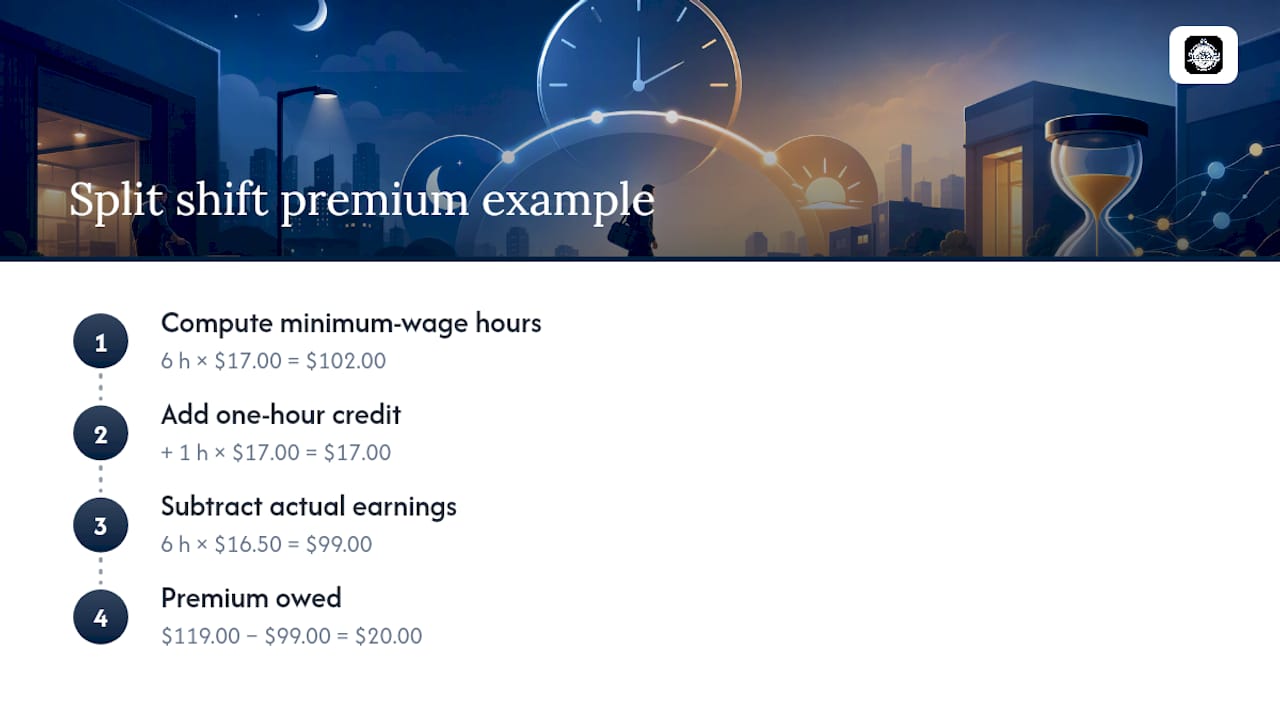
Here's a worked example for a worker whose local minimum wage is $17.00 per hour, working 6 total hours across a split shift, earning $16.50 per hour for actual work performed:
Pro Tip: Pull the current local minimum wage ordinance for every city where your field employees clock in before running this calculation. A worksite that crosses a city line mid week can quietly change the applicable rate, and payroll software that defaults to the state minimum will underpay the premium without anyone noticing.
Reporting the Premium on Pay Stubs Without Triggering a Violation
The split shift premium has to appear as its own itemized line on the wage statement, separate from regular wages. This isn't optional formatting. It's a direct extension of the itemization obligations built into California wage-statement law, and HRCalifornia's guidance treats it as one of the most commonly missed steps in split shift compliance.
One nuance that catches payroll teams off guard: the premium is not treated as hours worked for overtime purposes. It gets added to gross pay, but it doesn't factor into the regular rate calculation used for overtime.
Solid recordkeeping makes the difference between a clean audit and a costly one:
- Keep the calculation worksheet showing minimum wage, hours, and earnings for each split shift pay period.
- Retain timecards showing the exact clock-in and clock-out times around the unpaid gap.
- Save written scheduling authorizations that show whether the split was employer-required or employee-requested.
Pro Tip: Store your calculation backup in the same system as your timecards, not a separate spreadsheet nobody updates. When a DLSE investigator asks for six months of split shift records, you want one export, not a scavenger hunt.
Where Employers Get Split Shift Pay Wrong
Most enforcement problems come down to a short list of repeat mistakes, not novel legal theories.
- Applying the state minimum wage when a higher local ordinance actually governs the worksite.
- Skipping the itemized wage-statement line even when the calculated premium comes out to zero.
- Treating an employee-initiated schedule change as employer-required, or the reverse, without documentation to back the classification.
Wage-statement itemization failures carry their own statutory penalties independent of whether the premium itself was paid correctly, which means a business can owe money even after getting the math right. When a scheduling policy affects many workers the same way, a single misclassified shift pattern can scale into a class claim fast. Court decisions like Securitas Security Services USA, Inc. v. Superior Court, discussed in the same HRCalifornia analysis, show how continuous overnight shifts can avoid split shift classification entirely when the schedule forms one uninterrupted block. Regular audits, a written scheduling policy, and documented sign-offs on voluntary requests close most of the gap.
— Clock-me
Documenting Split Shifts With Time-Tracking Technology
Every calculation above depends on one thing: accurate, timestamped records of when an employee actually clocked in and out around the unpaid gap. A payroll audit trail needs clock times, the approved schedule, the applicable local wage rate, and a record of any manual overrides, because investigators routinely request exactly that combination.
An automated time-tracking platform handles the collection side of that work:
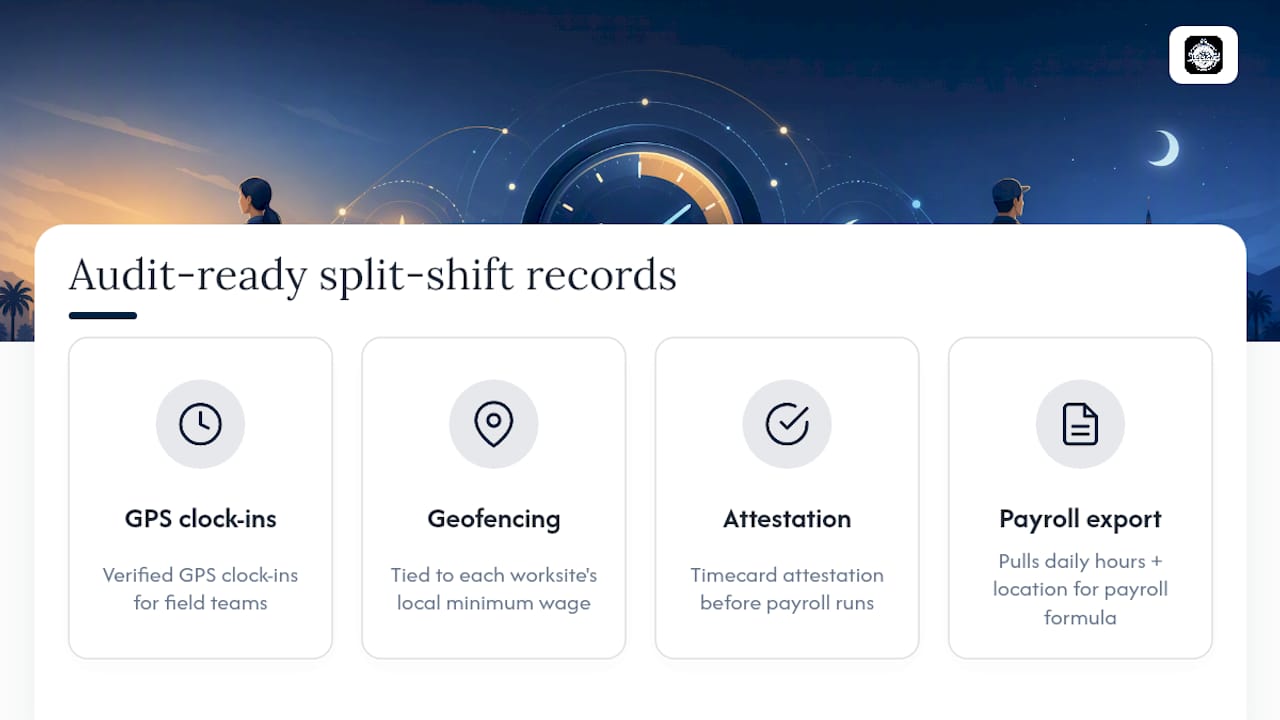
- GPS-verified clock-ins timestamp exactly when a worker starts and ends each segment of a split shift, removing guesswork from the gap length.
- Geofencing confirms the worker was actually at the assigned worksite, which matters when different locations carry different local minimum wages.
- Timecard attestation has the employee confirm the hours before payroll runs, adding a documented approval step.
- Payroll export tools generate the daily records payroll needs to run the premium calculation without manual data entry.
A platform like Clock-me can produce the timestamped, location-tagged records that back up a split shift premium calculation, but the legal classification of any given schedule still belongs to your payroll team or counsel.
Employer Checklist: Fix Split Shift Pay Now
Start by auditing current schedules for employer-required gaps longer than 60 minutes. Confirm which local minimum wage applies to each worksite and update payroll accordingly. Make sure pay stubs show a distinct split shift premium line, even at $0.00, with calculation backup saved. Train schedulers on the employer-required versus voluntary distinction, and keep written sign-offs whenever an employee requests their own split.
Turn Split Shift Records Into an Audit-Ready Export
Clock-me gives field teams a faster way to build the exact documentation this rule demands, without the paperwork trail most time-tracking setups leave behind.
Instead of reconstructing clock-in and clock-out gaps from memory or scattered spreadsheets, managers get verified GPS clock-ins, geofencing tied to each worksite's local minimum wage, and timecard attestation that locks in employee confirmation before payroll runs. That combination is what turns a split shift premium calculation from a manual guess into a defensible record. For teams juggling multiple worksites with different local wage ordinances, payroll export tools pull the daily hours and location data needed to run the formula correctly, every pay period.
If you're setting up split shift tracking for the first time, the GPS time tracking setup guide walks through getting a field team clocking in within minutes. Teams that want the technical details on how attestation and payroll export work can check the Clock-me solutions FAQ before rolling it out. None of this replaces legal counsel on how to classify a specific schedule, but it does give payroll the records to defend whatever call gets made.
Where to Verify This Information
For primary source verification, start with the DLSE's split shift page for the core definition, the 2002 DLSE opinion letter for the one-hour benchmark, IWC Wage Orders for the statutory basis, and HRCalifornia for calculation walkthroughs. A 2026 practitioner analysis from Paul Cheng Law covers current numeric examples and risks for employers new to California.
This article is general information, not a substitute for advice from a qualified lawyer. Consult a qualified legal professional about your own circumstances before acting on anything here.
Sources
- Split Shift - California Department of Industrial Relations
- Split Shift Pay - HRCalifornia
- When “Split Shifts” Require an Extra Hour of Pay — Paul Cheng Law (2026)
FAQ
Do You Get Paid More for a Split Shift in California?
Yes, when the split is employer-required and exceeds a bona fide meal period, you're owed a premium of one hour's pay at the applicable minimum wage, minus any earnings above minimum wage that day.
What Are the Rules Around Split Shifts?
The gap has to be employer-required, longer than 60 minutes, and occur within the same workday; live-in employees, exempt salaried staff, and employee-requested schedule changes fall outside the requirement.
What Are the Downsides of a Split Shift for Employees?
Split shifts stretch an unpaid gap across the middle of a workday, which can make commuting, childcare, and second jobs harder to schedule around, even when the premium offsets some of the lost pay.
Are Split Shifts Legal in California?
Yes, split shifts are legal as long as the employer pays the required one-hour minimum-wage premium when it applies and itemizes it separately on the wage statement.
How Does Clock-me Help With Split Shift Compliance?
The platform records GPS-verified clock-in and clock-out times, geofences worksites tied to local minimum wage rates, and exports payroll data that payroll teams can use to calculate and document the premium.