

If you show up for a scheduled shift in California and your employer sends you home early or doesn't put you to work at all, you're owed reporting time pay in most cases. The rule requires half your scheduled shift, with a floor of 2 hours and a ceiling of 4 hours, paid at your regular rate. Reporting time pay counts as wages, so it has to show up on your pay stub and in your final paycheck.
TL;DR:
- Employees scheduled for a shift and sent home after less than half that time are entitled to between 2 and 4 hours of reporting time pay at their regular rate, depending on the scheduled shift length.
- Reporting time pay applies when employees physically arrive, log on remotely, or are notified to report under employer control, but not for voluntary early arrivals or purely optional check-ins.
- Employers can avoid paying reporting time if disruptions are caused by Acts of God, utility failures, government orders, safety threats, or shifts scheduled for less than two hours.
- Accurate documentation of shifts, notices, and clock-in timestamps is essential to defend against wage claims and prevent penalties for unpaid reporting time pay.
- Reporting time pay does not count as hours worked for overtime calculations and must be listed separately on pay stubs to ensure proper compliance and transparency.
Table of Contents
- What Is Reporting Time Pay in California?
- When Does Reporting Time Pay Apply?
- Exceptions: When Reporting Time Pay Isn't Owed
- Calculating Reporting Time Pay: Examples and Overtime Rules
- Employer Duties and How Employees Enforce Their Rights
- Quick Scenarios: Reporting Time Pay in Real Situations
- Reducing Reporting Time Pay Risk With Better Tracking Tools
- Notice Requirements Employers Should Follow
- Reporting Time Pay vs. Call-In Pay: What's the Difference?
- Does Reporting Time Pay Affect Exempt vs. Non-Exempt Classification?
- How Reporting Time Pay Interacts With Meal and Rest Breaks
- Beyond Wage Claims: Civil Penalties for Reporting Time Pay Violations
- Publisher Perspective: Scheduling Fairness Protects Everyone
- Where to Verify These Rules Yourself
- Sources
- FAQ
What Is Reporting Time Pay in California?
Reporting time pay comes from California's Industrial Welfare Commission wage orders, which require employers to pay employees who report for a scheduled shift but aren't given at least half of that shift's hours. The Labor Commissioner's Office (DLSE) describes the rule's purpose plainly: it compensates workers for the inconvenience of showing up, and it pushes employers toward more careful scheduling instead of calling people in on a whim.
This isn't a fringe benefit or a courtesy payment. It's a wage, which means:
- It must be recorded on the employee's pay stub for that pay period.
- It must be included in the employee's final paycheck if employment ends.
- Unpaid reporting time can trigger waiting time penalties under Labor Code §203.
The California Supreme Court's ruling in Murphy v. Kenneth Cole Productions reinforced this classification, confirming that reporting time pay is treated as wages rather than a penalty, which matters for statute of limitations and enforcement purposes. That distinction shaped how DLSE now evaluates late or unpaid reporting time claims.
When Does Reporting Time Pay Apply?
"Reporting for work" covers more than walking through the front door. DLSE guidance and case law recognize several ways an employee triggers the rule:
- Physically arriving at the worksite at the scheduled start time.
- Logging on to a remote system, point-of-sale terminal, or company app when the job requires it.
- Showing up at a client site for field-based or contract work.
- Starting a delivery or service route, even before reaching a fixed location.
- Calling in when a shift requires phone-based check-ins, such as the mall retail model addressed in Ward v. Tilly's, which found that on-call telephone reporting can qualify as "reporting for work."
The core test is whether the employee was furnished less than half of the scheduled shift. If someone is scheduled for 8 hours and sent home after 2, that's less than half, and reporting time pay applies. If they're scheduled for 8 and sent home after 5, no reporting time pay is owed because they already received more than half their shift.
Employer control matters throughout this analysis. If the company set the schedule, required the check-in, or dictated the reporting method, the reporting time pay clock generally starts. Voluntary early arrivals or purely optional check-ins typically don't count.
Exceptions: When Reporting Time Pay Isn't Owed
The wage orders carve out specific situations where employers don't owe reporting time pay, even if a shift gets cut short. IWC Order No. 9 lists the recognized exceptions:
- Acts of God, such as earthquakes or severe storms that shut down operations.
- Public utilities failures, including power outages or water main breaks outside the employer's control.
- Civil authority recommendations, like a government agency ordering an evacuation or closure.
- Threats to employees or property, such as an active security incident.
- Paid standby employees who are called in outside their normal schedule and already compensated for standby status.
- Shifts scheduled for less than two hours, which fall outside the reporting time framework entirely.
Employers claiming an exception carry the burden of showing it actually applies. A vague "we were slow that day" doesn't qualify. Documentation matters here: a utility company's outage notice or a government shutdown order is the kind of evidence that holds up in a DLSE claim.
Calculating Reporting Time Pay: Examples and Overtime Rules
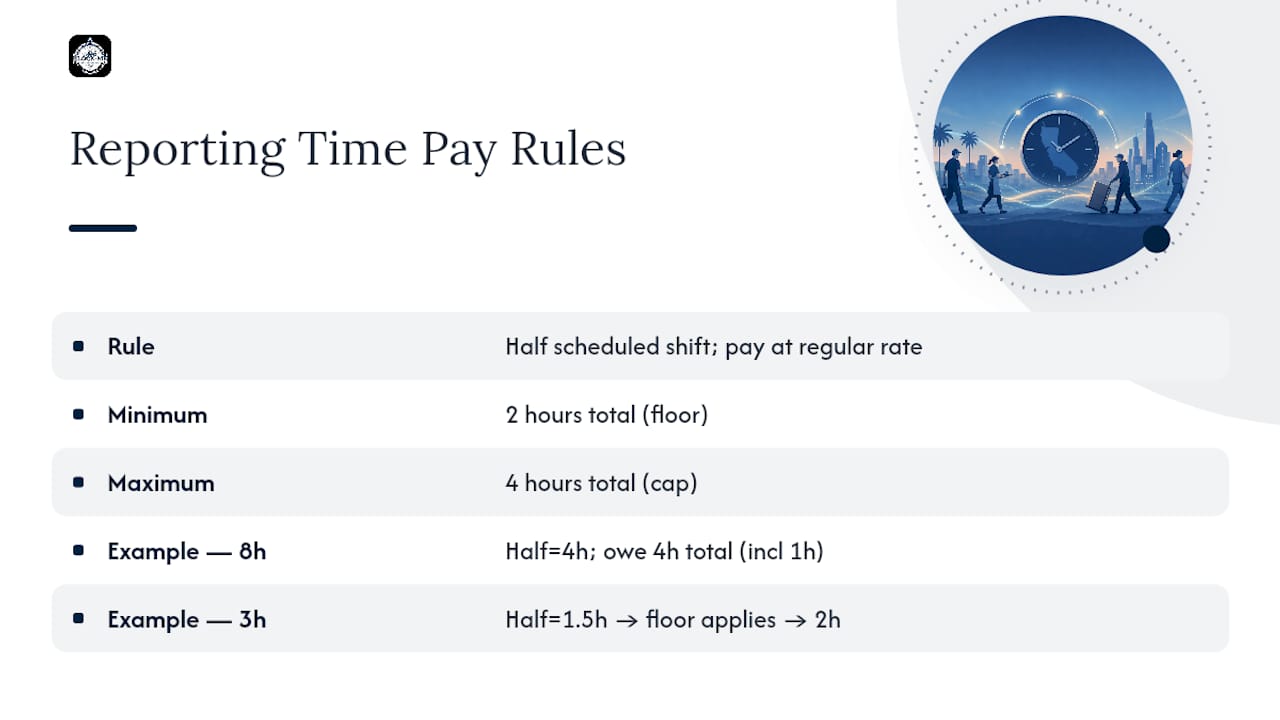
The math follows a simple structure: half the scheduled shift, with a 2 hour minimum and a 4 hour maximum, paid at the employee's regular rate.
Example 1: An employee is scheduled for an 8 hour shift but sent home after 1 hour of work. Half of 8 hours is 4 hours, which falls within the 2 to 4 hour range, so the employer owes 4 hours of reporting time pay total (the 1 hour already worked counts toward that 4 hours, so 3 additional hours are due).
Example 2: An employee is scheduled for 3 hours and sent home after 30 minutes. Half of 3 hours is 1.5 hours, but the 2 hour floor applies, so the employer owes a minimum of 2 hours total.
Second reporting in the same day: If an employee is called back for a second reporting and given less than 2 hours of work that time, the employer owes 2 additional hours at the regular rate for that second reporting.
Pro Tip: Reporting time pay does not count as time worked when calculating daily or weekly overtime, since it compensates for being available rather than for services rendered. Keep it as a separate line item on the pay stub so payroll audits don't lump it into overtime calculations by mistake.
Because reporting time pay is wages, it needs a paper trail: scheduled shift times, actual clock-in and clock-out timestamps, and the notice given (if any) about a shift change. Employers who skip this documentation make it harder to defend a wage claim later, and unpaid amounts can convert into waiting time penalties once an employee separates from the company.
Employer Duties and How Employees Enforce Their Rights
Employers are on the hook to calculate reporting time pay correctly, pay it in the same pay period it's earned, and reflect it accurately in payroll records. Skipping this isn't a minor clerical miss. It's a wage violation.
- Pay promptly. Reporting time pay is due for the pay period in which it's earned, just like regular wages.
- Document the shift. Keep records of the original schedule, any notice of change, and actual hours worked.
- Respond to claims quickly. If an employee raises a reporting time pay issue, address it before it escalates to a formal wage claim.
When employers don't pay, employees can file a wage claim directly with the Labor Commissioner's Office, which walks claimants through the paperwork and hearing process. Strong evidence includes texts or emails about shift changes, timeclock records, and witness statements from coworkers sent home the same day. Retaliation against an employee for filing a claim is separately actionable under California law, so employers who try to punish a worker for asserting these rights add another layer of exposure.
Quick Scenarios: Reporting Time Pay in Real Situations
- Sent home, then called back: An employee reports at 9 AM, is sent home at 10 AM, then called back at 1 PM for 3 more hours. The first reporting triggers standard reporting time pay math; the second reporting (3 hours worked) exceeds 2 hours, so no additional reporting time pay is owed for that second call in.
- Mandatory one-hour training: An employee already worked a full shift, then gets called back for a required 1 hour training session. That's a second reporting under 2 hours, so the employer owes 2 hours of pay for that training, not just 1.
- Utility outage closes the site: A power outage shuts down operations for the day. Under the public utilities failure exception, no reporting time pay is owed, assuming the outage is genuinely outside the employer's control.
Reducing Reporting Time Pay Risk With Better Tracking Tools
Vague schedules and undocumented shift changes are what turn a simple reporting time pay question into a costly dispute; implementing effective production reporting software for manufacturers can streamline these operations and reduce reporting time pay risk. Verified GPS clock-ins create a timestamped record of exactly when someone reported for work, whether that's a physical site or a client location. Identity verification closes the gap where buddy punching muddies who actually showed up. Digital scheduling notices, logged inside a platform like Clock-Me's solutions, give employers a defensible record of what was scheduled versus what actually happened. For teams managing multiple job sites, that kind of auditable trail matters more than a spreadsheet ever will.
Notice Requirements Employers Should Follow
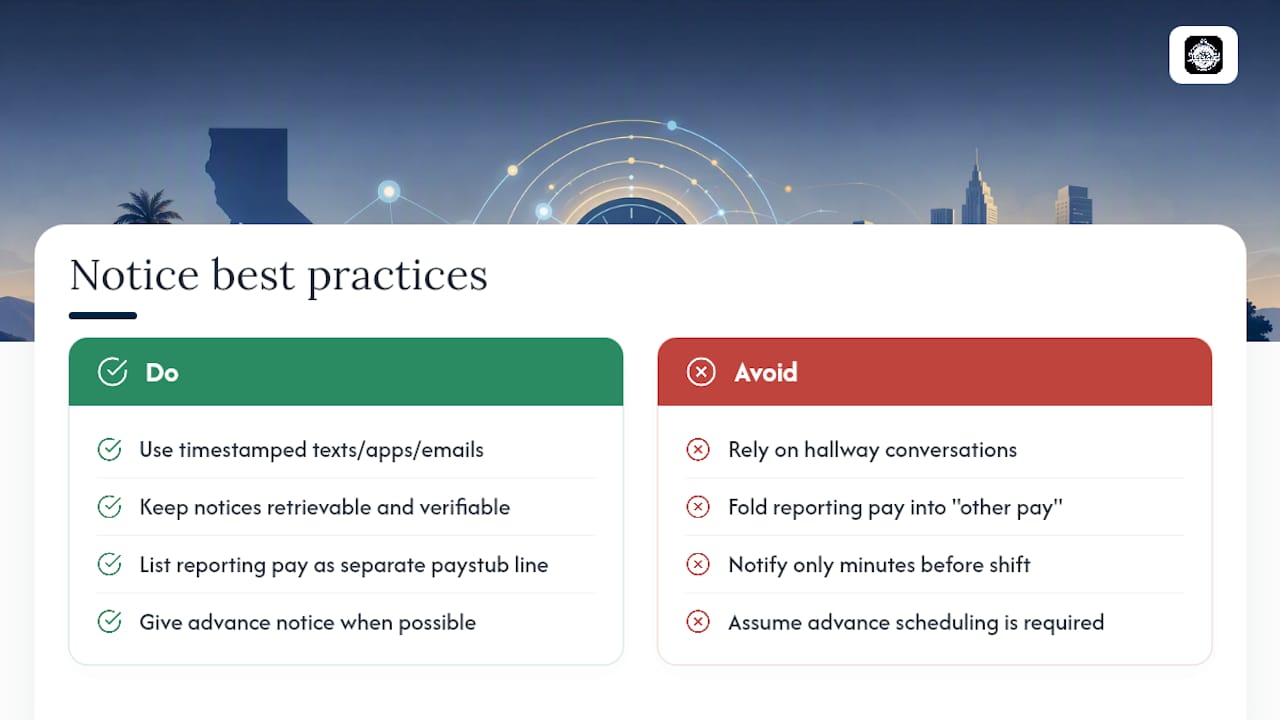
California law doesn't require a specific "reporting time pay notice" form, but employers still carry real obligations around how shifts get communicated. If a shift is canceled or shortened, that change needs to reach the employee through a verifiable channel, not a hallway conversation nobody remembers accurately later.
Text messages, scheduling app alerts, or emailed shift confirmations all work, as long as they're timestamped and retrievable. A notice sent the night before a shift is different from a notice sent five minutes before it starts, and DLSE will look at timing when evaluating whether an employer acted in good faith or just avoided paying reporting time pay through poor communication.
Wage statement requirements under Labor Code §226 apply here too. Reporting time pay must appear as its own line item on the pay stub, separate from regular hours worked, so employees can verify they received what they're owed. Employers who fold reporting time pay into a generic "other pay" category make it harder to catch errors, and that opacity tends to work against the employer if a dispute lands at the Labor Commissioner's Office.
Some employers try to get ahead of the issue with predictive scheduling practices, giving employees advance notice of shifts even though California doesn't mandate this statewide (unlike some cities with their own scheduling ordinances). It's a smart move regardless: fewer last-minute cancellations mean fewer reporting time pay triggers in the first place.
Reporting Time Pay vs. Call-In Pay: What's the Difference?
These terms get used interchangeably, but they're not identical. Reporting time pay is the California-specific statutory requirement tied to IWC wage orders. It applies when an employee reports for a scheduled shift and isn't given at least half that shift's hours.
"Call-in pay" is a broader, less formal term that sometimes refers to the same concept and sometimes refers to on-call or standby compensation, which follows different rules entirely. On-call time becomes compensable based on how much control the employer exercises over the employee's freedom during the waiting period, not on the reporting time pay formula. A 1993 DLSE opinion on standby time laid out that control-based test: short response windows, geographic restrictions, and limits on personal activities can convert standby time into hours worked, separate from any reporting time pay analysis.
The practical takeaway: if an employee is scheduled and shows up, use the reporting time pay formula. If an employee is on-call and waiting to be summoned, ask whether the employer's restrictions were tight enough to make that waiting time compensable under the broader control test. Confusing the two leads to underpayment in one direction or overpayment in the other, and payroll teams that don't separate these categories internally tend to make both mistakes.
Does Reporting Time Pay Affect Exempt vs. Non-Exempt Classification?
Reporting time pay applies to non-exempt employees. Exempt employees, those who meet the salary basis and duties tests under California law, are paid a fixed salary regardless of hours worked or shifts canceled, so the reporting time pay formula doesn't apply to them at all.
This creates a classification risk worth flagging: if an employer misclassifies a non-exempt worker as exempt to sidestep hourly wage obligations, reporting time pay becomes one more unpaid category stacked on top of unpaid overtime and missed break premiums. Misclassification claims often surface reporting time pay violations as a secondary finding once a DLSE investigation opens, because investigators look at the full pay structure once they're already reviewing timecards and schedules.
For non-exempt employees, reporting time pay obligations apply the same way whether the worker is full-time, part-time, or seasonal. Job title or pay frequency doesn't change the calculation. What matters is hourly, non-exempt status and whether the shift met the half-hours threshold.
How Reporting Time Pay Interacts With Meal and Rest Breaks
Reporting time pay and meal or rest break premiums are separate obligations, and employers sometimes mistakenly assume paying one covers the other. It doesn't. An employee who reports for a shift and receives reporting time pay because they were sent home early is still owed a rest break premium if they worked long enough to trigger a break requirement and didn't receive one.
Consider a worker scheduled for 6 hours who's sent home after 3.5 hours worked. That period exceeds 3.5 hours, which means a 10-minute rest break was likely due during that time. If it wasn't provided, the employer owes a separate one hour premium at the regular rate, layered on top of whatever reporting time pay calculation applies to the shortened shift.
The same logic applies to meal periods. A shift long enough to trigger a 30 minute meal break carries that obligation independent of whether the shift ended early or triggered reporting time pay. Payroll teams that treat these as one combined "make good" payment routinely underpay, because each violation carries its own premium and its own line item on the pay stub.
Beyond Wage Claims: Civil Penalties for Reporting Time Pay Violations
Unpaid reporting time pay doesn't just expose an employer to a single wage claim. Once an employee separates from the company, unpaid reporting time pay can trigger waiting time penalties under Labor Code §203, which continue accruing at the employee's daily rate of pay for up to 30 days.
Beyond individual claims, patterns of reporting time pay violations across a workforce can draw attention from California's Private Attorneys General Act (PAGA), which allows employees to sue on behalf of the state for civil penalties tied to Labor Code violations, with a share of penalties distributed to affected employees and the remainder going to the state. A single unpaid shift is a wage claim. A scheduling practice that repeatedly shorts multiple employees is the kind of pattern that turns into a PAGA action, and those cases carry exposure well beyond the original unpaid wages.
Recordkeeping failures compound the risk. If an employer can't produce accurate schedules and timestamps during a DLSE investigation or PAGA claim, the burden of proof often shifts in the employee's favor, and penalty calculations tend to default to the employee's version of events.
Publisher Perspective: Scheduling Fairness Protects Everyone
Reporting time pay rules aren't red tape. They exist because unpredictable scheduling costs workers real money in gas, childcare, and lost hours elsewhere. Employers who treat accurate scheduling and prompt payment as operational habits, not legal minimums, avoid most disputes before they start. Tools that verify when someone actually reported for work make that habit easier to build and easier to defend.
— Clock-me
Where to Verify These Rules Yourself
For primary-source confirmation, start with the DLSE reporting time pay FAQ and the IWC wage order provisions governing your industry. If you need to pursue unpaid wages, DLSE's wage claim filing guide walks through the process step by step.
This article is general information, not a substitute for advice from a qualified lawyer. Consult a qualified legal professional about your own circumstances before acting on anything here.
FAQ
What Is Reporting Time Pay in California?
Reporting time pay is compensation owed when an employee reports for a scheduled shift but isn't put to work or receives less than half their scheduled hours. It's calculated as half the scheduled shift, with a 2 hour minimum and 4 hour maximum at the regular rate.
Does Reporting Time Pay Apply if I Work From Home?
Yes. Logging on to a required remote system or app counts as reporting for work under DLSE guidance, so the same half shift formula applies if you're sent offline early.
Is Reporting Time Pay the Same as Overtime Pay?
No. Reporting time pay compensates for being available, not for services rendered, so it doesn't count toward daily or weekly overtime calculations, though it must still appear as wages on your pay stub.
Can My Employer Refuse to Pay Reporting Time Pay During a Power Outage?
Yes, if the outage qualifies as a public utilities failure outside the employer's control under the recognized exceptions. The employer still needs to show the exception genuinely applies.
What Happens if My Employer Never Pays Reporting Time Pay?
You can file a wage claim with the Labor Commissioner's Office, and unpaid amounts can trigger waiting time penalties under Labor Code §203 once your employment ends.