
Yes: in real-world apps you can reliably detect most mock-location attempts by layering platform flags, device-integrity checks, physics heuristics, and sensor fusion, then enforcing checks at high-risk actions like clock-ins or payouts. The stack that works: mock-flag detection, root or emulator fingerprinting, physics anomaly checks, sensor correlation, and geofence enforcement tied to sensitive events. No single layer stops a determined attacker with rooted hardware, but stacked together, they close most of the gap.
TL;DR:
- Combining mock-flag detection, root/jailbreak checks, physics anomalies, and sensor correlation creates a robust layered defense against location spoofing.
- Checks should be performed at key moments, such as clock-in or payout, and fed into a trust score rather than relying on a single binary flag.
- Sensor fusion and physics heuristics are most effective when analyzing movement trails over snapshots, making data correlation a core part of detection.
- Detecting advanced spoofing tools requires combining system-level checks, sensor data analysis, and high-cost hardware-based defenses, but no method is infallible.
- Proper response strategies include gentle retries, user prompts, or action holds, with strong audit trails for legal and dispute resolution purposes.
Table of Contents
- What Is Mock Location Detection and Why One Check Isn't Enough
- How Do You Build the Detection Pipeline Into Your App?
- Can Sensor Data Catch Spoofing That Fools GPS Checks?
- Does Detection Work the Same on Android and iOS?
- What Should Happen When You Flag a Suspicious Location?
- How Do You Evaluate a Detection SDK or Plugin?
- How Clock-Me Applies This Stack to Real Field Teams
- How Do Advanced Spoofing Tools Get Around Detection?
- Where Does Location Tracking Cross a Privacy Line?
- Does Aggressive Detection Hurt the User Experience?
- What Legal Risks Come With Enforcing Location Checks?
- Where Has Layered Detection Actually Worked?
- A Developer's Take on Where This Playbook Actually Pays Off
- Get Verified Time Tracking Without Building This Stack Yourself
- Sources
What Is Mock Location Detection and Why One Check Isn't Enough
Mock location detection is the practice of verifying that a device's reported GPS coordinates reflect its actual physical position rather than a spoofed or injected value. The term covers everything from a single API call to a full pipeline that scores location trustworthiness in real time. Developers building fraud-sensitive features, especially workforce or delivery apps, need to think of it as a layered defense rather than a single gate.
Android's Location.isFromMockProvider() flag is the obvious starting point. It flags locations set through the developer-options mock provider, and it catches casual spoofing instantly. The problem: advanced spoofing tools increasingly bypass this flag entirely, either by patching the OS layer or using apps that inject coordinates without registering as a mock provider.
Root and jailbreak detection catches a different population of attackers. Rooted Android devices and jailbroken iPhones enable system-level GPS hooking that never touches the mock-provider API, so checking for root binaries, suspicious system packages, or jailbreak file paths closes part of that gap. Emulator fingerprinting matters too, since bot farms and QA rigs running on virtual devices produce sensor and hardware signatures no real phone matches.
Physics checks catch what flags miss. A user "traveling" 40 miles in 90 seconds, an altitude reading frozen at exactly 0.0 meters, or GPS accuracy that never wavers by even a meter are all classic tells of injected data rather than a live receiver.
Layering matters because each method has blind spots the others cover:
- Mock flags catch casual spoofing but miss root-level injection
- Root/emulator detection catches modified devices but misses stock hardware running a GPS-spoofing app
- Physics checks catch impossible movement but miss slow, careful spoofing
- Sensor fusion catches static or scripted movement but adds processing overhead
How Do You Build the Detection Pipeline Into Your App?
The order matters as much as the checks themselves. Run cheap, static checks first and reserve expensive, continuous monitoring for moments that actually carry risk.
- On app launch or session start: check the mock-provider flag and run root/jailbreak/emulator fingerprinting. These are fast, local, and don't need network calls.
- Before any location-dependent action: pull a fresh location sample and immediately cross-check it against the last known good sample for plausibility (distance, time elapsed, accuracy).
- During the session: sample accelerometer and gyroscope data at low frequency to build a lightweight motion profile, without draining battery.
- At the moment of the sensitive action (clock-in, geofenced check-in, payout request): run the full check sequence and send the resulting telemetry to your backend for scoring.
- Server side: aggregate device signals, permission history, and behavioral patterns into a trust score rather than a binary pass/fail, an approach telematics platforms use to combine multiple weak signals into one operational decision.
Send timestamped location, accuracy, provider name, motion-sensor snapshots, and integrity-check results to the backend. Keep raw sensor data minimal and aggregated where possible.
Decision tiers might look like this: a single anomalous reading with otherwise clean history triggers a silent re-check; two anomalies in one session trigger a warning and a forced GPS refresh; a rooted device plus a physics violation blocks the action and flags the account for review.
Pro Tip: Don't run continuous sensor sampling at high frequency all day. It kills battery life and annoys users. Save the expensive checks for the two or three moments in a session where spoofing actually costs you money.
Can Sensor Data Catch Spoofing That Fools GPS Checks?
A single GPS reading, however implausible, is just a data point. A trail of readings correlated against motion sensors is evidence. That distinction is the core of sensor fusion, and it's why sophisticated detection stacks weight movement trails over snapshots.
Coherence means the accelerometer's energy output should roughly match the speed changes implied by consecutive GPS points. If reported speed jumps from 0 to 60 mph but the accelerometer shows the phone sitting motionless on a desk, something is wrong. Useful heuristics include:
- Rolling variance thresholds on GPS accuracy (real GPS jitters; spoofed feeds often don't)
- Teleport rules that flag any position change exceeding plausible travel speed for the elapsed time
- Constant-accuracy detection, since static-value altitude or accuracy readings are one of the more reliable tells of injected coordinates
- Gyroscope stillness paired with reported walking or driving motion
Lightweight versions of these checks run fine on-device. Heavier statistical analysis, like comparing a user's motion profile against thousands of historical sessions, belongs server-side. Treat an isolated anomalous reading as a maybe; treat a multi-point trail showing consistent physics violations as a strong signal worth acting on.
Does Detection Work the Same on Android and iOS?
It doesn't, and treating both platforms identically is a common mistake. Android gives developers the mock-provider flag plus visibility into Developer Options settings, but rooted devices and system-level spoofing apps route around both easily.
iOS never exposed an equivalent flag until CLLocationSourceInformation arrived in iOS 15, and even that only flags simulator-sourced or mock locations under specific conditions. That means iOS detection leans far more heavily on jailbreak detection and sensor fusion, since Apple's sandboxing limits what a legitimate app can inspect directly.
Watch for false positives from battery optimizers throttling background sensors or users who've revoked motion permissions. Test on rooted Android devices, jailbroken iOS test units, and device farms running realistic (not synthetic) mock GPS data before shipping.
What Should Happen When You Flag a Suspicious Location?
Detection without a response plan just generates logs nobody reads. Map every risk tier to a specific, proportionate action instead of a blanket block.
A low-confidence anomaly, like one slightly-off accuracy reading, should just prompt a silent GPS refresh. A medium-confidence flag, such as a physics violation with no root indicators, should trigger a friendly UI prompt asking the user to step outside or check location permissions. High-confidence flags (rooted device plus mock flag plus teleport pattern) warrant a hold on the action with a clear explanation, not a silent rejection that leaves the user guessing.
- Inform: show a plain-language message, not an error code, when GPS accuracy looks off
- Step up: request a fresh location fix or a quick manual confirmation
- Hold: pause the sensitive action (clock-in, payout) pending review
- Block: reserve for high-confidence, repeat, or clearly malicious patterns
Every flagged event needs a timestamped audit trail: raw signals, the decision made, and the outcome. This protects both the business and legitimate employees who get flagged by mistake, and it's the backbone of any dispute process.
Pro Tip: Build an "open location settings" helper directly into your remediation flow. Most false positives resolve the moment a user re-enables GPS or grants a permission they'd accidentally revoked, so make that a one-tap fix rather than a support ticket.
How Do You Evaluate a Detection SDK or Plugin?
Third-party libraries can save real engineering time, but coverage varies wildly. Before integrating one, check what it actually reports versus what it claims.
A solid plugin returns per-check detail rather than a single boolean. The Cap-go Capacitor plugin, for instance, returns a structured LocationIntegrityResult covering mock flags, developer options, known mock apps, motion correlation, and emulator detection, plus a helper to open device settings for remediation. Flutter's detect_fake_location package takes a similar per-platform heuristic approach, though it's worth testing coverage against your specific fraud patterns rather than trusting the README.
- Does it expose individual check results or just a pass/fail flag?
- Does it support continuous monitoring events, or only a one-time check?
- What telemetry does it collect, and is that disclosed clearly for your privacy policy?
- Is it actively maintained, and what's its latency impact on the action it's checking?
Also check the license. Most detection plugins ship under permissive terms like MIT, but confirm before embedding anything in a commercial product.
How Clock-Me Applies This Stack to Real Field Teams
Clock-Me's product exists because this detection stack has direct business consequences the moment field workers are involved. Every layer described above maps to a specific feature rather than a theoretical safeguard.
- Verified GPS punches apply physics and mock-flag checks at the exact moment of clock-in, the highest-risk action in any field workforce app
- Geofencing enforces location plausibility continuously, not just at login, tying location fraud prevention directly to payroll accuracy
- Identity verification adds a second layer beyond location, closing the buddy-punching gap that GPS checks alone can't solve
- Live dashboards give managers the audit trail this playbook recommends, without requiring anyone to dig through raw logs
| Detection layer | Clock-Me implementation |
|---|---|
| Mock-flag and physics checks | Verified GPS punches at clock-in/out |
| Continuous location enforcement | Geofencing tied to job sites |
| Identity confirmation | One-tap identity verification |
| Audit and dispute handling | Live crew dashboard with punch history |
The result is fewer disputed timesheets and a defensible record when payroll questions come up.
How Do Advanced Spoofing Tools Get Around Detection?
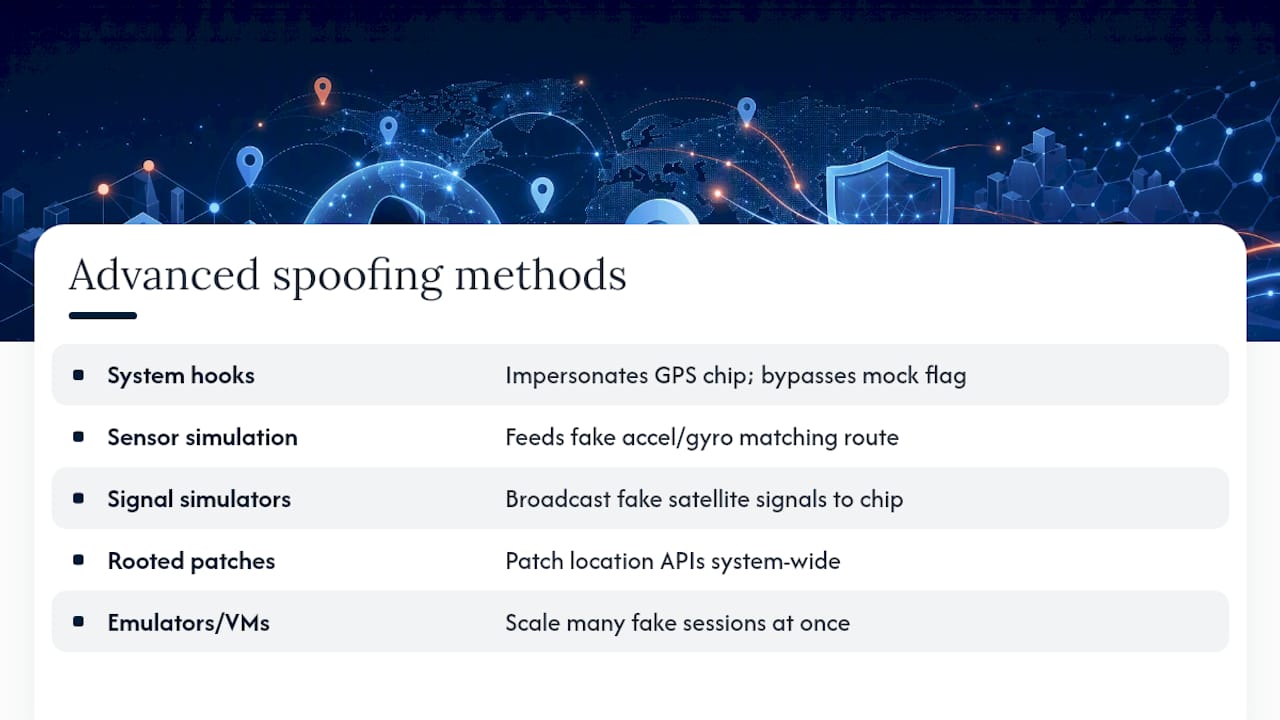
The spoofing side of this arms race has gotten considerably more sophisticated than the classic "developer options mock location" toggle. Modern GPS-spoofing apps hook directly into system location services at a level that never triggers isFromMockProvider, effectively impersonating a real GPS chip rather than registering as a fake provider.
Some tools go further and simulate sensor data alongside fake coordinates, feeding synthetic accelerometer and gyroscope values that loosely match the fabricated movement path. This is specifically designed to defeat sensor-fusion checks, which is why a naive "does the accelerometer show any motion" check is weaker than a check comparing the magnitude and timing of motion against the claimed speed and heading.
Hardware-based approaches exist too: GPS signal simulators and software-defined radio setups can broadcast fake satellite signals that a phone's actual GPS chip receives as legitimate, bypassing every software-layer check entirely. These are expensive and require some technical skill, so they show up more in high-value fraud scenarios than casual spoofing.
Rooted devices with Xposed-style frameworks can also patch location APIs system-wide, making spoofed coordinates indistinguishable from real ones to any app that only checks the standard location APIs. This is exactly why root detection remains a load-bearing part of the stack, not a nice-to-have. Virtual machine and emulator-based spoofing rounds out the list, often used at scale by bad actors running many fake sessions simultaneously rather than one person trying to fake a single commute.
No detection stack fully closes every one of these paths. The realistic goal is raising the cost and skill required to spoof convincingly, high enough that it stops being worth it for the vast majority of attackers.
Where Does Location Tracking Cross a Privacy Line?
Detecting spoofing requires collecting more device data, which puts privacy considerations right at the center of any implementation decision. The line between legitimate fraud prevention and overreach is often about scope, disclosure, and retention, not just intent.
Collecting root status, emulator flags, and motion-sensor snapshots is defensible when it's clearly tied to a stated purpose (verifying a work location at clock-in) and disclosed to the people it applies to. It becomes a problem when that same telemetry gets used for unrelated purposes, like inferring personal habits outside work hours, or when it's retained indefinitely without a clear reason.
Workforce apps have a slightly different ethical position than consumer apps here, because employees are a defined, disclosed population rather than an anonymous user base, and the tracking typically only applies during working hours or within a job-site geofence. That distinction matters for both trust and legal exposure. A clear data safety disclosure showing exactly what's collected and why goes a long way toward keeping that trust intact.
Minimize what you collect. Sensor snapshots for fusion checks don't need raw continuous streams, aggregated features (variance, peak values, timing) are usually enough and reduce your data liability. Avoid collecting location data outside the windows where it's actually needed for verification, and avoid repurposing fraud-detection telemetry for performance monitoring or other secondary uses without separate consent. The ethical baseline is simple: collect only what the specific check requires, tell people you're doing it, and don't let the data outlive its purpose.
Does Aggressive Detection Hurt the User Experience?
Every fraud check has a false-positive cost, and getting that balance wrong undermines the entire system faster than a spoofing exploit would. A user who gets blocked from clocking in because of a flaky GPS signal, not actual fraud, loses trust in the app fast, and repeated false positives train legitimate users to see the security layer as an obstacle rather than a safeguard.
Common false-positive triggers include aggressive battery optimizers that throttle background location services, users who've revoked motion-sensor permissions without realizing it affects functionality, and older devices with genuinely poor GPS accuracy that trips physics thresholds meant to catch spoofing. None of these indicate fraud, but a poorly tuned system treats them identically to malicious spoofing.
The fix is tiering responses proportionally rather than defaulting to a hard block. A single ambiguous signal should prompt a quick, low-friction retry, not an accusatory error message. Reserve hard blocks for high-confidence combinations of multiple independent red flags. Clear, specific messaging matters too: telling a user "we couldn't verify your location, try refreshing GPS" builds far more goodwill than a generic "action denied" with no explanation.
Measuring this well means tracking your false-positive rate as seriously as your detection rate.
What Legal Risks Come With Enforcing Location Checks?
Enforcing mock-location detection touches employment law, data privacy regulation, and contract terms simultaneously, and the rules vary significantly by jurisdiction. Location tracking tied to employment, particularly continuous or geofence-based tracking, falls under employee monitoring disclosure requirements in many regions, and those requirements are typically stricter than general app-privacy rules because of the power imbalance between employer and employee.
Consent and disclosure obligations differ by location. Some jurisdictions require explicit written notice before any location-based employee monitoring begins, along with a clear statement of purpose and retention period. Others focus more on data-minimization principles, requiring that only the data necessary for the stated purpose gets collected and that access is restricted. Before deploying any location-verification system tied to employment, confirm the specific disclosure and consent requirements in the regions your workforce operates in.
Enforcement actions carry their own legal exposure. Blocking an employee's clock-in or docking pay based on a flagged location event needs a documented, defensible basis, not just an algorithmic score, particularly if that decision gets challenged in a wage dispute or labor complaint. This is where audit trails stop being a nice engineering practice and become a legal necessity: a timestamped record of what was flagged, why, and what action followed protects the business if a decision is questioned later.
Terms of service and employment agreements should explicitly cover location verification if it's part of the workflow, so employees have clear, documented notice of what's being tracked and why before a dispute arises.
Where Has Layered Detection Actually Worked?
Field-service and logistics companies that moved from single-flag detection to layered stacks report a consistent pattern: the biggest drop in fraudulent punches comes not from catching more spoofing attempts outright, but from the deterrent effect of visible enforcement at the clock-in moment. Once workers know verification happens at that specific action, casual spoofing attempts drop sharply, since the effort-to-reward ratio stops making sense for most people.
Insurance telematics and fleet-tracking platforms have driven much of the practical innovation here, largely because the fraud incentives (lower premiums, falsified mileage) are direct and financial. Combining mock flags with sensor coherence and permission-monitoring into a single trust score rather than a binary check has become standard practice in that space, and workforce management tools have borrowed the same architecture directly.
The common thread across successful deployments is tying detection to a specific high-risk moment rather than running constant background surveillance. Continuous, ambient location tracking generates enormous data volume and diminishing fraud-prevention returns, while verification concentrated at the point of a risky action, like a clock-in, a payout request, or a geofenced checkpoint, catches the fraud that actually matters while keeping battery and privacy costs manageable. That's the operational lesson worth taking from every mature deployment: less always-on tracking, more precisely-timed verification.

A Developer's Take on Where This Playbook Actually Pays Off
The conventional advice on this topic treats mock location detection like a solved problem: add the mock-provider check, ship it, done. That advice was outdated years ago, and it's actively wrong now. The research here points to a different priority order than most teams assume, and it matters.
Most engineering teams over-invest in the flashiest layer (sensor fusion, machine-learning anomaly scoring) and under-invest in the boring one that actually stops the most fraud: tying verification to the specific moment an action carries risk. A system with mediocre sensor checks but airtight enforcement at clock-in will outperform a system with brilliant sensor fusion running on a loose, unenforced schedule.
The second thing conventional wisdom gets wrong is treating detection as a technical problem alone. It's a UX problem in disguise. Build the tiered response logic before you build the fancier detection heuristics, not after.
If you're prioritizing one thing first: get geofence enforcement right at the clock-in action before you touch sensor fusion. It's less impressive in a demo, and it's what actually protects payroll.
— Cristiano
Get Verified Time Tracking Without Building This Stack Yourself
Building a layered mock-location detection stack from scratch means months of engineering time you could spend on your actual product, and most teams underestimate how much ongoing tuning it takes to keep false positives low. Clock-Me gives field-service and workforce teams that entire stack already built and battle-tested: verified GPS punches, geofencing enforcement, identity verification, and a live dashboard that shows exactly what happened at every clock-in, without writing a line of detection code.
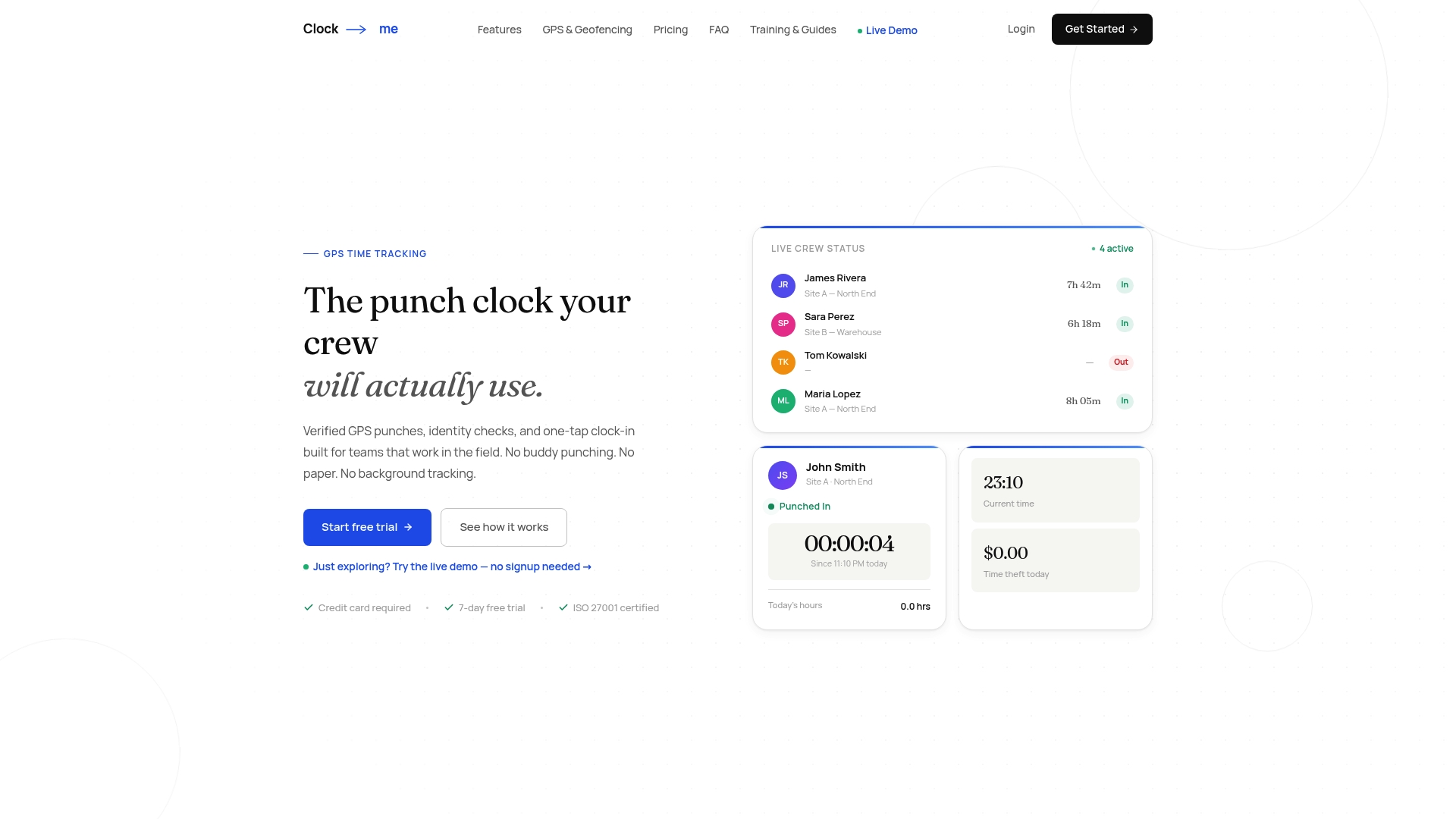
Every feature maps directly to the layers covered in this playbook: mock-flag and physics checks run automatically at clock-in, geofencing enforces location continuously around job sites, and identity verification closes the buddy-punching gap that GPS checks alone can't touch. Disputed timesheets drop because there's an actual audit trail behind every punch, not just a manager's memory.
If you're managing field crews and want to see this working before committing to anything, get started with Clock-Me and set up GPS time tracking in minutes, no signup required to try the live demo first.
Sources
For hands-on implementation, the Cap-go Capacitor plugin repository shows working multi-layer check code. Zimperium's location spoofing glossary covers the security-vendor perspective on sensor cross-referencing, and Radar's guide on location fraud prevention walks through geofencing and continuous-update strategy in more depth.