

A meal break attestation is a short statement, usually a click or a signature, where an employee confirms whether they took their meal break as scheduled. On its own, an attestation does not satisfy California's meal period rules: employers still need accurate, timestamped records of when the break actually started and ended. The safest path is to pair every attestation with a contemporaneous time punch and a way to flag exceptions the moment they happen.
TL;DR:
- Attestations alone do not meet California's meal period rules and must be paired with timestamped clock-in and clock-out data to be legally valid.
- Calfornia law requires duty-free 30-minute meal breaks for employees working over five hours, with premium pay owed if breaks are missed or not fully duty-free, regardless of attestations.
- Accurate, contemporaneous recordkeeping, including precise start and end times and audit trails, is crucial to defend against wage claims and rebut presumption of violations.
- Real-time attestation prompts at clock-out paired with supervisor reviews provide the most credible evidence, while end-of-shift attestations are weak in court.
- Using GPS verification and automatic exception routing helps maintain data integrity, but fostering a culture of prompt issue reporting is key to proper compliance and avoiding disputes.
Table of Contents
- What meal break attestation is and how it differs from time punches
- California legal requirements for meal periods and the limits of attestations
- Recordkeeping rules and why contemporaneous logs carry legal weight
- Attestation models: which workflow actually holds up
- Step-by-step implementation: building a defensible attestation system
- Common pitfalls that trigger audits and wage claims
- A practical checklist and attestation data model
- Clock-Me implementation notes for defensible attestation
- Why culture matters more than the form itself
- How Clock-Me supports a defensible attestation workflow
- Primary sources and guidance for deeper review
- Sources
- FAQ
What meal break attestation is and how it differs from time punches
An attestation is a confirmation step, not a time record. Most systems ask a simple question at clock-in, clock-out, or the end of a shift: did you take your 30-minute meal break, and if not, why? The response usually includes a timestamp of when the question was asked, a yes or no answer, and sometimes a reason code if the answer is no.
That is different from a contemporaneous punch, which records the actual moment an employee stopped and resumed work. A punch happens in real time and creates a hard data point. An attestation, especially one collected hours later, relies on memory and can be filled out quickly without much thought, which is exactly why it draws scrutiny in wage claims.
Attestations work best as a layer on top of punch data, not a substitute for it. They're useful for:
- Capturing context when a break was skipped, shortened, or delayed.
- Prompting an employee to flag an issue before it becomes a pattern.
- Giving supervisors a documented reason to investigate and correct a problem quickly.
Where attestations fall short is when they stand alone. A checkbox confirming "yes, I took my break" carries little weight if the time records show the employee clocked back in after only twenty minutes. Courts and labor agencies look at what the clock says, not just what the employee checked.
California legal requirements for meal periods and the limits of attestations
California's meal period rules are built around timing, not on paperwork. Under Labor Code Section 512, non-exempt employees who work more than five hours in a day must get a duty-free 30-minute meal period, and a second 30-minute meal period is required once a shift passes ten hours, subject to specific waiver conditions. The first meal period generally has to start before the end of the fifth hour of work.
"Duty-free" means exactly what it sounds like. During the break, the employee has to be relieved of all duties and free to leave the premises. If a business requires someone to stay on-site or monitor a phone, radio, or work channel during the break, that time is generally compensable rather than a true meal period, unless a narrow written agreement applies according to DLSE guidance.
An employer that fails to provide a compliant meal period owes the employee one additional hour of pay at the employee's regular rate of pay for each workday the violation occurred.
That premium, sometimes called meal period pay, comes from Labor Code Section 226.7(c). It's not a fine paid to the state. It's wages owed directly to the employee, which means it shows up on the same timeline as unpaid wage claims and carries the associated statute of limitations exposure for back pay.
One hour of premium pay is owed per workday for each missed, late, or short meal period, per the DLSE's meal periods FAQ. For an employer with dozens of field employees and inconsistent break tracking, that liability adds up fast across a pay period, let alone a multi-year claim window.
This is where attestation limits become clear. The DLSE has been consistent that a signed or clicked statement confirming a break was taken cannot fix a break that wasn't actually duty-free. If an employee was required to remain reachable, on-call, or on the property, no amount of after-the-fact confirmation changes the legal character of that time. The attestation might document what the employee believed or was told to say, but it doesn't override what the schedule and duties actually required.
Employers sometimes lean on attestation forms as a defensive tool, assuming a signed statement shifts the burden onto the employee. That assumption doesn't hold up well. The DLSE and reviewing courts consistently emphasize actual working conditions over confirmations of compliance. A well-designed attestation process still matters, but it's a piece of the record, not a legal shield by itself.

Recordkeeping rules and why contemporaneous logs carry legal weight
California doesn't just require meal breaks. It requires proof of them. Employers need to keep accurate records of meal period start and end times, and those records need to reflect what actually happened, not a rounded or approximate version of the shift.
A defensible recordkeeping system typically includes:
- Exact start and end times for every meal period, captured at the moment the break begins and ends.
- An edit history showing who changed a time entry, when, and why, rather than allowing silent overwrites.
- Supervisor notes attached to any exception, short break, or missed meal period.
- Employee acknowledgment of the recorded time, separate from any attestation about whether the break happened.
- Retention of raw data for as long as wage claim exposure exists, not just a summarized report.
The legal stakes around this recordkeeping got sharper after Donohue v. AMN Services, which shaped the guidance now reflected in CACI No. 2766B. Under that standard, time records showing a missed, short, or delayed meal period create a rebuttable presumption that a violation occurred. The burden then shifts to the employer to prove otherwise, typically by showing it provided a genuine opportunity for an uninterrupted 30-minute break and relinquished control over the employee's time.
That presumption is difficult to overcome with a rounded time record or a batch-processed attestation completed at the end of the week. It's much easier to defend with contemporaneous punches that match, minute for minute, what an attestation says happened.
Pro Tip: Configure your timekeeping system so meal period edits require a reason code and a supervisor's digital sign-off. An unexplained edit on a meal record is one of the first things a plaintiff's attorney looks for.
Practically, this means employers should treat every meal period edit as an event worth documenting, not a quiet correction. A time record that shows a 22-minute break, followed by a manual edit to 30 minutes with no explanation, looks worse in a wage claim than a short break that was flagged, investigated, and paid out with a premium at the time it happened.
Attestation models: which workflow actually holds up
Not all attestation setups carry the same legal weight. The timing and structure of the prompt matters as much as the wording.
Real-time clock-out attestation asks the question the moment an employee returns from break, tying the confirmation directly to the punch. Paired with an accurate time stamp, this is the strongest model because the attestation and the record are created in the same instant, leaving little room for a memory gap or later dispute.
End-of-shift batch attestation asks employees to confirm all of their breaks at once, usually when they clock out for the day. It's administratively simple and fast to roll out, but it's also the weakest model in court. An employee confirming five hours after the fact that they took a full break is exactly the kind of evidence that a rebuttable presumption analysis tends to undercut, especially if the underlying punch data shows something different.
Supervisor-verified exceptions route any flagged or missing break to a manager for review before the record is finalized. This model takes more setup and ongoing attention but works well for high-risk roles, field teams with irregular schedules, or any operation with a history of frequent exceptions.
A few features tend to make any of these models more credible:
- GPS-verified punches that confirm an employee's location at the time of the break, not just a manually entered time.
- Identity verification steps that rule out buddy punching and confirm the person clocking in and out is actually the employee.
- Geofencing that flags a break clock-out happening somewhere inconsistent with the job site.
- Uneditable audit trails that preserve the original punch even after a correction is logged.
The common thread across all three models is that the attestation is only as strong as the data sitting behind it. A yes-or-no click means little without a punch, a location, and a supervisor process to catch problems before they repeat.
Step-by-step implementation: building a defensible attestation system
Rolling out attestation the right way takes more than turning on a feature in your timekeeping software. It requires a policy update, a system configuration pass, training, and an ongoing audit rhythm.
- Update your written meal break policy. Spell out timing requirements, waiver conditions, how to report a missed or short break, and what happens if an employee is interrupted during a break.
- Distribute the policy and get signed acknowledgment. Every employee should know the rule before they're expected to follow an attestation prompt tied to it.
- Configure your system's attestation timing. Set the prompt to fire at clock-out, immediately after a break ends, rather than as an end-of-day catch-all.
- Require a reason code for any exception. A "no" answer or a short break should trigger a mandatory reason field, not just a blank confirmation.
- Route exceptions to a supervisor automatically. Build a workflow where flagged breaks land in a manager's queue for same-day review, not a weekly batch report.
- Train supervisors on correction and coaching steps. Reviewing an exception should end in either a documented explanation, a premium payment, or a coaching conversation with the employee.
- Set an audit cadence. Weekly spot checks catch problems early; a monthly deep review across all field locations catches patterns a single week might miss.
The metrics worth tracking are straightforward: rate of missed or short breaks by location and shift, average time between a flagged exception and supervisor resolution, and any repeat exceptions tied to the same employee or crew.
| Audit focus | What to check | Frequency |
|---|---|---|
| Missed break rate | Percentage of shifts with no qualifying 30-minute break | Weekly |
| Exception resolution time | Days between flagged break and supervisor sign-off | Weekly |
| Repeat offenders | Employees or crews with recurring short or missed breaks | Monthly |
| Premium pay accuracy | Whether owed premium pay was calculated and paid correctly | Monthly |
This cadence gives HR a paper trail showing the company caught problems and acted on them, which matters as much as preventing every single violation. Systems that catch and correct exceptions quickly tend to fare better in disputes than systems that only look clean on the surface.
Common pitfalls that trigger audits and wage claims
Attestations fail employers most often because of timing and pressure, not because the concept itself is flawed. A break confirmed a full shift after it happened, or confirmed under any hint of pressure from a supervisor, is weak evidence no matter how the form is worded.
The patterns that tend to draw attention in a Private Attorneys General Act claim or individual wage complaint include:
- Repeated short breaks clustered around the same shift or crew, suggesting a scheduling problem rather than isolated incidents.
- Missing or rounded time entries where the attestation says "yes" but the punch record shows no gap at all.
- Blanket waiver language applied to every employee regardless of shift length, which does not hold up against the specific waiver conditions in the law.
- Attestation responses that are always identical across an entire team, suggesting employees are clicking through without reading the prompt.
Pro Tip: If an audit turns up a pattern of short breaks in one location, treat it as a scheduling and staffing issue first. A supervisor who can't cover a post for 30 minutes is a bigger driver of violations than a poorly worded attestation form.
When a potential violation surfaces, speed matters more than perfection. Investigate the specific shift and employee involved, confirm whether the break met the duty-free standard, and if it didn't, pay the one hour of premium pay owed for that workday without waiting for a formal complaint. Document what was found and what corrective step followed, whether that's a schedule adjustment, a coaching conversation, or a policy clarification. That documentation, created close to the event, is far more persuasive than anything assembled after a claim is filed.
A practical checklist and attestation data model
A short, working checklist makes this easier to hand off to a manager or an IT team building out a system.
Policy and training
- Written meal break policy distributed and acknowledged by every employee.
- Supervisors trained on exception review, coaching, and premium pay calculation.
System configuration
- Attestation prompt fires at clock-out, tied to a real-time punch.
- Reason code required for any missed or short break.
- Exceptions route automatically to a supervisor queue.
Ongoing oversight
- Weekly review of missed and short break rates by location.
- Monthly audit of premium pay accuracy and repeat exceptions.
For the underlying data, a clean attestation record generally needs these fields:
| Field | Purpose |
|---|---|
| Timestamp | Exact moment the attestation was recorded |
| Employee ID | Ties the record to a specific person |
| Shift ID | Links the attestation to the correct scheduled shift |
| Response | Yes or no confirmation of a duty-free break |
| Reason code | Standardized explanation for a missed or short break |
| Comment | Free-text detail supporting the reason code |
| Supervisor flag | Marks whether a manager reviewed and resolved the exception |
Store this data alongside, not separate from, the raw punch record it corresponds to. When an audit or a wage claim comes up years later, being able to export both records together, matched by shift and timestamp, saves considerable time and looks far more credible than reconstructing the connection after the fact.
Clock-Me implementation notes for defensible attestation
The platform supports features such as GPS-verified clock-ins, identity verification to reduce buddy punching, geofencing to flag clock-outs away from the job site, and a streamlined clock-in process designed to encourage employee engagement during attestation.
For teams setting this up, the GPS Time Tracking Setup Guide walks through configuring clock-in and clock-out prompts, and the Data Safety Summary explains how location and attestation data are stored, which is worth reviewing before rolling out a policy that depends on that data holding up later.
The practical recommendation mirrors the checklist above: turn on real-time attestation prompts at clock-out, route exceptions to a supervisor the same day, and keep an audit log that pairs every attestation with its GPS-verified punch.
Why culture matters more than the form itself
The paperwork around meal break attestation gets a lot of attention, but the form itself rarely prevents a violation. What prevents violations is a supervisor who notices a crew is short-staffed before a break gets skipped, and a system that surfaces that problem the same day instead of at the end of a pay period.
Technology helps close the gap between what a policy says and what actually happens on a shift, but it works best paired with training that makes employees comfortable flagging a missed break without worrying about pushback. A five-person crew with a simple, consistently followed process to log and review exceptions will often out-defend a large company running a technically sophisticated system that nobody actually checks.
The employers who avoid trouble aren't the ones with the fanciest attestation form. They're the ones who treat every flagged exception as something worth fixing that week, not something to explain away later.
— Clock-me
How Clock-Me supports a defensible attestation workflow
Building meal break compliance around a checklist is one thing. Having a system that captures the data without adding paperwork is another. Clock-Me pairs GPS-verified clock-ins with one-tap attestation prompts, so employees confirm their break status at the exact moment they punch back in, not hours later from memory.
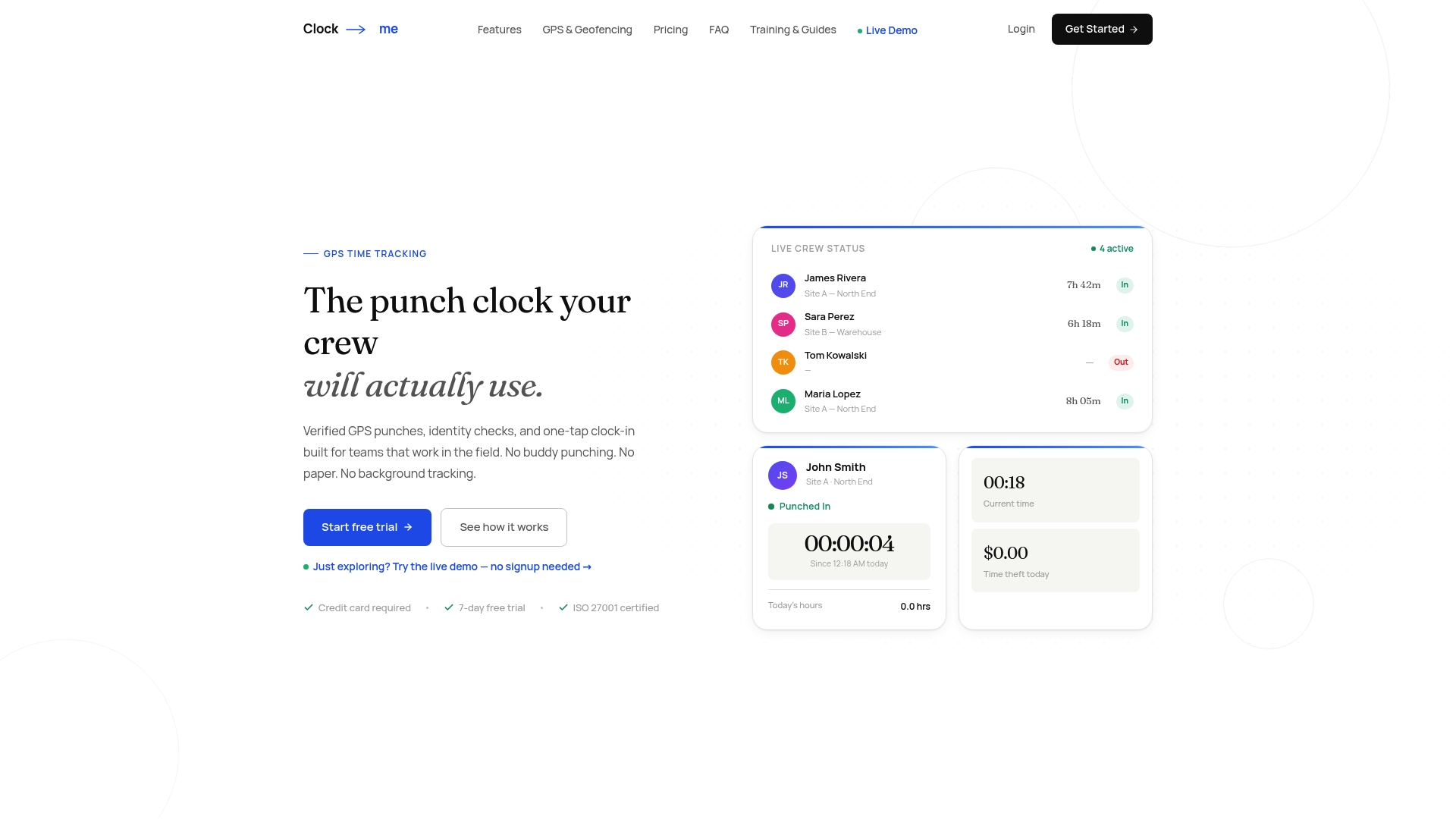
That real-time capture is paired with:
- Identity verification that confirms the person clocking in is the actual employee, not a coworker punching on their behalf.
- Geofencing that flags a break clock-out happening away from the job site.
- Live dashboards that let a supervisor spot a missed or short break the same day it happens, instead of during a monthly audit.
Clock-Me offers multiple subscription plans detailed on the solutions page. If your team is ready to move away from paper timesheets and end-of-week attestation guesswork, the GPS Time Tracking Setup Guide walks through getting a compliant workflow running in minutes.
Primary sources and guidance for deeper review
- The DLSE meal periods FAQ covers timing rules and premium pay directly from the state agency.
- The DLSE rest and meal periods guidance explains duty-free standards and waiver conditions in detail.
- CACI No. 2766B lays out the rebuttable presumption courts apply to incomplete time records.
- Holland & Knight's timekeeping analysis covers practical recordkeeping standards. European employers can review Operiva's time capture overview for a comparison approach.
Sources
- DLSE — Meal periods FAQ
- DLSE — Rest and meal periods (guidance PDF)
- Holland & Knight — California timekeeping practical guidance
FAQ
What is a meal attestation?
A meal attestation is an employee's confirmation, usually a quick click or signature, of whether they took their scheduled meal break. It documents the employee's own account of the break but does not replace the actual time record showing when the break started and ended.
What are the legal requirements for meal breaks in California?
Under Labor Code Section 512, non-exempt employees working more than five hours must receive a duty-free 30-minute meal period, with a second required after ten hours under specific conditions. Employers who fail to provide a compliant break generally owe one hour of premium pay for each workday the violation occurred.
What does "employee attestation" mean?
An employee attestation is a formal confirmation an employee provides about a specific fact, such as whether they took a required break or worked the hours shown on their timecard. It carries more weight when it's collected at the moment the event happened rather than reconstructed later from memory.
What is a timecard attestation?
A timecard attestation is an employee's confirmation that the hours and breaks shown on their timecard are accurate before the record is finalized for payroll. It works best alongside contemporaneous punches rather than as the only proof that the recorded times are correct.