

Yes, fake GPS detection works, but never trust a single signal. Start with Location.isMock() on API 31+ (falling back to isFromMockProvider() on older devices), an AppOpsManager check for mock-location injection, and motion-sensor correlation to catch impossible "teleportation" between check-ins. Sophisticated spoofing tools can bypass any one of these checks, which is why real assurance comes from stacking them with server-side verification.
TL;DR:
- Using
Location.isMock()and AppOpsManager checks alone cannot guarantee spoofing detection, so layering signals and server-side verification is essential.- Sensor heuristics, like cross-checking GPS movement with accelerometer, gyroscope, and barometric data, significantly increase spoofing detection accuracy while managing battery use.
- Emulators, rooting, and hooking frameworks leave identifiable fingerprints that, combined with OS flags, improve device integrity assessments but are not foolproof against dedicated attackers.
- Cross-referencing GPS data with Wi-Fi, cellular, IP geolocation, and timezone signals helps identify inconsistencies, especially over multiple sessions, to flag suspicious location behavior.
- Deploying an integrated detection system involves ongoing maintenance and data privacy compliance, with hardware verification available mainly for high-security scenarios beyond standard app capabilities.
Table of Contents
- What Is Fake GPS Detection and Why Does One Signal Never Suffice?
- OS-Level Signals and Quick Code Checks
- Sensor Heuristics: Catching Impossible Movement
- Environment Hardening: Emulators, Root, and Hooking
- Cross-Layer Verification: Network and Timezone Signals
- Developer Tooling and Integration Patterns
- Advanced GNSS-Level Anti-Spoofing: What the Research Says
- Operational Response: Blocking, Escalation, and Logging
- External Hardware and Signal-Level Verification
- Legal and Privacy Considerations
- Clock-me's Perspective: Why Layered Verification Matters for Time Tracking
- A Turnkey Path to Verified Clock-Ins
- Further Reading and Primary Sources
- Sources
- FAQ
What Is Fake GPS Detection and Why Does One Signal Never Suffice?
GPS spoofing on Android ranges from a $2 app that overwrites coordinates through a fake mock-location provider to signal-level attacks that feed a receiver counterfeit satellite data. The first category is what almost every attendance app, delivery platform, or dating app actually deals with. The second is a GNSS-level threat that mostly concerns critical infrastructure and aviation, though the detection research behind it is starting to matter for mobile too.
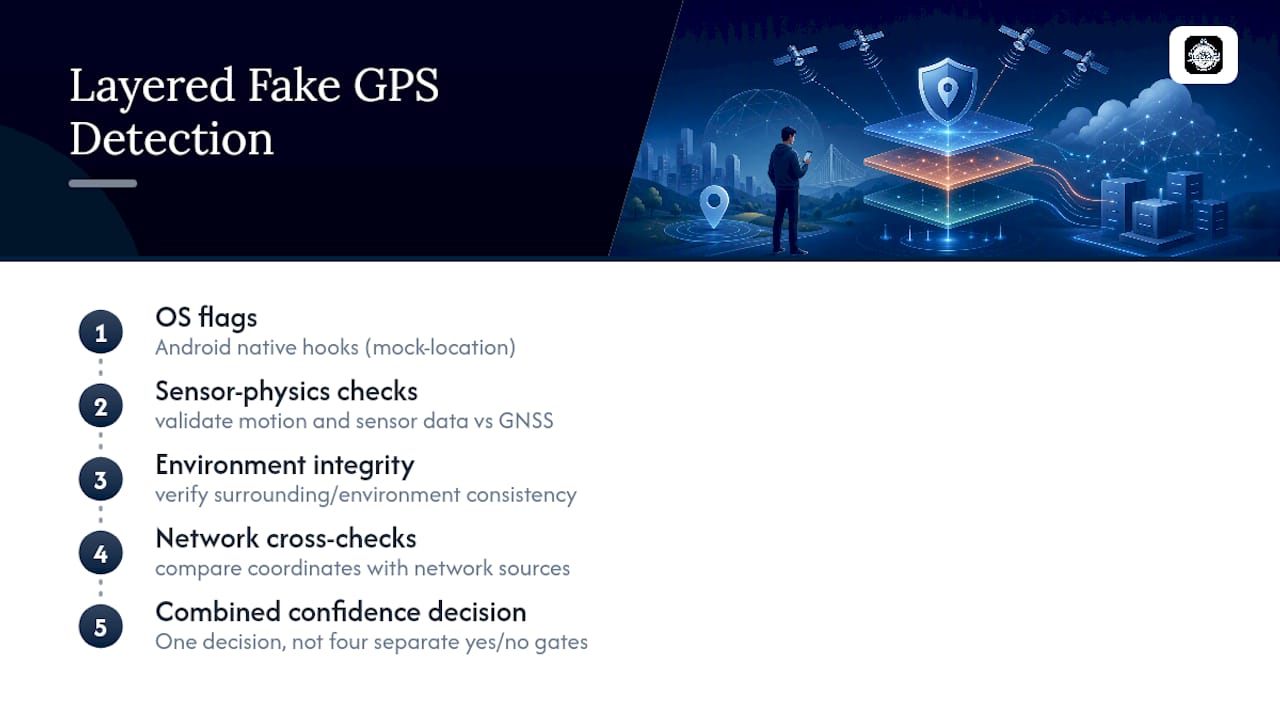
Detecting GPS manipulation on a phone means checking whether the reported coordinates actually came from the device's real location hardware, or from software that intercepted and rewrote the value before your app ever saw it. Android gives you several native hooks for this. None of them is airtight alone. A rooted device with a hooking framework can spoof its way past a naive mock-location check in seconds, so the practical answer to "prevent GPS spoofing" is layering: OS flags, sensor physics, environment integrity, and network cross-checks feeding into one decision, not four separate yes/no gates.
OS-Level Signals and Quick Code Checks
The fastest fake GPS detection layer lives in the Android SDK itself.
Location.isMock()(API 31+) is the modern, reliable flag. It returnstruewhen the location came from a test or mock provider, and Google's own documentation treats it as the primary signal going forward.Location.isFromMockProvider()covers older API levels and behaves the same way, though it's deprecated on newer SDKs.Settings.Secure.ALLOW_MOCK_LOCATIONis a legacy setting from pre-Kitkat devices. It's mostly gone now, but checking for it costs nothing and catches ancient device images.- AppOpsManager lets you query
OPSTR_MOCK_LOCATIONagainst installed packages to see which apps hold mock-location privileges, a check the MockLocationDetector project implements alongside settings and hook checks.
A minimal pseudocode pattern:
fun isLocationSuspicious(location: Location): Boolean {
    if (Build.VERSION.SDK_INT >= 31 && location.isMock) return true
    if (location.isFromMockProvider) return true
    return appOpsManager.hasMockLocationApp()
}
Permission scoping matters here. AppOpsManager queries require care on newer Android versions, and enumerating installed packages needs the QUERY_ALL_PACKAGES permission, which Google Play now restricts.
Sensor Heuristics: Catching Impossible Movement
Fake GPS location security gets a lot stronger once you stop trusting coordinates in isolation and start checking whether the device's own motion sensors agree with them.
The core idea: a phone that just "moved" 5 kilometers between two GPS reads, one second apart, should show corresponding accelerometer and gyroscope activity. If the sensors are flat while the coordinates jump, something rewrote the location feed.
- Buffer the last 5 to 10 GPS points in a rolling window and compute displacement and implied speed between each pair.
- Flag any implied speed exceeding a realistic ceiling. Most workforce and delivery apps set that around 100 m/s, since even a highway commute rarely clears 45 m/s.
- Cross-check displacement against accelerometer magnitude over the same window. A large jump with near-zero accelerometer variance is a strong spoof signal.
- Add a barometer check where available. Altitude that changes abruptly with no matching pressure delta is another mismatch worth flagging.
- Apply hysteresis, requiring two or three consecutive mismatches before flagging, so a single GPS drift event near tall buildings doesn't trigger a false positive.
Pro Tip: Give sensors a two-to-three-second warm-up window after the app resumes from background before scoring movement. Cold sensor reads right after a wake-up produce noisy deltas that look exactly like spoofing but aren't.
Sampling more frequently improves accuracy but drains battery fast, so most implementations only run the full sensor correlation burst at check-in events rather than continuously.
Environment Hardening: Emulators, Root, and Hooking
A phone that's been modified to spoof location usually leaves other fingerprints beyond the coordinates themselves.
- Emulator detection looks at build properties, sensor availability, and hardware IDs that real devices almost never combine, since most emulators used for spoofing were built for app testing, not disguise.
- Root detection checks for
subinaries, known root-management packages, and writable system partitions. Rooted status alone isn't proof of spoofing since plenty of legitimate users root their own devices, so treat it as one weighted input, not an automatic block. - Hook detection validates that the
Locationclass and its methods behave as the stock Android framework defines them, watching for the injected method signatures that frameworks like Xposed and LSPosed leave behind. - Combine all three with the OS-level flags from earlier, since a device that's both rooted and running a hooking framework is far more likely to be actively spoofing than one flag alone would suggest.
The hard limit: a sufficiently motivated attacker running a system-level hook can silence local checks entirely. That's the ceiling of what any on-device check can promise.
Cross-Layer Verification: Network and Timezone Signals
Detecting fake location services reliably means moving verification to your server, where the client can't lie about what it's telling you, because the attacker can spoof the phone but not your infrastructure's view of the request.
- Collect Wi-Fi SSIDs and BSSIDs along with cell-tower IDs as independent geo-anchors. A device claiming to be in Chicago while its Wi-Fi scan shows a router last seen in Manila is not a rounding error.
- Compare the client's IP-derived geolocation and SIM country code against the reported GPS coordinates. Cross-referencing GPS with Wi-Fi and cellular data is standard practice precisely because attackers who spoof one layer often forget to align the others.
- Check device timezone against the claimed location's expected timezone. It's a cheap check that catches a surprising number of lazy spoofing setups.
- Score trajectories over multiple sessions instead of judging one ping in isolation. A device that "teleports" once might have a GPS glitch; a device that does it every Monday at clock-in time is running a pattern.
- Store the raw signals (SSID list, cell IDs, IP, timestamp, sensor summary) for forensic review, but scope retention and access to what your privacy policy and applicable data-protection law actually permit.
Developer Tooling and Integration Patterns
Most production detectors fall into two operating modes, and picking the wrong one wastes both battery and engineering time.
detectOncepatterns run the full check bundle at a discrete event, like a time-clock punch or a delivery confirmation, which fits any app where location only matters at specific moments.- Continuous monitoring streams location and sensor events for apps that need ongoing trust, like fleet tracking, at a real battery cost.
- A practical risk score aggregates signals with weighted flags:
MOCK_PROVIDER,APP_OPS_FLAG,GEO_IMPOSSIBILITY, andMOTION_MISMATCHeach add points toward a normalized score, an approach reflected in sensor-fusion fraud scoring packages. - Set tiered thresholds. A low score logs silently; a mid score triggers a soft challenge; a high score blocks the action outright.
- Request only the permissions each check actually needs, and batch sensor polling around events rather than polling continuously to avoid burning the user's battery for a feature they never notice.
Advanced GNSS-Level Anti-Spoofing: What the Research Says
Consumer apps rarely need signal-level GNSS defenses, but the research is worth understanding because it sets the ceiling for what "verified" location can eventually mean.
Self-consistency verification of receiver clock state, a technique researchers call SCV-RCS, detects GNSS spoofing by checking whether a receiver's internal clock behavior stays mathematically consistent with genuine satellite signals over time.
The MDPI Sensors paper introducing SCV-RCS validated the method against the TEXBAT dataset with low false-alarm rates. A related PMC study on clock-state consistency found alarm delays of two seconds or less across tested spoofing scenarios, fast enough for real-time flagging.
Authenticated GNSS, specifically Galileo's Open Service Navigation Message Authentication (OSNMA), adds cryptographic signing to satellite messages, making data-level spoofing far harder to fake convincingly. These techniques belong in receiver hardware and infrastructure, not app code, but they explain why "verified GPS" is becoming a real engineering category rather than a marketing phrase.
Operational Response: Blocking, Escalation, and Logging
A detection signal is only useful if it maps to a consistent, defensible action.
- Low risk score: Log the event silently and let the action proceed. Most sensor noise and legitimate GPS drift land here.
- Medium risk score: Soft-block the action with a remediation prompt, such as asking the user to move outdoors or retry with location services fully enabled.
- High risk score: Require step-up identity verification, like a selfie check or manager approval, before the action completes.
- Persistent or severe risk: Place the account on hold for manual review and escalate to a human, especially when the pattern repeats across sessions.
Log the full signal bundle, not just the final score, since a manual reviewer needs the sensor deltas and network anchors to confirm or overturn an automated block. Balance friction carefully: flagging every borderline case erodes trust faster than the fraud it prevents.
External Hardware and Signal-Level Verification
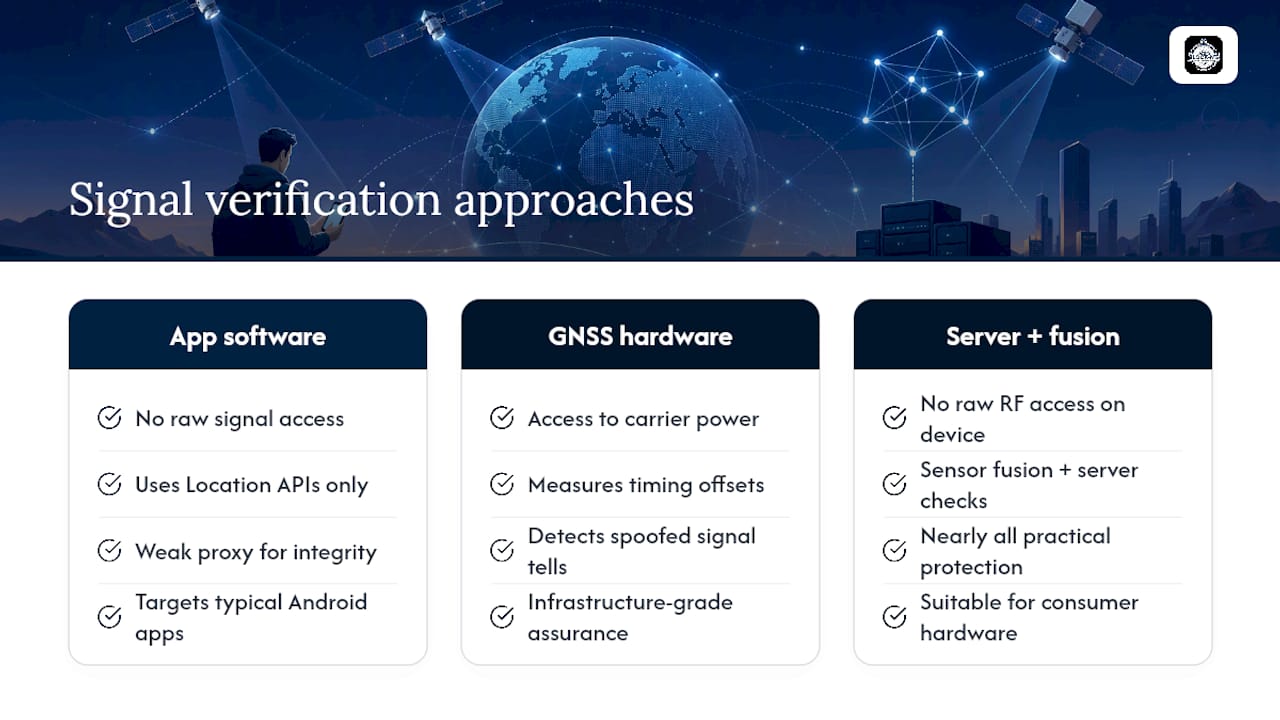
Most fake GPS detection in mobile apps happens entirely in software, but a smaller set of high-assurance scenarios call for verifying the actual radio signal, not just the coordinates a chipset reports.
Dedicated GNSS signal analyzers can measure raw carrier-to-noise ratios and timing offsets that consumer phone chipsets never expose to an app. A spoofed signal injected by a nearby transmitter often shows an unnaturally strong, unnaturally consistent power level compared to the natural variation of real satellite signals arriving from orbit. That's one of the classic tells security researchers look for in dedicated anti-spoofing hardware, and it's part of why CISA's guidance on GPS equipment for critical infrastructure recommends layered sensors and, in some deployments, blocking antennas as part of a defense-in-depth strategy.
Timing verification works on a related principle. Genuine GPS signals carry precise timing data synchronized across the satellite constellation, and a receiver's internal clock should stay mathematically consistent with that timing over time, which is exactly what the SCV-RCS research measures at the receiver level.
None of this applies directly to a typical Android app, since your code can't access raw signal power or carrier timing through the standard Location APIs. What it does mean is that "GPS accuracy" and "GPS confidence" fields exposed by LocationManager are a weak proxy for the real signal-integrity picture. If your product genuinely needs infrastructure-grade assurance, that requires purpose-built receiver hardware, not a software patch. For everything short of that, sensor fusion and server-side cross-checking give you nearly all the practical protection available on stock consumer hardware.
Legal and Privacy Considerations
Detecting spoofing means collecting more device data, and that data carries real legal weight.
Location history, device fingerprints, and network identifiers are personal data under most privacy frameworks, which means detection logic needs a documented lawful basis, a defined retention window, and safeguards against overreach. Continuous background tracking in particular draws more regulatory scrutiny than event-triggered checks, since it collects far more data than most detection use cases actually need. Employers using location verification for time tracking face an added layer: several jurisdictions, California among them, impose specific disclosure and consent requirements before an employer can use GPS data for attendance decisions. Build consent screens and data-retention limits into the detection pipeline itself, not as an afterthought bolted on after legal review.
Clock-me's Perspective: Why Layered Verification Matters for Time Tracking
Buddy punching and falsified check-ins are the workforce version of GPS spoofing, and the same layered logic applies. Clock-me pairs verified GPS clock-ins with geofencing and identity checks specifically because a single signal, like a raw coordinate, is trivial to fake and expensive to defend against alone.
The real tension is friction versus assurance. Strict thresholds catch more fraud but annoy honest employees; loose thresholds do the opposite. Tune enforcement to your actual risk, whether that's a construction crew spread across five sites or a home-care team with tight scheduling. Teams without the engineering bandwidth to build and maintain this stack should weigh a managed platform against the ongoing cost of doing it themselves.
— Clock-me
A Turnkey Path to Verified Clock-Ins
Building the detection stack described above, mock-location checks, sensor correlation, environment hardening, and server-side scoring, is a real engineering project, and maintaining it as spoofing tools evolve is an ongoing cost most field-service companies would rather not carry alone. Clock-me gives you that layered verification without the build.
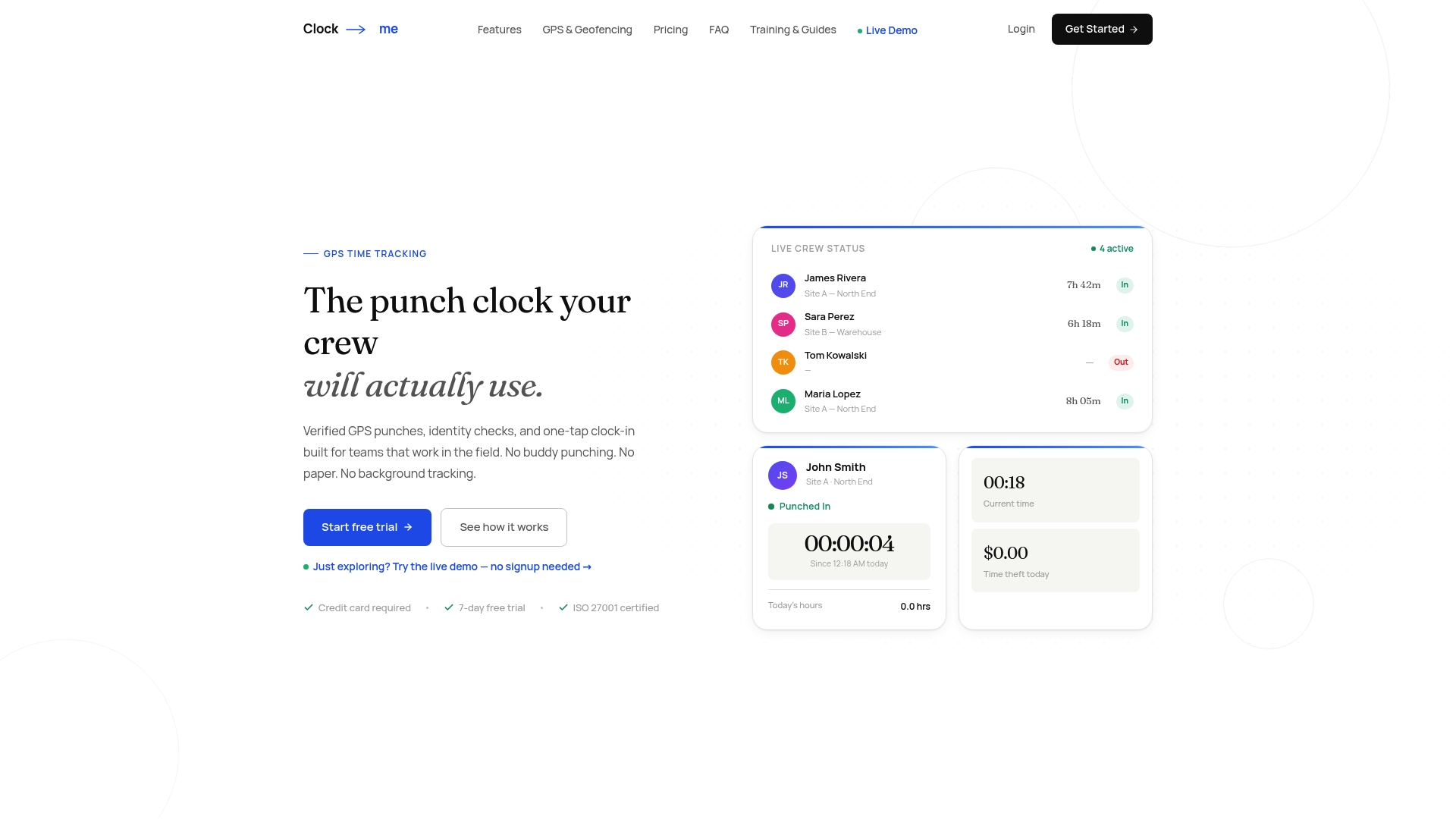
The platform combines one-tap GPS-verified clock-ins, geofencing, identity verification, and live dashboards so managers see attendance issues as they happen instead of during a payroll dispute weeks later. It's built specifically for teams enforcing California labor law compliance without drowning in paperwork, and setup requires no lengthy IT project. Plans start with a Free tier for small teams, scaling up through various paid tiers to suit different team sizes and needs, with Enterprise pricing available on request.
If your team is still relying on a single GPS coordinate to decide who gets paid for what, get started with Clock-me and see verified clock-ins working within minutes.
Further Reading and Primary Sources
For readers who want to go deeper into the research and tooling referenced above:
- PMC study on GNSS clock-state spoofing detection, covering alarm-delay results for clock-consistency checks.
- MDPI Sensors paper introducing SCV-RCS, the 2026 validation study behind the two-second detection claim.
- CISA guidance on GPS equipment for critical infrastructure, for hardware-level defense-in-depth recommendations.
- MockLocationDetector on GitHub, an open-source reference implementation of the OS-level checks covered above.
- Bureau, for multi-signal verification patterns.
Sources
- PMC article on GNSS clock-state spoofing detection
- MDPI Sensors paper on SCV-RCS (2026)
- Bureau
- auag0/MockLocationDetector (GitHub)
FAQ
Can Fake GPS Be Detected on Android?
Yes. Android exposes Location.isMock() on API 31+ and isFromMockProvider() on older versions, and pairing those with sensor correlation and server-side network checks catches the overwhelming majority of spoofing attempts. No single check catches everything, which is why layered detection outperforms any one API call.
Can You Fake Your GPS Location on a Phone?
Yes, mock-location apps and developer-mode settings let anyone override reported coordinates on Android without rooting the device. Rooted devices with hooking frameworks can go further and spoof past basic detection, which is exactly why fake GPS app risks extend beyond casual use into fraud and compliance concerns for employers.
How Do I Check for a Fake Location on My Own Device?
Check whether Developer Options has a mock-location app selected, since that's the most common consumer method. On the technical side, apps built with Google's own Location APIs can query isMock(), AppOpsManager permissions, and installed packages to flag suspicious location providers running on the device.
How Can I Tell if Someone Is Faking Their Location on My iPhone?
iOS doesn't expose the same mock-location APIs as Android, so detection there relies more on behavioral signals, like impossible travel speed between check-ins or a location that never matches Wi-Fi and cellular data. Cross-referencing GPS against network signals works on both platforms even when OS-level flags don't.
Does Clock-me Detect GPS Spoofing for Time Tracking?
Clock-me combines verified GPS clock-ins, geofencing, and identity verification to make spoofed check-ins far harder to fake and maintain. Current plan pricing, including the Free tier for small teams, is listed on the solutions page.