
Yes: most GPS spoofing is detectable in enterprise contexts when you combine client-side integrity checks, sensor and network correlation, server-side trajectory scoring, and GNSS-level methods for high-assurance cases. No single check catches everything, but stacking cheap software signals with occasional hardware-grade verification closes almost every gap attackers exploit. For workforce and fleet tracking, that layered approach is exactly what platforms like Clock-Me are built to run.
TL;DR:
- Combining server-side trajectory scoring, sensor correlation, and GNSS-level checks can detect most GPS spoofing attempts without specialized hardware.
- Spoofing methods range from simple mock-location apps to advanced SDR-based signals, each leaving distinct detectable signatures like speed anomalies or sensor inconsistencies.
- Implementing layered detection involving mock flags, root/emulator checks, sensor cross-referencing, network verification, and physics heuristics effectively prevents workforce spoofing.
- GNSS-level algorithms such as SCV-RCS and AoA methods detect high-value, high-threat spoofing by analyzing receiver clock stability and signal arrival angles.
- Out-of-the-box solutions like Clock-Me provide verified GPS and spoofing protection without extensive engineering, enabling real-time fraud detection for field operations.
Table of Contents
- What Is GPS Spoofing, and How Does It Differ From Mock Locations?
- Why Spoofing Detection Matters for Fraud and Operations Teams
- How Attackers Actually Spoof a Location
- The Layered Detection Stack That Actually Works
- When You Need GNSS-Level Detection Algorithms
- Building an Operational Detection Program
- How Clock-Me Handles Location Integrity for Field Teams
- Where to Read Further on GNSS and Spoofing Detection
- What Most Spoofing Guides Get Wrong
- Get Verified Location Data Without Building It Yourself
- Sources
What Is GPS Spoofing, and How Does It Differ From Mock Locations?
GPS spoofing means transmitting fake satellite signals that trick a GNSS receiver into computing a false position. It operates at the signal level, using software-defined radio (SDR) or dedicated hardware to overpower or mimic real satellite broadcasts. That distinguishes it from mock-location injection, which is a device-level trick: an app or developer setting tells the operating system to report a fabricated location without touching any actual GPS signal.
Jamming is a third, cruder category. Instead of faking a position, a jammer floods the GNSS frequency band with noise so the receiver cannot compute any fix at all, denying service rather than falsifying it.
The distinction matters because each requires different defenses:
- Mock-location injection is caught by checking OS-level flags and app permissions.
- Device-level spoofing (rooted phones, emulators) requires integrity and root detection.
- Signal-level spoofing needs physics heuristics or GNSS receiver analysis.
Common targets include workforce attendance apps, delivery and rideshare platforms, drone navigation, and IoT asset trackers, each with different attacker incentives and different tolerance for false positives.
Why Spoofing Detection Matters for Fraud and Operations Teams
Location fraud is not a hypothetical risk for anyone paying field employees or dispatching vehicles by GPS. A worker who spoofs a "clock-in" from home costs real payroll dollars for hours never worked on site. A delivery driver faking a drop-off location creates disputed deliveries and chargebacks. A fleet operator relying on falsified GPS breadcrumbs loses the ability to bill clients accurately for time on location.
Statistic callout: Physics-based detection research shows that spoofed GPS traces routinely produce impossible travel speeds, unnatural jitter patterns, and mismatches between reported location and onboard motion sensors, signals that are essentially absent from genuine GPS noise.
Beyond fraud, there's a compliance dimension. Businesses that must document meal and rest breaks or prove an employee was physically on a job site need location data that will hold up to an audit. Spoofed punches don't just cost money. They corrupt the very records meant to protect the business.
How Attackers Actually Spoof a Location
Attacker sophistication runs on a spectrum, and each tier leaves different fingerprints in your telemetry.
Low-skill attackers use developer mock-location apps or Android's built-in mock-provider setting. This is the most common method because it requires zero technical skill beyond enabling Developer Options and picking a fake-GPS app from an app store.
Medium-skill attackers root or jailbreak their device, then use tools like Magisk or Xposed modules to hide the mock-location flag from apps that check for it. Emulator injection falls in this tier too: running an app inside an Android emulator on a desktop, then feeding it arbitrary coordinates directly.
High-skill attackers deploy SDR-based spoofers or portable hardware transmitters that broadcast counterfeit satellite signals to a real GPS chip. This tier can execute multi-source spoofing, simulating several satellites in sync, and even adaptive spoofing that adjusts output to defeat known detection thresholds.
Each leaves distinct evidence:
- Mock apps trigger the
isFromMockProvider()/isMockflag directly. - Rooted bypasses show filesystem traces (su binaries, Magisk signatures) even when the mock flag itself is suppressed.
- Sudden timezone or IP changes alongside a GPS jump suggest emulator use rather than genuine travel.
- Perfectly round or suspiciously uniform coordinate jitter is a signature spoofing tools struggle to fake convincingly.
Pro Tip: Never trust a single signal in isolation. A rooted-device check can be bypassed by a skilled attacker, but the combination of a rooted flag plus a physics-impossible speed jump is far harder to fake simultaneously.
The Layered Detection Stack That Actually Works
You don't need SDR hardware to catch the overwhelming majority of workforce and fleet spoofing attempts. A software stack, applied in this order, handles it:
- Mock-provider and OS-level flags. Check
Location.isFromMockProvider()on Android (and the iOS equivalent for jailbreak/simulation signals) as your first, cheapest filter. This alone catches most casual spoofing attempts using standard fake-GPS apps. - Root and emulator integrity checks. Scan for su binaries, known Magisk or Xposed module signatures, and emulator build properties (generic hardware strings, missing sensors). Because rooted devices can hide mock flags from the OS entirely, this layer has to run independently of the mock-provider check, not depend on it.
- Sensor correlation. Cross-reference GPS movement against the accelerometer, gyroscope, and magnetometer. A phone reporting a half-mile jump with zero corresponding motion data is teleporting, not traveling.
- Network cross-checks. Compare Wi-Fi SSID, cell-tower ID, and IP-based geolocation against the claimed GPS coordinate. A punch-in claiming a job site in Denver from an IP address in another state is a clear mismatch.
- Physics heuristics. Flag impossible speeds (over roughly 150 mph for a ground vehicle, for instance), suspiciously constant accuracy readings, and jitter patterns too clean to be real. These physics-based checks are among the most reliable indicators of sophisticated spoofing precisely because they don't depend on the device telling the truth about itself.
- Server-side trajectory scoring. Aggregate every signal above into a single risk score per event, rather than a binary pass/fail on any one check. Set thresholds that trigger a soft block (require re-punch), a full challenge (photo verification), or a silent audit flag for review.
Pro Tip: Log every raw signal, even the ones that pass, not just the flagged events. When you eventually tune your thresholds, you'll need the full distribution of normal behavior to know what "suspicious" actually looks like for your workforce.
Layer-based stacks combining mock-location flags, rooted-device detection, physics checks, and device fingerprinting have shown in production deployments to cut workforce spoofing incidents substantially, without requiring specialized receiver hardware.
When You Need GNSS-Level Detection Algorithms
Software-only checks cover the vast majority of workforce and fleet fraud cases. But some environments, high-value asset tracking, critical infrastructure, or adversaries using SDR-grade hardware, need detection at the GNSS signal level itself.
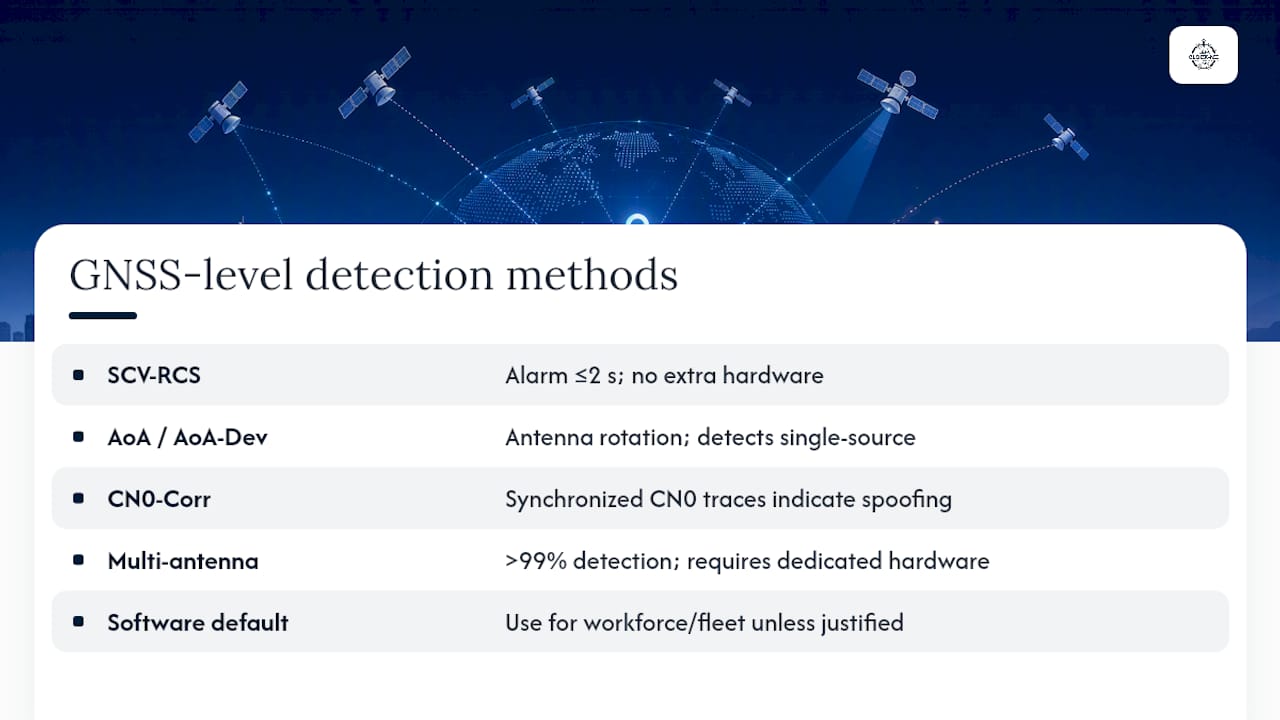
SCV-RCS (self-consistent verification of receiver clock state) monitors whether a receiver's estimated clock bias stays consistent with its integrated clock drift over time. Genuine satellite signals produce a stable relationship; spoofed signals disrupt it. The method can raise an alarm within two seconds, and it needs no auxiliary hardware, just access to clock and Doppler measurements the receiver already exposes.
Angle-of-arrival (AoA) and AoA-Dev techniques use physical antenna rotation, sometimes with rotation speed kept secret as a countermeasure, to detect whether incoming signals arrive from a single spoofed source rather than the distributed directions of real satellites.
CN0 cross-correlation (CN0-Corr) exploits a subtler tell: spoofed signals broadcast from one transmitter tend to show synchronized carrier-to-noise ratio traces across all "satellites," while genuine signals show natural, independent variance. Rotation-based AoA and CN0 correlation have been validated in prototype experiments that achieved high accuracy within seconds, including against adaptive spoofing attempts.
Multi-antenna baseline configurations compare signal timing across two or three physically separated antennas. This approach achieves detection rates above 99% in testing, but it demands dedicated hardware, careful calibration, and a device form factor that supports multiple antennas, ruling it out for phone-based workforce apps.
For workforce and delivery tracking, the software stack should be your default. Reach for GNSS-level methods only when the asset value, regulatory requirement, or threat model justifies the hardware and engineering investment.
Building an Operational Detection Program
A detection stack is only as good as the operational process wrapped around it. Four things matter most.
Telemetry minimums. Store, per event: raw GPS coordinates, accuracy radius, mock-provider flag state, root/emulator indicators, accelerometer/gyroscope snapshot, Wi-Fi/cell-tower ID, and a timestamp with millisecond precision. Skimping here means you can't retroactively investigate a disputed punch.
Rules and thresholds. Start conservative: flag any location jump implying speed over roughly 150 mph, any coordinate accuracy value that never varies across ten consecutive readings, and any mock-provider flag regardless of other signals.
Escalation flow. Route flagged events through a graduated response, not an instant ban.
- Soft block: require the user to re-punch with fresh GPS data.
- Challenge: request a photo or biometric confirmation.
- Audit log: record the full event for review regardless of outcome.
- Human escalation: route repeated or high-confidence flags to HR or operations.
Privacy and testing. Retain location data only as long as your compliance and dispute-resolution needs require, and document what you collect and why. Test your rules against known spoofing patterns before rolling out enforcement, using controlled trials rather than live employee punches.
| Program element | What to define | Why it matters |
|---|---|---|
| Telemetry fields | GPS, accuracy, mock flag, sensor snapshot, network ID | Enables retroactive investigation |
| Detection thresholds | Speed, jitter, accuracy consistency | Separates real anomalies from noise |
| Escalation path | Soft block → challenge → audit → HR | Avoids false-positive overreaction |
| Retention policy | Defined window tied to dispute windows | Balances privacy with accountability |
How Clock-Me Handles Location Integrity for Field Teams
Clock-Me builds this layered thinking directly into its punch clock rather than treating it as an add-on. Verified GPS punches confirm the device wasn't running a mock-location provider at the moment of clock-in, identity verification ties the punch to the actual employee rather than a shared device, and geofencing rejects punches originating outside a defined job-site radius before they ever reach payroll.
Key features that map to the detection layers above:
- Verified GPS punches with mock-location and integrity checks at the point of capture.
- Identity verification to prevent buddy punching regardless of location accuracy.
- Geofencing that enforces a hard location boundary, not just a plausibility score.
- Live dashboards showing real-time crew location so anomalies surface immediately, not at payroll close.
A recommended configuration pairs geofencing (hard boundary) with identity verification (who's really punching) as two independent layers, so defeating one doesn't defeat the whole system. Businesses evaluating this can run a live demo to see how flagged punches surface on the admin dashboard before committing to anything.
Where to Read Further on GNSS and Spoofing Detection
Technical teams building custom detection should start with the SCV-RCS paper for clock-based verification, the AoA and CN0-correlation research for rotation and signal-timing methods, and the DHS PNT program for infrastructure-level guidance and receiver whitelist development. For application-layer implementation, the Android mock-location developer guide remains a solid starting reference.
What Most Spoofing Guides Get Wrong
Most write-ups on this topic treat GPS spoofing as a binary: either your app is vulnerable or it isn't. That framing misses the point entirely. Every layer in this stack has a known bypass. Mock-provider flags get hidden by Magisk. Sensor correlation gets fooled by a static phone on a desk with a spoofed GPS feed. Even GNSS-level clock analysis assumes access to raw measurements most consumer chips don't expose.
The judgment this research actually supports is different: detection isn't about finding the one perfect method, it's about making the cost of defeating every layer simultaneously higher than the fraud is worth. A worker skipping a shift isn't going to build an SDR spoofer. They'll use a fake-GPS app, and a mock-provider check plus a geofence stops them cold.
Where conventional advice falls short is recommending GNSS-level algorithms to businesses that will never face an SDR-equipped adversary. That's engineering effort spent on the wrong threat model. Prioritize the software stack first. Reserve hardware-grade verification for the rare case where the asset actually justifies it.
— Cristiano
Get Verified Location Data Without Building It Yourself
Building the detection stack described above, mock-provider checks, root detection, geofencing, sensor correlation, is months of engineering work most operations teams don't have time for. Clock-Me gives field-service businesses that same layered protection out of the box, without writing a line of detection code.
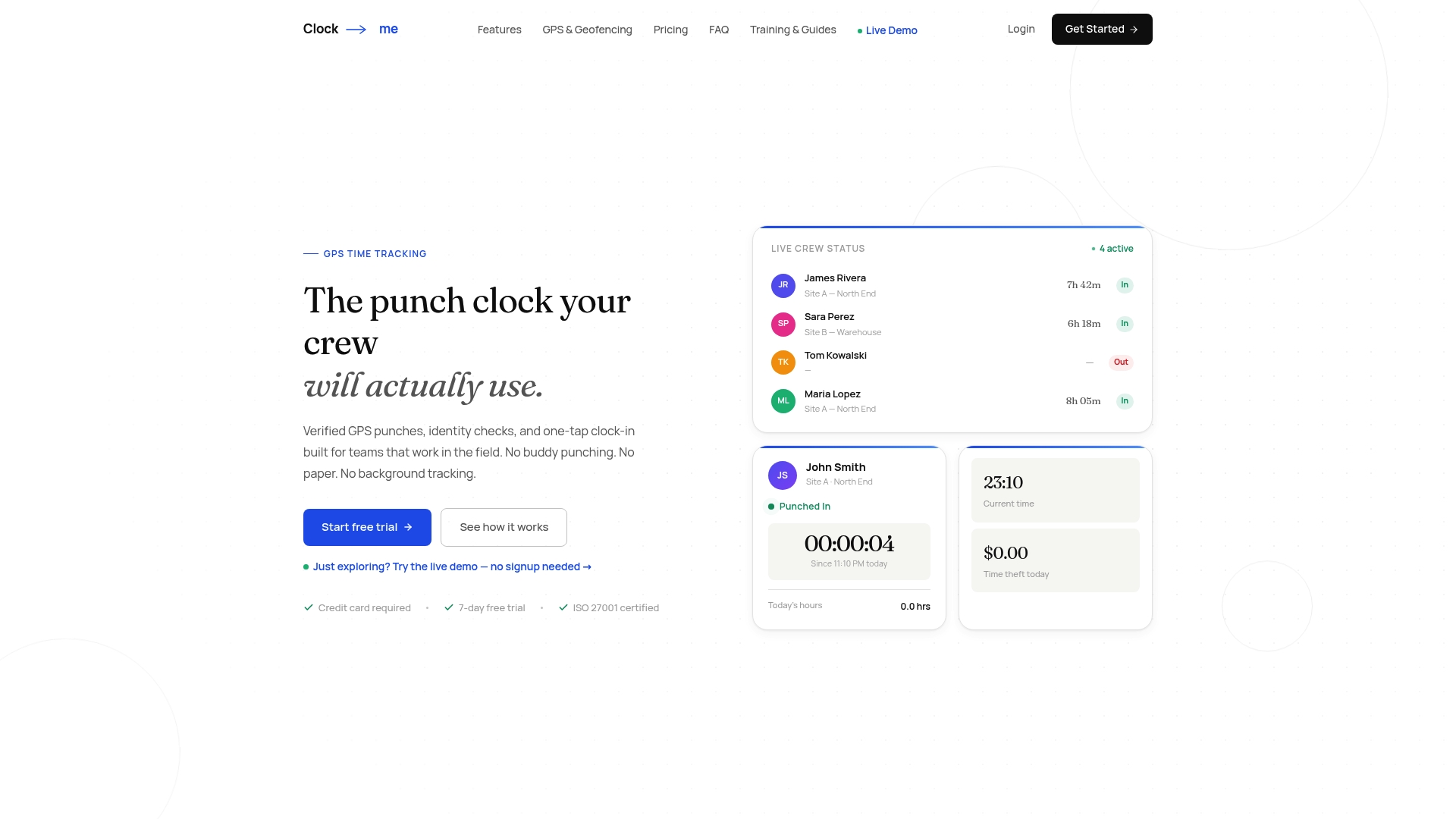
Every punch runs through verified GPS capture, identity confirmation, and geofence enforcement automatically, and flagged events show up on a live dashboard instead of surfacing three weeks later at payroll reconciliation. That's the practical difference for a construction, landscaping, or maintenance business: you get the fraud protection this article describes without hiring an engineer to build it.
Explore the geofencing and verified-punch features directly, or start a live demo to watch a flagged punch move through the system in real time. No signup required to look around first.
Sources
- Physics-based heuristics for spoof detection (PMC)
- GNSS spoofing detection via self-consistent verification of receiver’s clock state (SCV-RCS)
- Angle-of-arrival and CN0-correlation detection methods (University research prototype)
- DHS PNT program