

Under California law, employer‑required or employer‑controlled travel is compensable, and you calculate the payable portion as the time it takes to reach the required site minus the employee's normal commute time. That rule comes straight from the California Supreme Court's decision in Morillion v. Royal Packing Co. and from Division of Labor Standards Enforcement guidance interpreting "hours worked." You also owe reimbursement for related expenses under Labor Code §2802. The sections below walk through the math, the pay rate rules, and the payroll steps that keep you out of a wage claim.
TL;DR:
- Employers must pay for travel time under California law when employees are under employer control or directed to a specific site, regardless of travel distance.
- The calculation subtracts the employee’s usual commute time from total travel time to a temporary site, with travel tracked in minutes, not miles.
- Travel time is paid at least minimum wage or the employee’s regular rate, including overtime if it exceeds standard work hours, with proper payroll calculations.
- Reimbursement is required for necessary expenses like mileage, lodging, meals, parking, and tolls, with proper documentation for audit defense.
- Implementing clear policies, GPS verification tools, and detailed record-keeping helps ensure compliance and reduces the risk of wage disputes or investigations.
Table of Contents
- When Is Travel Time Compensable Under California Law?
- How to Calculate Compensable Travel Time in California
- Which Pay Rate Applies, and What Happens With Overtime?
- What Expenses Must You Reimburse Under Labor Code §2802?
- What Should a California Travel-Time Policy Include?
- What Records Protect You If the DLSE Investigates?
- How Verified GPS Time Tracking Supports Travel Pay Compliance
- Why Travel-Time Compliance Is Risk Management, Not Just Payroll
- Track Travel Time Without the Paperwork Trail
- Where to Read the Primary Sources
- Sources
- FAQ
When Is Travel Time Compensable Under California Law?
The test isn't distance. It's control. California treats time as "hours worked" whenever an employee is "subject to the control of an employer" or "suffered or permitted to work," language the DLSE's wage guidance draws directly from the Industrial Welfare Commission wage orders. If you tell someone where to be and when, and they can't use that time freely, you're paying for it.
Morillion v. Royal Packing Co. is the case every California employer should know by name. The state's highest court ruled that agricultural workers required to ride employer‑provided buses to remote fields had to be paid for that bus time, because they couldn't use the ride for their own purposes and boarding was mandatory. The logic extends well past farm buses.
Common scenarios that trigger compensable travel include:
- An employer requires staff to meet at a central lot and ride a company van to a jobsite.
- A supervisor directs an employee to drive to a client site other than their normal workplace for the day.
- A company mandates attendance at an out‑of‑town conference or training session.
- A crew lead sets a mandatory check‑in time and location before the workday officially starts.
Here's where employers get tripped up: federal law under 29 CFR §785.37 treats some overnight and one‑day travel differently, and HR teams sometimes lean on that federal standard to avoid paying. California's broader control test overrides it. If you're operating in this state, the federal carve‑outs won't protect you.
How to Calculate Compensable Travel Time in California
The formula is simpler than most payroll systems make it look:
Compensable travel time = total travel time to the temporary site minus the employee's normal commute time.
You're not comparing miles. You're comparing minutes. An employee who normally drives 20 minutes to the main office but gets sent to a client site 50 minutes away owes 30 minutes of paid travel time each way, or 60 minutes for the round trip.
Two quick examples make this concrete:
- Redirected office worker. Maria normally commutes 15 minutes to her regular office. Her manager sends her to a one‑day training 45 minutes away. She's owed 30 minutes of paid travel each direction, 60 minutes total, on top of her working hours at the training.
- Mandatory meet‑up point. A landscaping crew normally drives directly to job sites, roughly 10 minutes from home. One week, the employer requires everyone to meet at a central depot and ride a company truck, adding 35 minutes each way. That extra 35 minutes each direction is compensable, since the ride itself is under employer control per Morillion.
Two complications come up often. If an employee has no fixed workplace, such as a field technician who reports to a different site daily, the "normal commute" baseline gets fuzzier, and you should document the average commute distance from their home base. If a temporary assignment stretches beyond about a month, the site may effectively become the employee's new regular workplace, which changes how you measure "normal" commute time going forward.
Pro Tip: Track travel in minutes, not miles, and keep a written record of each employee's baseline commute time on file. When a dispute arises months later, that documented baseline is what protects you.

Which Pay Rate Applies, and What Happens With Overtime?
Travel time doesn't get a discount rate by default. You owe at least minimum wage or the employee's regular hourly rate for time spent traveling under employer control, and standard overtime rules still apply on top of that.
A few rules HR teams need to build into payroll services:
- If employer‑required travel pushes a nonexempt employee past 8 hours in a day or 40 hours in a week, that travel time counts toward the overtime threshold.
- Payroll must recompute the regular rate across the full work period, including travel hours, rather than treating travel as a separate bucket paid at a flat rate. Skipping this step is one of the most common findings in wage audits, according to DLSE guidance.
- You may set a special, lower travel rate in advance, as long as it never drops below minimum wage, and employer guidance from institutions like Caltech stresses that this rate must be communicated to employees before travel begins, not after the fact.
- For salaried nonexempt employees, convert the salary to an hourly equivalent before calculating overtime on any travel‑driven overtime hours.
Trying to average out travel pay after the fact, or applying a travel rate nobody agreed to in writing, is exactly the kind of practice that turns into a class claim.
What Expenses Must You Reimburse Under Labor Code §2802?
Labor Code §2802 requires you to reimburse employees for all necessary expenditures they incur as a direct result of performing their job duties; travel is one of the most common triggers. This is a separate obligation from paying travel time itself; you owe both.
Reimbursable items typically include:
- Mileage for personal vehicle use at a documented rate, or actual gas and vehicle costs.
- Lodging when overnight travel is required.
- Meals incurred during required travel, whether reimbursed via per diem or actual receipts.
- Parking, tolls, and incidental costs tied directly to the assignment.
Documentation matters as much as the reimbursement itself. Keep mileage logs and receipts on file, because a bare policy statement without supporting records won't hold up if an employee disputes what they were owed. Failing to reimburse isn't a minor paperwork miss, either. Under §2802, unreimbursed expenses can accrue interest from the date the employee paid out of pocket, and employees who win a reimbursement claim can recover attorney's fees. Decide upfront whether your policy uses per diem or actual expense reimbursement, and write that choice into your policy rather than deciding case by case.
What Should a California Travel-Time Policy Include?
Most travel‑pay disputes trace back to a policy that was vague, unwritten, or never communicated before the trip happened. Fixing that takes less effort than defending a claim later.
- Define your terms in writing. Spell out what counts as a "normal commute" and what qualifies as a "temporary work site" for your workforce, since these definitions drive every calculation downstream.
- Build travel coding into your timesheet system. Payroll staff need a clear, separate code for compensable travel time so it doesn't get lumped in with regular hours or dropped entirely.
- Communicate special rates before travel starts. If you're using a special travel rate, put it in writing and collect an employee acknowledgment before the trip, not after.
- Audit sample pay runs quarterly. Pull a handful of travel‑related pay periods each quarter and check that hours, rates, and overtime were calculated correctly.
- Train dispatch and payroll staff together. The people scheduling travel and the people processing pay need to use the same definitions, or gaps show up fast.
Pro Tip: Run a mock audit on your last three out‑of‑town assignments before a real one comes from the Labor Commissioner's office. It's far cheaper to catch a coding error yourself.
What Records Protect You If the DLSE Investigates?
The DLSE's opinion letter on out‑of‑town business travel confirms that travel to a required out‑of‑town meeting counts as hours worked even when it happens outside normal business hours. That single opinion has shaped how investigators evaluate travel pay claims across the state.
If you're audited or sued, expect requests for: written travel authorizations, employee schedules, timesheets showing travel hours separately, travel itineraries, and reimbursement receipts. The employers who struggle most share the same pattern: no pre‑approval process, a vague or nonexistent travel policy, and timesheets that lump travel into general work hours instead of breaking it out. Keep a complete evidence package (authorization, timesheet, receipts, itinerary) for every out‑of‑town trip for three to four years.

How Verified GPS Time Tracking Supports Travel Pay Compliance
Paper timesheets and manual notes rarely survive a wage claim intact. GPS‑verified clock‑ins, identity checks, and geofenced start and stop points create a timestamped, location‑backed record that's far harder to dispute than a handwritten log.
That kind of record does real work in the scenarios covered above:
- A mandatory meet‑up ride shows exactly when the geofence was triggered at the depot and when it closed at the jobsite.
- A one‑day redirection to a client site logs the actual travel window against the employee's baseline commute.
- Out‑of‑town training attendance gets a clean digital trail instead of a guess reconstructed weeks later.
Clock‑Me's solutions build these timestamped records automatically, and live dashboards paired with payroll export mean travel hours get coded correctly the first time, feeding overtime calculations without a manual reconciliation step.
Why Travel-Time Compliance Is Risk Management, Not Just Payroll
Getting travel pay wrong rarely surfaces as one small correction. It surfaces as a multi‑employee claim covering months of undocumented trips, and by then the retroactive math is painful. Treat travel‑time policy the same way you'd treat any other operational risk: something you audit before it becomes a liability, not after.
If you haven't reviewed how your company codes and pays travel time in the last year, that's the single audit worth scheduling this quarter. Pair any policy update with a payroll process check, because a good written policy paired with sloppy timesheet coding still leaves you exposed.
— Clock-me
Track Travel Time Without the Paperwork Trail
Clock-me replaces guesswork and handwritten travel logs with GPS-verified clock‑ins and geofenced check‑ins that timestamp exactly where and when an employee started and stopped traveling. For the compliance questions this article just walked through, that's the difference between reconstructing a trip from memory during an audit and pulling up a verified record in seconds.
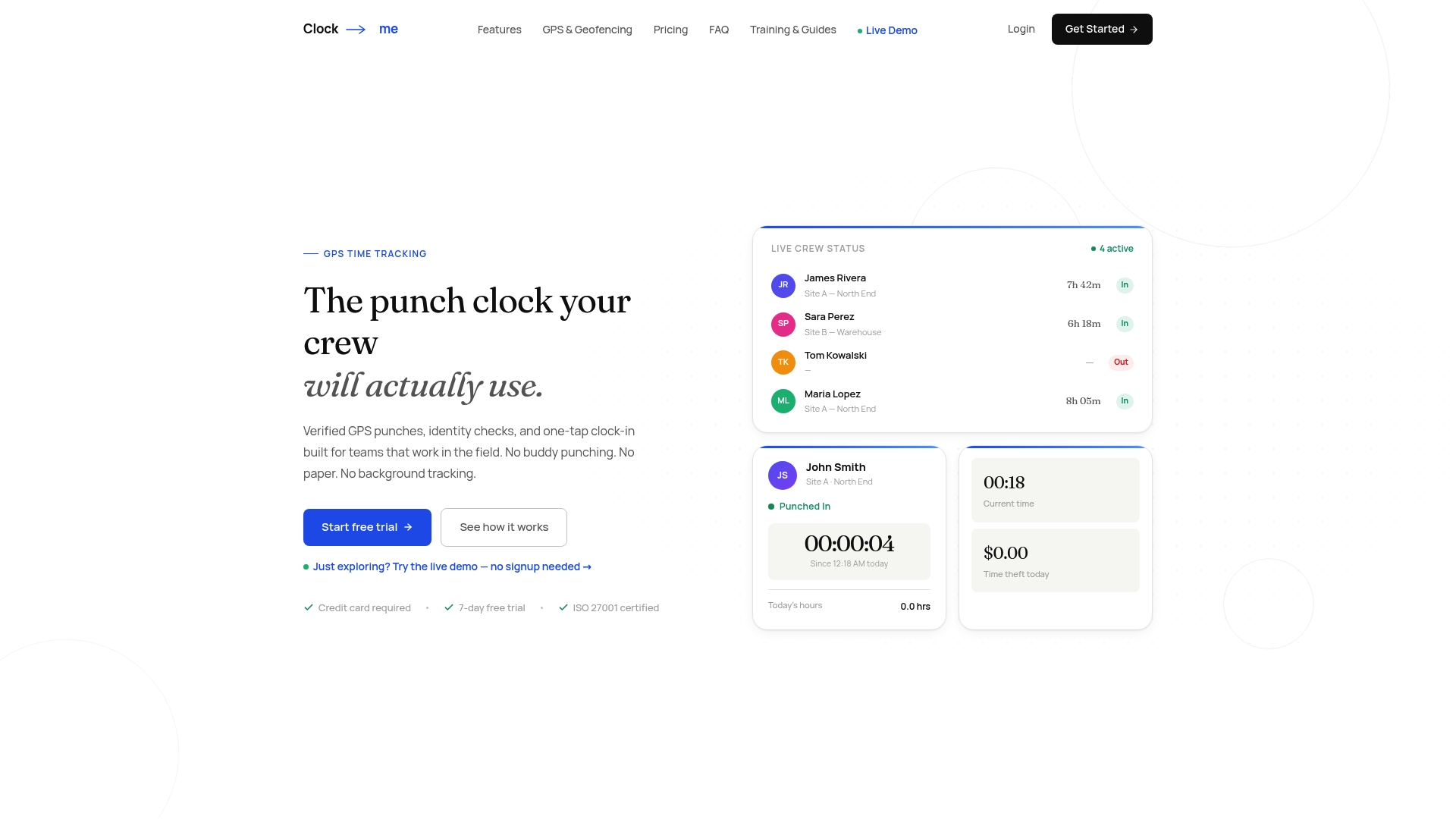
The platform's identity verification blocks buddy punching, while live dashboards let managers see travel and work hours as they happen instead of waiting for a timesheet to land at the end of the week. Payroll export then carries that verified travel data straight into your pay run, so overtime calculated on travel‑heavy days doesn't require a manual recheck. Plans start with a free tier for small teams, scaling up through Starter, Growth, and Business as your field workforce grows. If you're ready to see how it fits your current travel‑pay process, the setup guide walks you through getting a team clocking in within minutes.
Where to Read the Primary Sources
- Labor Code §2802 — full statutory text on expense reimbursement.
- DLSE Wages Guidance — the state's interpretation of "hours worked."
- DLSE Opinion Letter, February 21, 2002 — out‑of‑town travel ruling.
- DIR prevailing wage travel and subsistence provisions — structured travel pay examples.
Sources
- California Legislative Information — Labor Code §2802
- Division of Labor Standards Enforcement — Wages guidance (DLSE)
- DLSE Opinion — Whether Time Spent Traveling on an Out‑of‑Town Business Trip Constitutes 'Hours Worked'
FAQ
Do You Get Paid Out for Vacation Time in California?
Yes. California treats earned vacation as wages, and the DLSE's FAQ on vacation pay confirms accrued, unused vacation must be paid out at termination under Labor Code Section 227.3. This is a separate rule from travel time pay, though both fall under the same wage‑protection framework.
What Is the 7-Minute Rule in California?
Rounding practices for timeclock punches may apply, such as rounding to the nearest quarter hour, as long as the rounding doesn't consistently shortchange employees over time. It has no direct bearing on travel time calculations, which are measured in actual minutes against an employee's normal commute baseline.
Should I Get Paid for Travel Time for Training?
Yes, when the training is employer‑required and out‑of‑town, that travel counts as hours worked according to a DLSE opinion letter addressing this exact scenario. This holds even if the travel happens outside your normal work schedule or on a weekend.
Do Hourly Employees Get Paid for Travel?
Hourly employees must be paid for travel time whenever that travel is under employer control, such as a mandatory meet‑up point, a same‑day reassignment to a different site, or required out‑of‑town trips. The compensable amount is the travel time to the site minus the employee's normal commute, paid at least at minimum wage or their regular rate, with overtime rules applying if the added hours push them over daily or weekly thresholds.
How Can Employers Track Travel Time Accurately?
The most reliable method combines a written policy defining "normal commute" and "temporary site" with a time‑tracking system that timestamps and geolocates clock‑ins. Tools like Clock‑Me automate that documentation through GPS‑verified punches and geofencing, reducing the manual timesheet errors that tend to surface during a DLSE audit.