
California requires employers to record daily start and end times, meal periods, split shifts, and total hours worked, then keep those records for at least three years. Employers must also provide meal and rest breaks and pay a one-hour premium when a break is missed. Electronic timekeeping systems are permitted, as long as they produce records that are accurate, accessible, and ready to hand over on request.
TL;DR:
- Employers must maintain accurate daily timestamps, including clock-in, clock-out, and break records, for at least three years, whether on paper or digital.
- Missed meal or rest periods incur one hour of premium pay per violation, with courts noting scheduling pressure can create liability even if breaks are technically scheduled.
- Overtime rules apply daily and weekly, with time-and-a-half after eight hours per day or forty hours per week, and double time after twelve hours in a day.
- Off-the-clock work is compensable if employers knew or should have known work continued after clock-out, and time rounding practices must be neutral and audited regularly.
- Digital systems are compliant if records remain accurate and accessible, requiring timestamps, attestations, and audit trails, especially for remote and GPS-verified clock-ins.
Table of Contents
- Recordkeeping requirements and what to store
- Meal and rest period rules, waivers, and penalty pay
- Overtime, daily and weekly hours, and alternative workweeks
- Off-the-clock work, rounding, and accuracy rules
- Wage statements, employee access to records, and response timelines
- Using electronic systems, including GPS-verified clock-ins, to meet legal obligations
- Inspections, penalties, and remedial steps after a violation
- Practical compliance checklist and sample policy items
- Timekeeping requirements for telecommuting and remote work
- Compliance with California's supplemental paid sick leave time tracking
- Impact of changes in work schedules and timekeeping adjustments
- Making the rules operational
- How Clock-Me helps employers document time and breaks
- Sources
- FAQ
Recordkeeping requirements and what to store
Labor Code §1174 sets the baseline: employers must log daily start and end times, meal periods, split shift intervals, and total daily hours for every non-exempt employee. Those records need to stay on file for at least three years, either at the worksite or at a central location inside California.
Personnel files should include names, home addresses, occupations, and the ages of minor employees. Records must be kept in a legible, indelible format, whether that is paper or a digital export that can be printed or reviewed on demand.
For payroll exports, build a habit around these fields:
- Employee name, ID number, and job classification.
- Daily clock-in, clock-out, and break timestamps.
- Total regular, overtime, and double-time hours per pay period.
- Version and export date, so audit trails show exactly what changed and when.
Willful failure to maintain these records, or to allow inspection of them, can carry civil penalties under Labor Code §1174.5. Treat recordkeeping as a daily habit, not a task you clean up before an audit.
Meal and rest period rules, waivers, and penalty pay
California's meal and rest rules are specific, and small scheduling mistakes turn into real financial exposure. Under Labor Code §512 and related IWC orders, employees working more than five hours get an unpaid, 30-minute meal period. Shifts past ten hours require a second meal period, though employees can waive it under specific conditions.
- Meal periods must fully relieve the employee of duty; being on call at a desk still counts as work.
- Rest periods run 10 minutes for every four hours worked, or major fraction, per DLSE guidance.
- On-duty meal periods are paid and allowed only when the job genuinely prevents relief and both sides sign a written agreement.
Missed meal or rest periods trigger one additional hour of pay for each violation under Labor Code §226.7, and DLSE guidance confirms claims for that premium pay carry a three-year statute of limitations. Courts, including the California Supreme Court in Brinker, have made clear that scheduling pressure that discourages breaks can create liability even when a break was technically offered.
Overtime, daily and weekly hours, and alternative workweeks
California overtime rules run on both a daily and weekly clock, which trips up employers used to federal-only standards. Non-exempt employees earn time-and-a-half after eight hours in a workday or 40 in a workweek, and double time kicks in after 12 hours in a single day.
- Daily overtime: 1.5 times the regular rate past 8 hours, up to 12.
- Daily double time: 2 times the regular rate past 12 hours.
- Weekly overtime: 1.5 times the regular rate past 40 hours, regardless of daily totals.
- Seventh consecutive workday: overtime applies to the first 8 hours, double time after that.
Employers who want an alternative workweek schedule, such as four 10-hour days, need a secret-ballot election where two-thirds of affected employees approve it. Once adopted, those schedules still need daily records showing actual hours worked, not just the planned schedule. Premium pay for missed breaks is calculated separately from overtime and does not count toward the regular rate for overtime purposes.
Off-the-clock work, rounding, and accuracy rules
Liability for off-the-clock work does not require proof that a manager ordered it. If an employer knew or should have known that employees kept working after clocking out, the hours are compensable, a principle courts have reinforced in cases following Brinker. Rounding time entries is allowed only when the practice is neutral on its face and, over time, does not systematically shortchange employees.
- Audit time punches periodically to check for rounding patterns that favor the employer.
- Put a written policy in place that explicitly forbids off-the-clock work.
- Train managers to recognize and stop informal extra work before or after shifts.
- Give employees a clear channel to report unpaid time without fear of retaliation.
Pro Tip: Run a quarterly rounding audit comparing raw punches to paid hours. If the rounded total consistently favors the company, drop the rounding and pay actual time.
Wage statements, employee access to records, and response timelines
Labor Code §226 spells out exactly what belongs on every pay stub, and getting it wrong is one of the more common compliance gaps HR teams discover too late.
- Gross wages earned and total hours worked for the pay period.
- All deductions, itemized by category.
- Net wages, pay period dates, and the applicable hourly rates.
- Employee name and the last four digits of their Social Security number or an employee ID.
- Legal name and address of the employing entity.
Employees have a right to inspect or copy their payroll records, and employers who fail to comply within the required window face penalties and potential civil action under §226. When preparing exports, redact other employees' personal data before sharing anything, and keep a log of who requested records and when you responded.
Using electronic systems, including GPS-verified clock-ins, to meet legal obligations
Digital timekeeping satisfies California law as long as the records stay accurate and accessible. DLSE opinion guidance notes that computerized payroll records are acceptable, but employers may need a local copy or contingency plan so records remain available even if a system goes down.
- Capture clock-ins, clock-outs, and meal or rest entries with timestamps tied to each event.
- Require timecard attestation or manager approval before a pay period closes.
- Keep an audit trail that shows every edit, who made it, and why.
- Limit GPS capture to the moment of punching in or out, not continuous tracking.
Pro Tip: Publish a short employee notice explaining what location data you collect and how long you keep it. It heads off privacy complaints before they start.
Clock-Me's feature set reflects this approach, pairing GPS-verified punches with attestation steps and exportable logs, and its data safety summary lays out how location data is handled.
Inspections, penalties, and remedial steps after a violation
When the Division of Labor Standards Enforcement opens an investigation, it typically requests time records, wage statements, and written policies covering meal and rest periods. Gaps in any of those documents tend to draw the most scrutiny.
- Recordkeeping failures can trigger penalties under Labor Code §1174.5.
- Wage statement violations carry their own penalty structure under §226.
- Missed meal or rest periods add up quickly at one hour of premium pay each.
If you find a gap, run a payroll audit covering the affected period, issue corrective pay immediately, and update the written policy so the same issue does not repeat. Document manager coaching sessions and keep them on file. That paper trail becomes your defense if a claim moves forward.
Practical compliance checklist and sample policy items
A short daily and weekly routine catches most problems before they become claims.
- Confirm every non-exempt employee clocked in, out, and for both breaks each shift.
- Review flagged missed breaks or unusual punches before payroll runs.
- Export and store timecards with version labels for the pay period.
- Spot-check manager edits weekly to confirm each one has a documented reason.
Your written policy should prohibit off-the-clock work, explain how meal and rest periods are scheduled and recorded, define any rounding rule in plain language, and set out consequences for repeated violations. Train managers on these points at onboarding and again once a year.
Pro Tip: Keep every policy version and the date employees acknowledged it. If a dispute surfaces two years later, you want to know exactly what rule was in effect.
Timekeeping requirements for telecommuting and remote work
Remote employees are covered by the same daily recordkeeping rules as anyone clocking in at an office or job site. The challenge is capturing accurate start times, end times, and break periods when there is no physical clock or supervisor watching the floor.
Employers should require remote and hybrid staff to log in and out through a system that timestamps each event, rather than relying on self-reported hours at the end of the week. Meal and rest period rules apply exactly the same way: a remote employee must be fully relieved of duty during an unpaid meal period, which means no monitoring software checking activity, no expectation of responding to messages, and no calls during that window.
Off-the-clock exposure is often higher with remote work, since employees may answer emails after logging out without anyone noticing until a dispute arises. A written remote work policy should state expected working hours, how to log time accurately, and how to report any work performed outside scheduled hours. Managers should review remote timecards with the same attention given to in-office staff, since the recordkeeping and premium-pay obligations under Labor Code §1174 and §226.7 do not change based on where the work happens.

Compliance with California's supplemental paid sick leave time tracking
California's supplemental paid sick leave rules require employers to track accrued and used sick leave separately from regular hours worked, and that tracking has to show up somewhere an employee or investigator can review it. Wage statements or a separate written notice must show the amount of paid sick leave available, updated each pay period the employee uses it.
Timekeeping systems need to distinguish sick leave hours from regular hours, overtime, and other leave categories so payroll calculations stay accurate. When an employee reports sick, that entry should carry its own code in the timekeeping system rather than getting folded into a generic absence category, since misclassifying leave can create wage statement violations under Labor Code §226.
Retention rules apply here too: sick leave accrual and usage records should be kept for the same period as other payroll records, giving HR a full history if a dispute over available balance ever comes up. Employers running multiple locations or a mix of full-time and part-time staff benefit from a system that calculates accrual automatically, since manual tracking across different accrual rates is where most errors creep in.
Impact of changes in work schedules and timekeeping adjustments
Schedule changes, whether a shift swap, a temporary move to a four-day week, or a sudden switch to remote work, do not suspend any of the timekeeping obligations already covered. Every schedule variation still needs daily records showing actual hours worked, not the hours that were planned.
When a schedule changes, update timekeeping configurations before the new schedule takes effect, not after. A common gap shows up when an employer adopts an alternative workweek schedule but forgets to adjust overtime calculations, since daily overtime thresholds still apply on the new schedule unless it was adopted through the proper secret-ballot process described earlier. Split shifts, where an employee works two separate periods in a day with an unpaid gap in between, can trigger split shift premium pay if the combined pay for the day does not exceed minimum wage plus one additional hour.

Reporting time pay is another area that shifts with scheduling changes. If an employee shows up for a scheduled shift and is sent home early or not put to work at all, California generally requires paying for at least half the scheduled shift, with a minimum of two hours and a maximum of four. Any time a manager changes a published schedule with short notice, HR should confirm the timekeeping system reflects the actual shift worked, not the originally posted one, so reporting time pay calculations stay accurate.
Making the rules operational
Legal requirements only reduce risk when they turn into habits. A short weekly checkpoint, where a manager reviews flagged punches and missed breaks before payroll runs, catches more problems than any policy document sitting in a drawer. Consistent enforcement matters more than a perfectly worded policy: employees notice when rules apply to some shifts and not others, and inconsistency is what turns a minor gap into a claim.
Technology can support this, but only when it is configured around the actual legal requirements rather than dropped in as a generic app.
— Clock-me
How Clock-Me helps employers document time and breaks
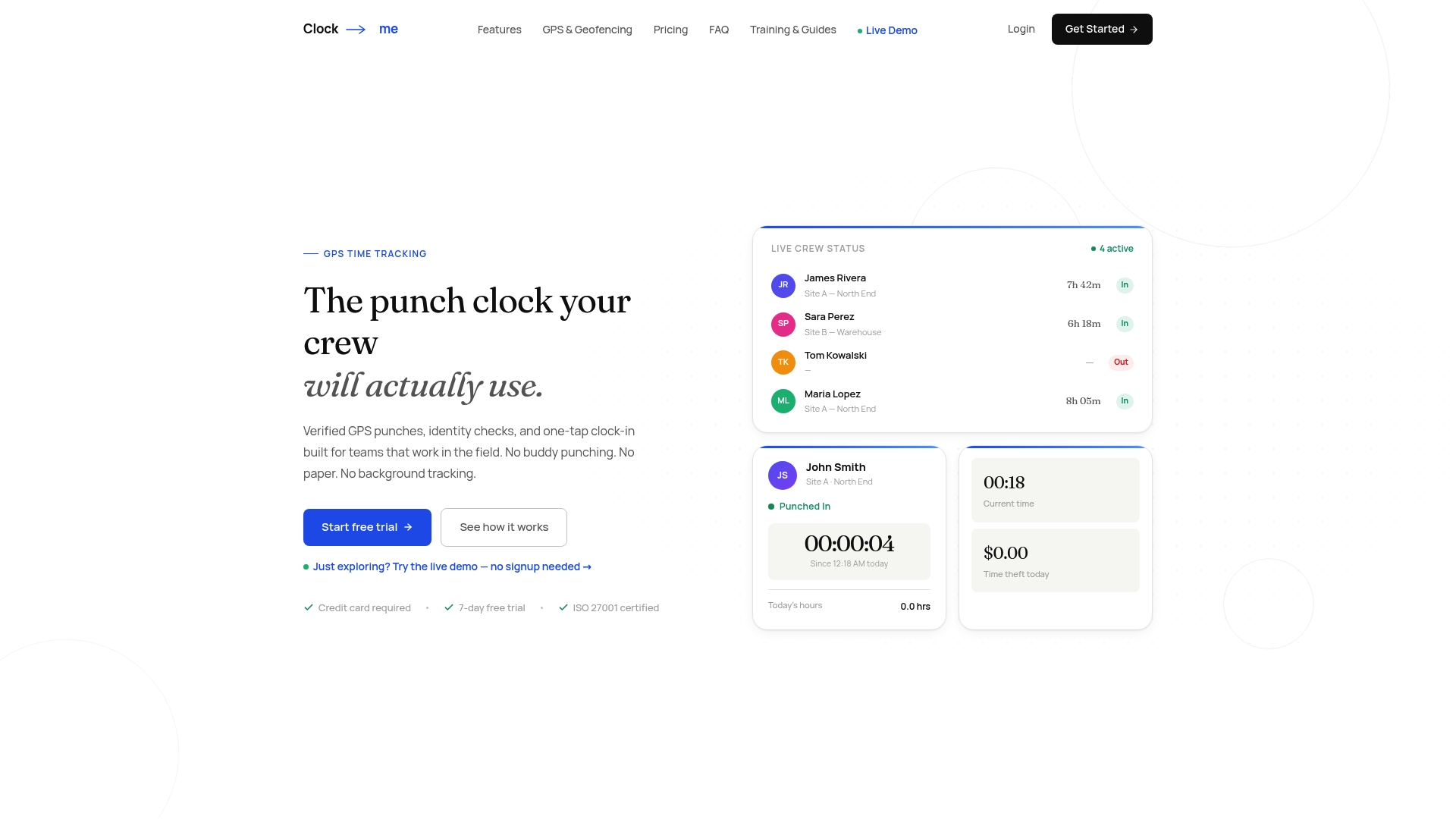
Building the checklist above by hand works, but it takes ongoing discipline across every shift and every manager. Some workforce management platforms provide auditable records in line with this article: GPS-verified punches confirm clock-in locations, timecard attestation adds a sign-off step before payroll runs, and geofencing supports confirmation that staff are on-site when they clock in. Payroll exports can include detailed audit trails showing edits and approvals.
- GPS-verified clock-ins tied to specific locations.
- Timecard attestation before each pay period closes.
- Geofencing to confirm on-site punches.
- Payroll-ready exports with edit history included.
Review the Clock-Me solutions page to compare plans, from the Free tier through Enterprise, and see which fits your team's size.
Sources
FAQ
Does the 7 minute rule apply in California?
California allows rounding of time entries only when the practice is neutral and does not systematically shortchange employees over time. A rounding approach that rounds to the nearest 5 minutes can be lawful if it evens out, but employers should audit results regularly rather than assume any fixed rule is automatically safe.
Is it against the law to work off the clock in California?
Yes. Employers are liable for off-the-clock work whenever they knew or should have known it was happening, even without a direct order to work unpaid, a principle reinforced in cases following Brinker. A written policy prohibiting off-the-clock work helps, but it only protects the employer if managers actively enforce it.
What is the 7 minute rule for timekeeping?
It refers to a common rounding practice where time is rounded to the nearest set increment. In California, any such rounding method is lawful only if it is neutral in practice and does not consistently reduce paid hours.
Is the 32-hour workweek legal in California?
There is no state law setting a required workweek length, so a standard schedule shorter than full time is legal. Overtime rules still apply based on daily and weekly thresholds, meaning hours worked beyond 8 in a day or 40 in a week still trigger overtime pay regardless of the total planned workweek.