

Rounding employee time can be lawful under federal rules, but California law strictly limits how you use it. Meal-period punches cannot be rounded at all, and any rounding policy you keep must be provably neutral over time, citing 29 C.F.R. § 785.48. Your first move: audit your exact timestamps now and stop rounding meal punches immediately if your system currently does.
TL;DR:
- Rounding shift hours is permissible only if it is proven to be neutral over time, with actual payroll data confirming no systematic underpayment or overpayment.
- Meal-period punches cannot be rounded under California law, and even minor discrepancies can lead to premium pay requirements when documented.
- Employers must audit and retain precise timestamp data regularly to demonstrate neutrality and quickly address any undercompensation issues.
- Courts increasingly scrutinize rounding policies when underlying records show that actual time is captured; a neutral policy is no longer enough if the data reveals net losses.
- Moving to exact timestamp recording, such as GPS-verified clock-ins, reduces legal risks significantly compared to relying on rounded time deltas.
Table of Contents
- Legal framework: federal rounding standard and California precedent
- How rounding increments work in practice
- Meal and rest break exception: why meal punches can't be rounded
- Recent appellate developments raising rounding risk
- Employer compliance checklist for rounding policies
- Worked examples: how small rounding gaps add up
- What to do if you face a claim or DLSE inquiry
- Why exact timestamps beat rounding as a risk strategy
- How Clock-Me supports compliant timekeeping
- Sources
- FAQ
Legal framework: federal rounding standard and California precedent
Federal wage law has permitted time rounding for decades. Under 29 C.F.R. § 785.48, employers may round employee clock-ins and clock-outs to the nearest five minutes, one-tenth of an hour, or quarter hour as long as the practice does not, over time, fail to compensate employees for all the time they actually worked. The regulation does not ask whether a single punch rounds in the employee's favor. It asks whether the pattern, averaged across many punches, comes out neutral.
California's Division of Labor Standards Enforcement adopted this federal standard as its own enforcement baseline. The DLSE treats a rounding system as permissible only when it neither systematically favors the employer nor shortchanges workers, and it expects employers to be able to demonstrate that neutrality with real payroll data rather than a policy statement alone.
California's appellate courts sharpened this further. In See's Candy Shops, Inc. v. Superior Court, the Court of Appeal formally adopted the federal neutrality-over-time standard for California, upholding a rounding policy because the employer's own records showed a net surplus of paid time across the workforce. That decision became the template most California employers still cite when defending a rounding policy.

Then came Troester v. Starbucks Corporation, where the California Supreme Court rejected the federal "de minimis" doctrine for unpaid off-the-clock minutes. Under federal law, a few unpaid minutes here and there can sometimes be excused as too trivial to matter. California does not recognize that excuse. If an employee is made to work uncompensated minutes on a regular basis, the aggregate matters, even when each individual instance looks small.
Together, these rulings set the modern test:
- Rounding must be neutral on its face and neutral in practice, not just in policy language.
- Employers carry the burden of proving neutrality with actual data, not assumptions.
- California rejects the federal de minimis defense, so small recurring losses of paid time add up to real liability.
How rounding increments work in practice
Most California rounding policies use one of three increments, each with its own cutoff point:
- Five-minute rounding: a clock-in or clock-out rounds to the nearest five-minute mark, with the midpoint (2.5 minutes) as the cutoff. A punch at 8:02 rounds down to 8:00; a punch at 8:03 rounds up to 8:05.
- Tenth-of-an-hour (six-minute) rounding: time rounds to the nearest six-minute increment, with a three-minute cutoff. A punch at 8:02 rounds down to 8:00; a punch at 8:04 rounds up to 8:06.
- Quarter-hour (15-minute) rounding: the largest increment DOL Fact Sheet #53 recognizes, with a seven-minute cutoff. A punch at 8:06 rounds down to 8:00; a punch at 8:08 rounds up to 8:15.
The math works cleanly on paper, but the federal fact sheet itself warns that daily rounding can quietly generate overtime once you total a full workweek. An employee who is rounded down two minutes at clock-in and up five minutes at clock-out most days is not experiencing a wash. The employer needs to run the actual weekly totals, not just check that the rounding rule matches the regulation.
Common implementation errors include applying different increments to clock-ins versus clock-outs without testing the combined effect, rounding meal or rest break punches the same way as shift punches, and setting the rounding increment above 15 minutes, which no court or agency guidance supports.

Meal and rest break exception: why meal punches can't be rounded
The clearest line in California rounding law comes from Donohue v. AMN Services, LLC, decided by the California Supreme Court. The court held that rounding meal-period time punches is fundamentally incompatible with the state's meal-period protections under Labor Code section 512 and the wage orders. A 30-minute meal period is a specific, mandatory block of unpaid time. Rounding that shortens it, even by a few minutes, can turn a legally compliant break into a violation that triggers premium pay.
The ruling also established an important evidentiary tool: when time records show a meal period that started late, ended early, or ran short, California law now presumes a violation occurred. That presumption shifts weight onto the employer, who must rebut it with evidence that the employee was actually provided a full, uninterrupted 30-minute break, and that no one discouraged or interrupted it.
The practical consequences reshape how HR teams need to handle meal punches:
- Meal-period timestamps must be recorded and paid exactly as punched, with no rounding applied.
- A shortened or late meal period revealed by exact records creates a rebuttable presumption of violation, not just a flag for review.
- Any confirmed noncompliant meal period triggers one additional hour of premium pay for that workday.
Unlike shift-time rounding, where a small loss on one punch might be offset by a gain elsewhere, a shortened meal period has no such offset. The premium-pay remedy exists precisely because the harm to the employee, losing part of a legally required break, cannot be averaged away.
Recent appellate developments raising rounding risk
Rounding's legal ground kept shifting after Donohue. In Camp v. Home Depot U.S.A., Inc., the California Court of Appeal allowed a wage claim to proceed even though the employer had a facially neutral rounding policy, because the employer's own time records already captured the exact minutes worked. The court's reasoning cuts against the traditional rounding defense: if a company's system already knows the precise clock-in and clock-out times, rounding stops looking like an administrative convenience and starts looking like an unnecessary source of underpayment.
That shift matters for any employer using modern timekeeping software. Courts are increasingly skeptical of rounding policies when the underlying technology could just pay employees for the minutes actually recorded. The neutral-rounding defense from See's Candy still exists, but it now carries a heavier evidentiary burden: employers need statistical payroll analysis showing the rounding nets out over a representative period, not just a policy that reads well.
A few patterns should raise immediate concern during an internal review:
- The system captures exact timestamps but still applies rounding on top of them, creating a paper trail that shows precisely how much time was shaved off.
- An aggregate audit across pay periods reveals a net loss of compensated minutes for employees rather than a wash.
- Rounding is applied inconsistently across departments, shifts, or locations, undermining the claim that the policy is neutral.
Any of these signals should trigger a closer look before a complaint or lawsuit forces one.
Employer compliance checklist for rounding policies
A defensible rounding policy, or a decision to eliminate rounding altogether, comes down to documentation and testing. Use this sequence:
- Write the policy in plain terms. State the exact increment used (five minutes, six minutes, or 15 minutes), the rounding algorithm applied, and an explicit statement that meal-period punches are never rounded.
- Separate meal-period rules from shift rounding. Spell out how off-the-clock time is recorded and when a short or late meal period triggers premium pay.
- Retain raw data, not just summaries. Keep original timestamps, payroll exports, and any system change logs going back at least the length of California's wage claim statute of limitations, generally several years, since a rounding defense is only as good as the underlying records.
- Run a statistical audit on a representative sample. Pull a meaningful sample of pay periods across departments and shifts, then calculate whether the aggregate effect of rounding favors the employer, the employee, or nets out close to neutral.
- Correct undercompensation immediately when found. If an audit shows employees lost paid minutes on net, issue back pay for the shortfall rather than waiting for a claim.
- Train managers on grace-period boundaries. If you allow employees to clock in early or stay a few minutes late without pay, managers need to actively enforce that no work happens during that unpaid window.
- Give employees written notice of the policy. A rounding policy that employees have never seen is harder to defend as an established, neutral practice.
Pro Tip: Run your rounding audit the same way you'd run a payroll error check, quarterly, on real numbers, not once a year on assumptions.
Worked examples: how small rounding gaps add up
- Daily variance creating overtime: an employee clocked in at 7:56 rounds to 8:00 (a four-minute loss) and clocks out at 4:04 rounding to 4:00 (another loss) five days a week. That is roughly 40 minutes of unpaid work weekly, which can push total hours worked over 40 and create unpaid overtime liability under Fact Sheet #53's own overtime example logic.
- Meal punch rounding: an employee's actual meal period ran 29 minutes but the system rounded it to a full 30. Under Donohue, that rounded record still triggers a presumption of a short break and one hour of premium pay once the true timestamp surfaces.
- Audit interpretation: if a sample of 200 shifts shows employees lost an aggregate net amount of paid time rather than breaking even, that pattern signals the policy is not neutral and needs remediation before it becomes a claim.
What to do if you face a claim or DLSE inquiry
Move fast and document everything.
- Preserve all raw timekeeping and payroll logs immediately, including system backups; do not let routine data purges run.
- Run an internal sample audit covering the same period at issue in the complaint, using real timestamps rather than rounded totals.
- Gather every version of your written time and attendance policy along with proof employees received it.
- Calculate and issue any corrective pay owed, and keep a record of that correction along with any retraining given to managers.
- Bring in employment counsel early, and present your audit as evidence of neutral, consistent application across a representative sample rather than a single favorable pay period.
Why exact timestamps beat rounding as a risk strategy
Once a system can capture the exact minute someone clocks in, rounding stops paying for itself. The administrative convenience it once offered is small next to the litigation exposure Camp and Donohue have opened up. Verified timestamps, geofenced clock-ins, and clean audit logs give you a factual record that neutralizes most rounding disputes before they start.
— Clock-me
How Clock-Me supports compliant timekeeping
Clock-Me was built for teams that need exact records, not estimates. Because every clock-in is GPS-verified and identity-checked, you get precise, tamper-resistant timestamps instead of a rounding algorithm you have to keep auditing.
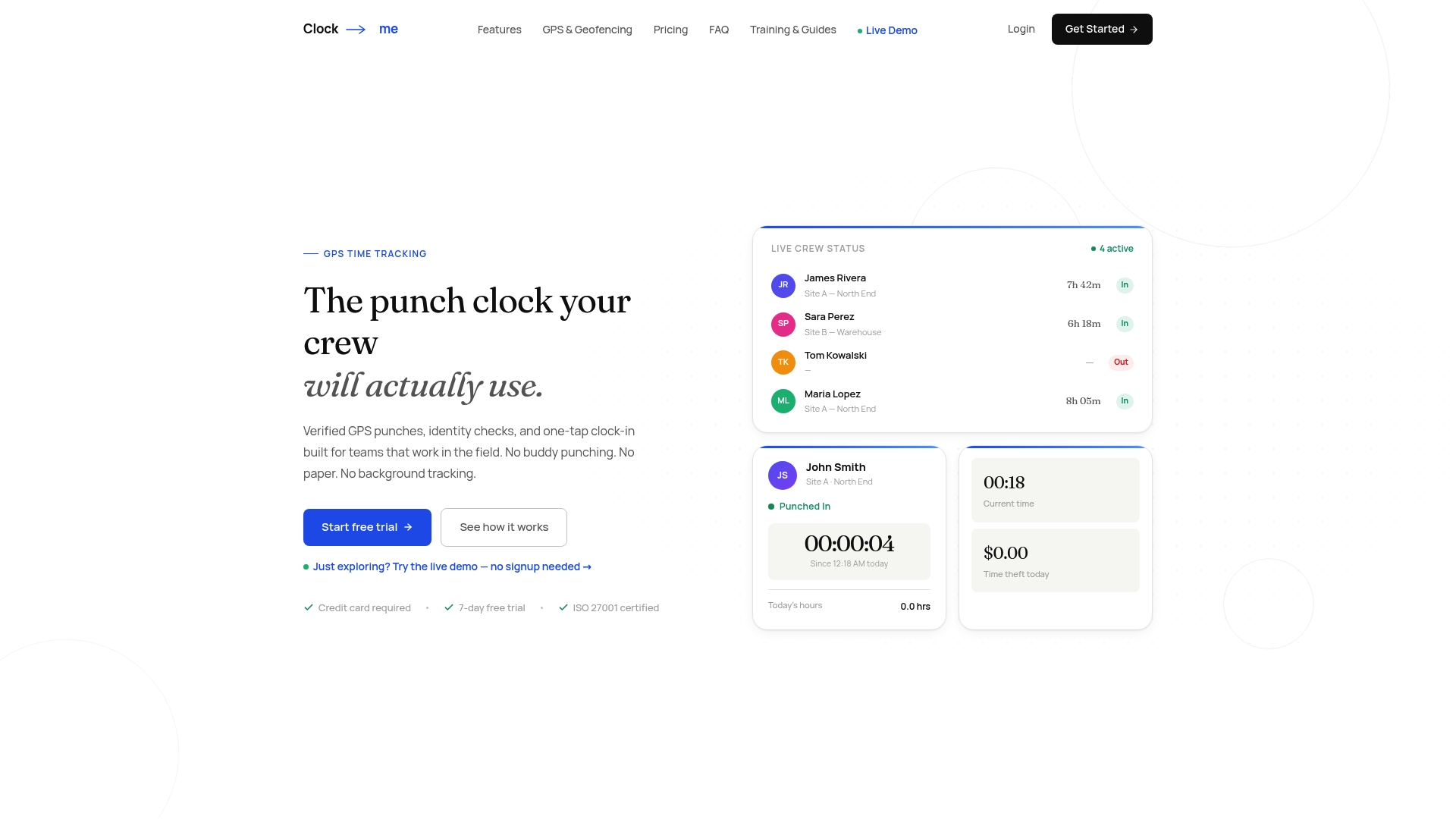
- Clock-ins capture the real minute an employee starts and ends a shift, removing the guesswork rounding introduces.
- Timestamp exports provide payroll and legal teams with a clean, exact record for statistical audits.
- Meal-break flags help catch a short or late meal period before it becomes a Donohue presumption problem.
- Payroll export tools turn timekeeping data into audit-ready evidence without extra paperwork.
If your current policy still rounds shift or meal punches, see how exact timestamping works on the Clock-Me solutions page or walk through setup with the get-started guide.
This article is general information, not a substitute for advice from a qualified lawyer. Consult a qualified legal professional about your own circumstances before acting on anything here.
Sources
- Donohue v. AMN Services, LLC (California Supreme Court opinion)
- Fact Sheet #53 — The Health Care Industry and Hours Worked | U.S. Department of Labor
- Camp v. Home Depot U.S.A., Inc. (6th District Court of Appeal opinion)
FAQ
What are the laws regarding timesheets in California?
California requires employers to keep accurate, detailed time records showing hours worked, meal periods, and pay rates, and any rounding applied to those records must be neutral over time under the standard the DLSE enforces. Meal-period punches must reflect the actual start and end times rather than a rounded approximation.
Can a job legally round up your hours?
Yes, an employer can round hours up or down under 29 C.F.R. § 785.48, but only if the practice is neutral over time and does not systematically shortchange employees. California courts, including in See's Candy, require proof of that neutrality rather than just a policy statement.
Does the 7 minute rule apply in California?
The seven-minute cutoff applies specifically to quarter-hour (15-minute) rounding under federal rules adopted by the DLSE: a punch under seven minutes past the quarter hour rounds down, and one at seven minutes or more rounds up. It never applies to meal-period punches, which the California Supreme Court's Donohue decision requires to be recorded exactly.
Can you work 4-10 hour days in California without overtime?
A properly adopted alternative workweek schedule can allow four longer workdays without daily overtime for hours worked up to the maximum allowed by that schedule, but that arrangement depends on separate wage order rules and employee election procedures, not on rounding policy. Any rounding still applied within that schedule must remain neutral and cannot touch meal-period timestamps.