

Under California law, most nonexempt employees earn time-and-a-half after 8 hours in a day or 40 in a week, and double-time after 12 hours in a day. Seventh consecutive day work adds its own trigger: 1.5× for the first 8 hours, 2× after that. These rules come from Labor Code Section 510, and employees are presumed nonexempt unless the employer proves otherwise. The DLSE publishes the official interpretation for edge cases.
TL;DR:
- Daily overtime applies after eight hours and doubles after twelve hours in a single workday, regardless of weekly hours worked.
- Weekly overtime only counts straight-time hours beyond forty, with premium hours paid separately and not included in the weekly threshold.
- Accurate regular rate calculation must include bonuses, commissions, and shift differentials; miscalculations lead to widespread payroll errors.
- Employers must precisely track actual hours worked, as "suffered or permitted" work counts regardless of formal approval, creating a strong need for verified timekeeping.
- Misclassification of workers as independent contractors or failing to record on-call and make-up time can trigger costly wage claims and legal disputes.
Table of Contents
- California Overtime Rules: When Daily, Weekly, and Seventh-Day Triggers Apply
- How to Calculate the Regular Rate of Pay (With Worked Examples)
- Who's Exempt From California Overtime Requirements?
- Alternative Workweeks and Make-Up Time: Changing How Daily Overtime Applies
- Employer Obligations: Recordkeeping, Payment Timing, and the "Suffered or Permitted" Standard
- Common Payroll Mistakes and Employee Remedies for Unpaid Overtime
- Timekeeping Controls That Reduce Overtime Disputes
- California Overtime Rules Specific to Agricultural Workers
- Overtime Rules for Domestic Workers and Live-In Employees
- How Recent Legislative and Court Activity Has Shaped Overtime Law
- California Overtime Rules vs. Federal FLSA Provisions
- Overtime Rules for Independent Contractors vs. Employees
- Is On-Call and Call-Back Time Paid as Overtime?
- A Practical Balance Between Worker Protections and Employer Compliance
- Clock-Me Helps You Document Hours Accurately and Reduce Overtime Disputes
- Where to Verify These California Overtime Rules Yourself
- Sources
- FAQ
California Overtime Rules: When Daily, Weekly, and Seventh-Day Triggers Apply
California's overtime structure runs on three separate clocks, and confusing them is the single most common payroll error we see. Understanding how they stack matters more than memorizing any one number.
Daily overtime. A nonexempt employee who works more than eight hours in a single workday earns one and one-half times their regular rate for each hour past eight, up to twelve. Once hours pass twelve in that same day, the rate jumps to double-time. This applies regardless of the weekly total. Someone who works a single 13-hour shift and nothing else that week still earns daily overtime and double-time for that one day.
Weekly overtime. Separately, any hours worked beyond 40 in a workweek earn 1.5×. Here's the part that trips people up: only straight-time hours count toward that 40-hour threshold. Hours already paid at a premium (the daily overtime hours) don't get counted again toward weekly overtime. The DLSE Enforcement Manual calls this the anti-pyramiding rule, and it exists specifically to prevent an employee from collecting multiple overtime premiums on the same hour of work.
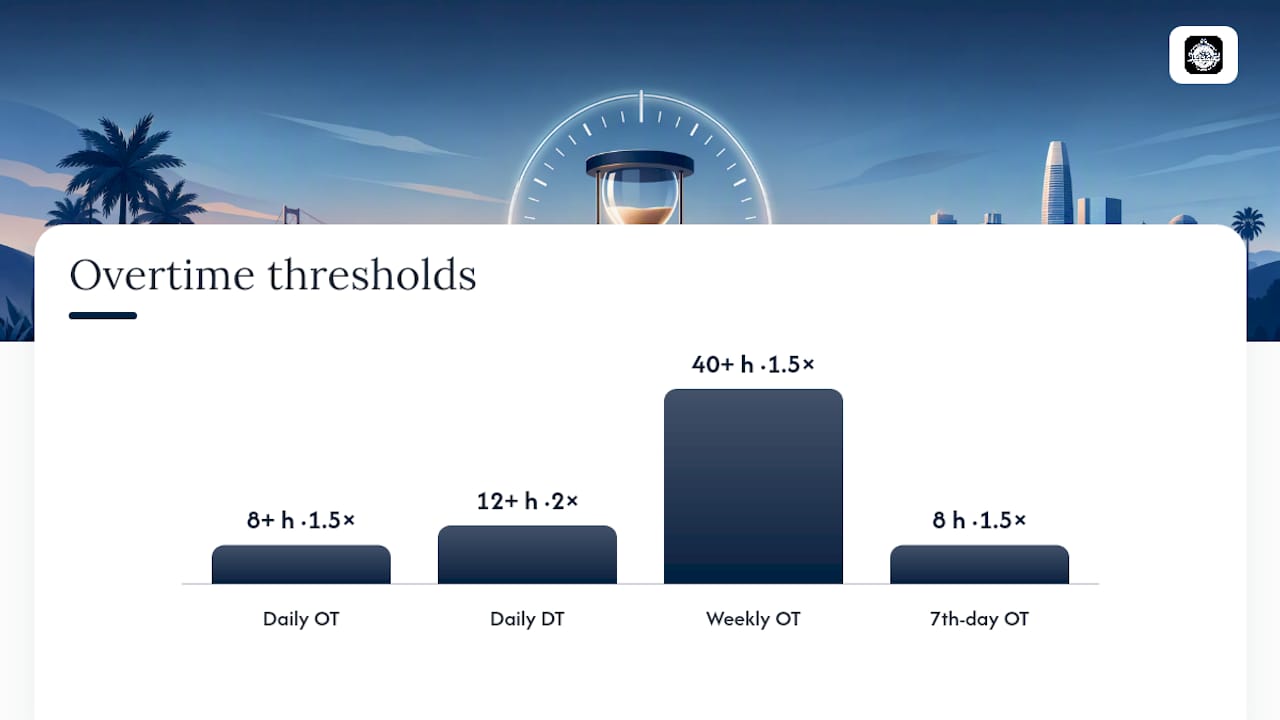
Seventh consecutive day rules. When an employee works all seven days of a single workweek, the first eight hours on that seventh day pay at one and one-half times their regular rate, and anything beyond eight hours on that day pays at double-time. This trigger is about the calendar workweek, not a rolling seven-day count, so the same employee working Sunday through the following Saturday across two different workweeks does not automatically qualify.
A few boundary conditions worth flagging:
- The "workday" is a fixed 24-hour period the employer designates, and it doesn't have to match the calendar day.
- The "workweek" is any fixed, recurring 168-hour period; it doesn't need to start on Sunday or Monday.
- Daily and weekly overtime don't combine into a third premium. An 11-hour day inside a 45-hour week generates daily overtime for hours 9 through 11, and separate weekly overtime only for straight-time hours that push the week past 40.
- Paid time off (vacation, sick leave, holidays) generally does not count as "hours worked" for overtime calculation purposes.
How to Calculate the Regular Rate of Pay (With Worked Examples)
Every overtime and double-time calculation starts with one number: the regular rate of pay. Get this wrong and every downstream calculation is wrong too, even if the hours are tracked perfectly.
The regular rate is not always just the hourly wage. It includes:
- Base hourly pay for hourly employees.
- Salary converted to an hourly equivalent for salaried nonexempt employees.
- Non-discretionary bonuses, spread across the hours they were earned for.
- Commissions and piecework earnings, averaged into an hourly figure.
- Shift differentials and other per-hour premiums.
Statistic Callout: According to DLSE guidance, overtime must be paid at the correct premium whether or not the employer specifically authorized the extra hours. Unauthorized overtime is still owed overtime pay.
Converting a salary to an hourly rate. Take the monthly salary, multiply by 12 to get annual salary, divide by 52 to get weekly salary, then divide by the employee's normal weekly hours (typically 40) to get the hourly regular rate.
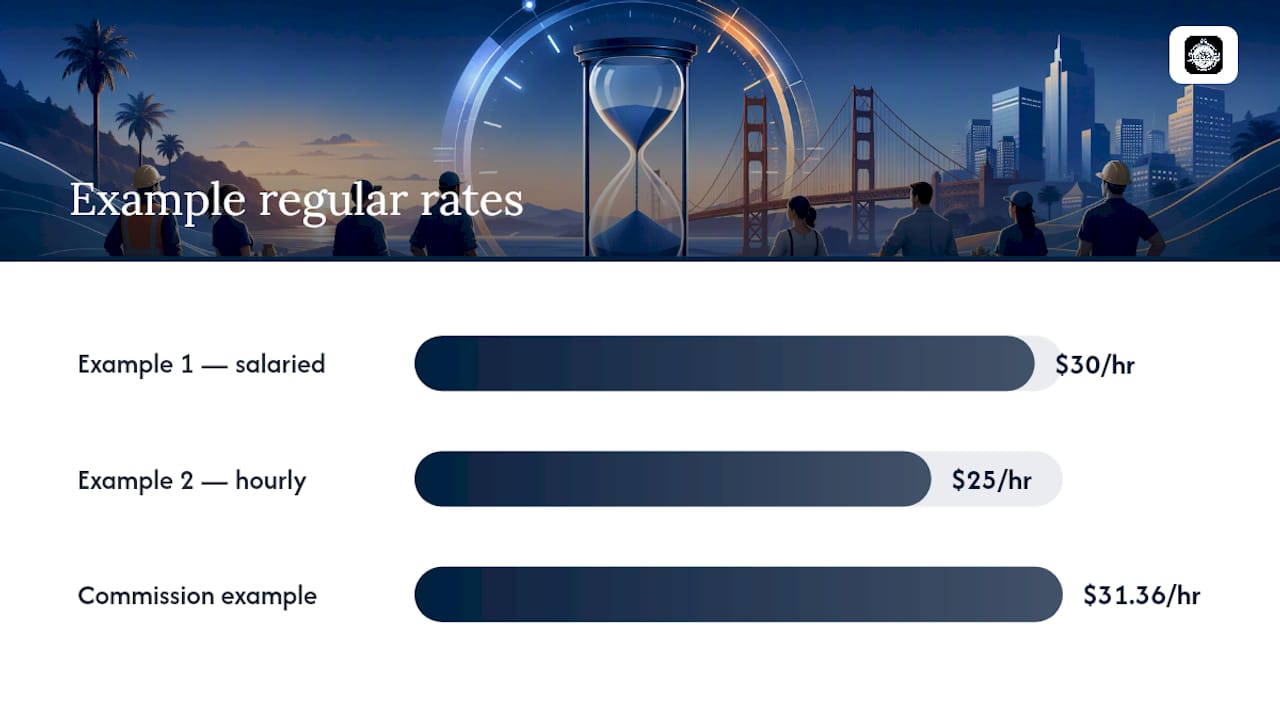
Example 1: A nonexempt employee earns a monthly salary of $5,200. Annualized: $62,400. Weekly: $1,200. Divide by 40 hours: a regular rate of $30/hour. If that employee works 45 hours in a week, they're owed 40 hours at $30 plus 5 hours at $45 (1.5×), for a total of $1,425.
Example 2: An hourly employee earning $25/hour works a 10-hour day. Hours 1 through 8 pay at $25. Hours 9 and 10 pay at $37.50 (1.5×). That single day's pay is $275, before factoring in the rest of the week.
Commission example: A salesperson earns a $500 non-discretionary weekly bonus on top of a $20/hour rate, working 44 hours. Divide the $500 by 44 hours to get an extra $11.36 per hour, raising the regular rate to $31.36. The 4 overtime hours pay at $47.04 each, not $30.
Remember the anti-pyramiding principle from the previous section: daily overtime hours already paid at a premium don't get recounted as straight-time when checking whether the week crossed 40 hours.
Who's Exempt From California Overtime Requirements?
California law presumes every employee is nonexempt and entitled to overtime. The burden falls on the employer to prove an exemption applies, not on the employee to prove they're covered.
The most common exemptions fall under the "white-collar" categories, and each requires meeting a strict duties test plus a minimum salary threshold, not just a job title:
- Executive exemption: primarily manages the business or a department, regularly directs at least two other employees, and has real authority in hiring or firing decisions.
- Administrative exemption: performs office or non-manual work directly related to management policies, and regularly exercises independent judgment on significant matters.
- Professional exemption: covers licensed professionals (attorneys, doctors, certain accountants) and employees in recognized creative or learned professional fields.
- Outside sales exemption: spends the majority of working time away from the employer's place of business selling products or services.
- Union/collective bargaining exceptions: certain overtime provisions can be modified through a valid collective bargaining agreement that meets specific wage and premium conditions.
Industry-specific carve-outs exist too, and they're spelled out in the IWC Wage Orders, which vary by sector. A wage order covering the manufacturing industry differs meaningfully from one covering agriculture or healthcare, so checking the applicable order matters more than relying on general rules.
Pro Tip: Job title means nothing to the DLSE. Misclassification claims are among the most expensive wage-and-hour risks employers face, often stretching back years in back pay.
Alternative Workweeks and Make-Up Time: Changing How Daily Overtime Applies
Employers can adopt an alternative workweek schedule that changes when daily overtime kicks in, but the process is formal and the outcome doesn't touch weekly overtime at all.
Under Labor Code Section 511, employers can propose a schedule like four 10-hour days instead of five 8-hour days. On that schedule, hours 9 and 10 don't trigger daily overtime, since they're part of the regular scheduled shift. Adoption requires:
- A written proposal describing the specific schedule options.
- A secret-ballot election within the affected work unit, approved by at least two-thirds of employees voting.
- Filing the results with the Division of Labor Standards Enforcement within 30 days.
The regular rate calculation doesn't change just because the schedule does. Alternative workweeks shift when overtime starts, not how it's calculated once it does.
Make-up time works differently. An employee who needs personal time off can make up those hours in the same workweek without triggering daily overtime, as long as they submit a written request in advance and don't work more than 11 hours in the make-up day or 40 in the week. Employers cannot encourage or solicit make-up time requests; the request has to originate with the employee.
Employer Obligations: Recordkeeping, Payment Timing, and the "Suffered or Permitted" Standard
California places the compliance burden squarely on employers, and the obligations don't end once overtime is correctly calculated.
- Pay overtime on time. Labor Code Section 204 requires that overtime earned during one payroll period be paid no later than the next regular payday, even if the exact overtime calculation takes extra time to process.
- Keep accurate time records. Applicable wage orders require employers to record actual hours worked, not scheduled hours, and to retain those records for at least three years.
- Post required wage order notices in a location visible to employees, covering the specific industry's applicable rules.
- Understand "suffered or permitted." If an employer knew or should have known an employee was working, whether or not it was authorized, that time counts as hours worked and must be paid, including any resulting overtime.
That last point is where most disputes originate. An employee who answers emails from home after clocking out, or who stays 15 minutes late finishing a task without formal approval, has still worked compensable time if the employer had reason to know about it.
Pro Tip: Silence is not a defense. If a manager never explicitly approved extra hours but also never stopped an employee from working them, courts and the DLSE tend to treat that as "permitted" work. Written policies that require prior approval for overtime only protect an employer if they're actually enforced, not just posted in a handbook.
Common Payroll Mistakes and Employee Remedies for Unpaid Overtime
Even well-intentioned employers make recurring errors, and understanding the enforcement path matters for both sides of the relationship.
The most frequent mistakes include:
- Requiring or allowing off-the-clock work, especially before shifts start or after they officially end.
- Misclassifying employees as exempt based on job title rather than actual duties.
- Improperly converting comp time or "banked hours" instead of paying overtime in cash.
- Miscalculating the regular rate by excluding bonuses or commissions that should have been included.
Employees who believe they've been shorted overtime pay have two main paths: filing a wage claim with the DLSE, which is generally faster and doesn't require an attorney, or filing a civil lawsuit, which allows for broader remedies but takes longer and typically involves legal representation.
Typical remedies include back pay for unpaid overtime, waiting-time penalties (up to 30 days of wages when final pay is late), penalties for inaccurate wage statements, and in civil actions, attorney's fees. The statute of limitations generally runs three years for most wage claims, sometimes longer when tied to a written contract. Given the deadlines involved, employees with a potential claim should contact the DLSE or an employment attorney promptly rather than waiting.
Timekeeping Controls That Reduce Overtime Disputes
The single biggest driver of overtime litigation isn't a disagreement over the rate. It's a disagreement over the hours themselves. When there's no reliable record of when someone actually started or stopped working, both sides are left arguing from memory.
Rigorous timekeeping closes that gap. GPS-verified clock-ins tie a punch to a real location and time, geofencing prevents clock-ins from outside an approved job site, and identity verification stops one employee from clocking in for another. Together, these controls create a documented, timestamped record that directly counters "suffered or permitted" disputes, since the employer can show precisely when work started and stopped rather than relying on a supervisor's recollection.
A practical rollout looks like this:
- Set a written overtime policy requiring advance approval, and actually enforce it rather than letting it sit in a handbook.
- Deploy verified digital clock-ins with geofencing for field or multi-site teams, so location and time are captured automatically.
- Run a monthly audit comparing scheduled hours against actual clocked hours to catch drift early.
- Train supervisors to flag and approve overtime in real time instead of after the fact.
None of this changes the underlying legal obligations. Technology documents compliance; it doesn't substitute for correctly classifying employees or calculating the regular rate. Employers facing a genuine classification question should still consult employment counsel before relying on any tool to settle it.
California Overtime Rules Specific to Agricultural Workers
Agricultural employees used to operate under a separate, less protective overtime schedule, and that gap has been closing in phases rather than all at once.
Historically, agricultural workers were exempt from the standard daily overtime rules entirely, subject only to a weekly threshold under a dedicated wage order. Legislative reform phased in daily overtime for agricultural employees at larger employers first, gradually tightening the daily threshold from a higher starting point down toward the standard 8-hour trigger, with smaller agricultural employers (25 or fewer employees) following on a delayed schedule.
The practical effect is that most agricultural employers, regardless of size, are now expected to operate under, or be transitioning toward, the same 8-hour daily and 40-hour weekly overtime triggers that apply to most other industries, per the applicable wage order covering agricultural occupations. Some narrower exceptions still exist for specific tasks tied to irrigation, livestock, or harvest timing, where the nature of the work makes rigid daily limits impractical.
Agricultural employers should check the current wage order applicable to their specific operation rather than assuming the general industry rules apply, since agricultural classifications can vary by crop type, employer size, and the specific task being performed.
Overtime Rules for Domestic Workers and Live-In Employees
Domestic workers, including nannies, caregivers, and housekeepers, are generally covered by the same daily and weekly overtime triggers as other nonexempt employees, but live-in status changes how hours worked get counted.
A live-in employee who resides in the employer's home is not automatically paid for every hour they're on the property. Only time actually spent performing job duties, or time during which the employee cannot leave and is required to be available, counts as hours worked. Meal breaks, sleep periods, and personal time genuinely free from duties generally don't count toward the daily or weekly overtime threshold, provided the employee actually gets uninterrupted rest.
Personal attendants, a specific category of domestic worker whose duties are primarily supervisory or companionship in nature rather than physical household labor, fall under a different wage order provision with its own overtime threshold, often set at a higher daily hour count before the premium kicks in. This distinction matters because misclassifying a general domestic worker as a "personal attendant" to avoid standard overtime triggers is a common source of disputes in this industry.
Employers of domestic workers still carry the same recordkeeping burden as any other employer. Given the informal nature of many household employment arrangements, written time records become even more important, since there's rarely a formal punch clock system to fall back on if a dispute arises.
How Recent Legislative and Court Activity Has Shaped Overtime Law
California overtime law isn't static, and two forces keep reshaping it: legislative phase-ins targeting specific industries, and court rulings that clarify how existing statutes apply to real payroll disputes.
The agricultural overtime phase-in described earlier is the clearest recent example of legislative change altering the overtime landscape for an entire industry over several years rather than through a single abrupt rule change. Similar incremental approaches have applied to minimum wage increases that indirectly affect the regular rate calculation, since a higher minimum wage raises the baseline every overtime premium is built on.
Court decisions have also refined how the regular rate itself gets calculated, particularly around what counts as a "non-discretionary" bonus that must be folded into the regular rate versus a truly discretionary payment that can be excluded. Litigation has also clarified rounding practices, addressing whether employers can round clock-in and clock-out times to the nearest five or ten minutes, and under what conditions that rounding is neutral enough to survive a legal challenge.
For both employees and employers, the practical takeaway is the same: don't rely on a general understanding of "how overtime works in California" that's more than a year or two old. Check the current text of the Labor Code and the current DLSE guidance before assuming a rule that applied five years ago still applies today, and consider following California legislative tracking if your industry is one that tends to see frequent wage-and-hour updates.
California Overtime Rules vs. Federal FLSA Provisions
California and federal law both regulate overtime, and where they conflict, the employee gets whichever rule is more generous. That's not a loophole; it's the governing principle.
The federal Fair Labor Standards Act sets a weekly overtime threshold only, at 1.5× for hours over 40 in a week, with no daily overtime trigger at all. California layers its daily 8-hour and 12-hour double-time triggers, plus the seventh-day rule, on top of that federal floor. In nearly every practical scenario, California's rules end up more protective, so employers operating in the state comply with California law and, in doing so, automatically satisfy the federal minimum.
The two systems diverge more noticeably on exemption tests. The FLSA's salary threshold for white-collar exemptions is set federally and adjusts periodically, while California sets its own, generally higher, minimum salary requirement tied to the state minimum wage. An employee who qualifies as exempt under the federal salary threshold might still be nonexempt under California's higher bar, meaning the employer still owes California overtime despite technically meeting federal requirements.
Employers operating in multiple states cannot simply apply a single national overtime policy. California employees need the state-specific calculation applied to their actual hours, regardless of what payroll systems built around federal rules default to.
Overtime Rules for Independent Contractors vs. Employees
Overtime rules only apply to employees. Independent contractors are not covered by California's overtime statutes at all, which is exactly why worker classification carries so much financial weight.
California uses the "ABC test" to determine whether a worker is properly classified as an independent contractor. Under this test, a worker is presumed to be an employee unless the hiring business proves all three of the following: the worker is free from the company's control in performing the work, the worker performs tasks outside the company's usual course of business, and the worker is customarily engaged in an independently established trade doing similar work for others.
Fail any one of those three prongs, and the worker is legally an employee, entitled to overtime, meal and rest breaks, and the full range of wage-and-hour protections, regardless of what a signed contract calls them. This is precisely why misclassifying a worker as an independent contractor to sidestep overtime obligations is one of the costliest mistakes an employer can make. Back pay claims in these cases often reach back multiple years and stack overtime premiums, missed break penalties, and wage statement violations into a single, expensive claim.
Some occupations have narrower statutory exceptions to the ABC test (certain licensed professionals, some referral agencies, specific business-to-business relationships), but these exceptions are narrow by design and don't create a general escape hatch. Any business relying on independent contractor status to avoid overtime obligations should confirm the classification holds up under the actual ABC test, not just under the language of the contract.
Is On-Call and Call-Back Time Paid as Overtime?
On-call time counts as hours worked, and therefore factors into overtime, when the restrictions placed on the employee are significant enough that they can't effectively use the time for their own purposes.
Courts look at several factors: how quickly the employee must respond if called, whether they can leave home or run personal errands, whether they can consume alcohol or otherwise limit their own activity, and how often they're actually called in during a typical on-call period. An employee required to stay within a 10 minute response radius of the workplace, carrying a pager and unable to make normal plans, is very likely engaged in compensable on-call time. An employee who simply needs to be reachable by phone and can go about a normal evening is a closer call, and often isn't.
Call-back time, when an off-duty employee gets summoned back to the workplace, is more straightforward: that time is compensable from the moment the employee responds to the call, and it counts toward both daily and weekly overtime thresholds just like any other worked hour. If a call-back pushes someone past 8 hours for the day when combined with their regular shift, the daily overtime premium applies to those additional hours.
Employers with employees on regular on-call rotations should build a written on-call policy that spells out response time requirements and how on-call hours get compensated, since ambiguity here is a common source of wage claims, particularly in industries like healthcare, utilities, and field services where on-call coverage is routine.
A Practical Balance Between Worker Protections and Employer Compliance
California's overtime framework exists because hourly work is where power imbalances between employers and employees show up most directly, and the statute reflects that reality. Clock-me's position is straightforward: accurate records protect employees from being shorted, and they protect employers from disputes rooted in guesswork rather than documentation.
The two goals aren't in tension nearly as often as payroll conversations make it seem. An employer that can produce a precise, timestamped record of exactly when someone clocked in and out isn't just reducing legal exposure. It's giving employees confidence that their pay reflects the hours they actually worked, without relying on a supervisor's memory or a paper timesheet filled in days later.
Where we'd push back on conventional advice: too many compliance guides treat recordkeeping as a defensive afterthought, something you build only once a dispute starts. The stronger approach treats accurate time data as infrastructure from day one, not evidence assembled after the fact.
Clock-Me Helps You Document Hours Accurately and Reduce Overtime Disputes
Getting California overtime rules right depends entirely on having accurate hours to calculate from, and that's exactly where most disputes start: not in the math, but in the record of when work actually happened. Some workforce management solutions replace guesswork and buddy punching with GPS-verified clock-ins, geofencing, and identity verification, so every timestamp reflects where and when an employee actually worked.
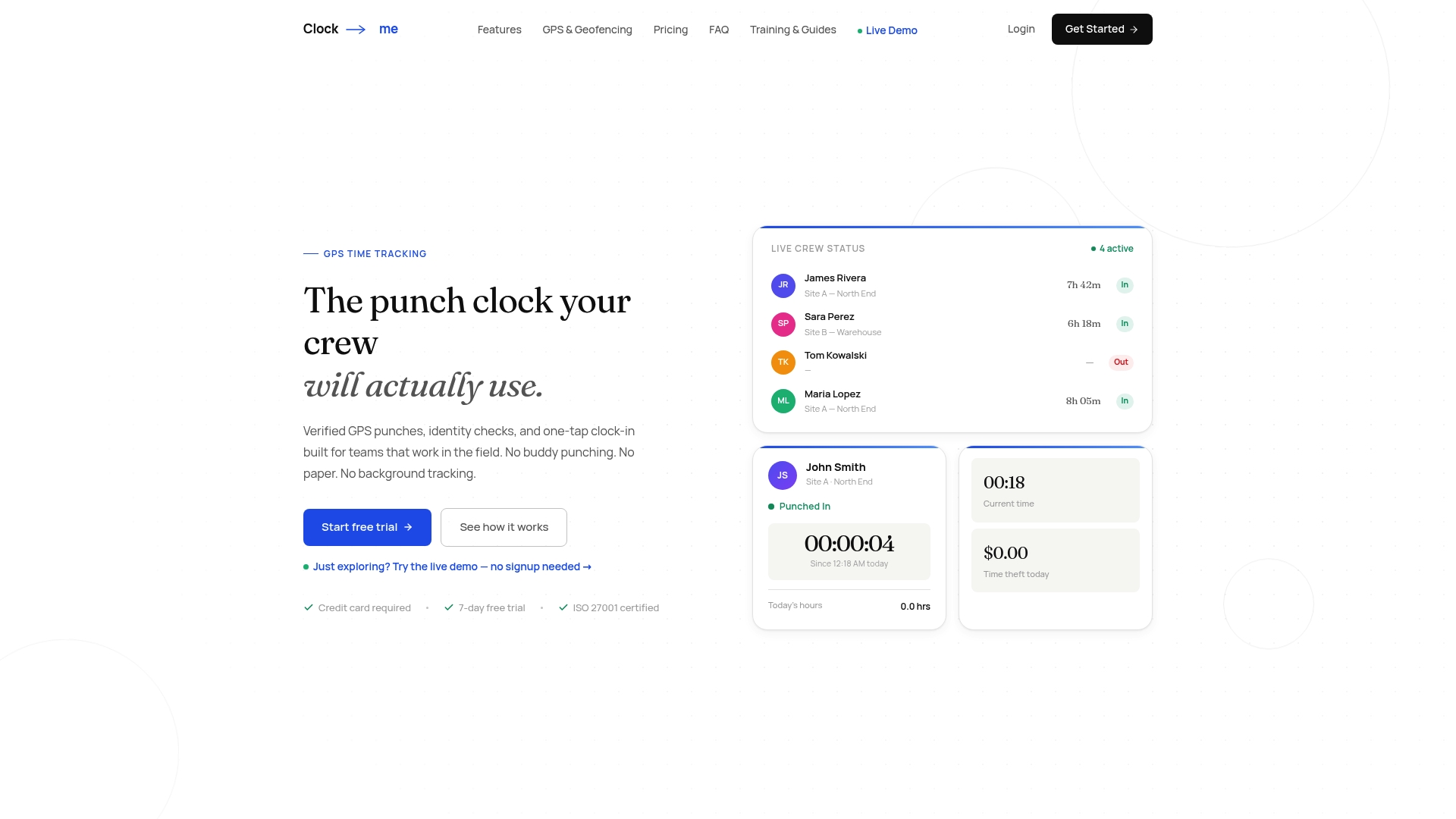
For managers juggling field teams across multiple job sites, that means fewer arguments about whether an employee was on the clock and a clean, exportable record when payroll runs. Clock-me's timekeeping features include timecard attestation and live dashboards, giving supervisors real-time visibility instead of reconstructing hours after a pay period closes. None of this changes your legal obligations around classification or regular rate calculations. Those still require a careful read of the statute or a conversation with employment counsel. What accurate timekeeping does is remove the ambiguity that turns an honest payroll mistake into a costly wage claim.
If you're ready to see how verified time tracking fits your team, get started with Clock-me and set up your first geofenced job site in minutes.
Where to Verify These California Overtime Rules Yourself
Primary sources beat secondhand summaries, especially for a topic where the details determine what you owe or are owed.
- Labor Code Section 510: the core statute setting daily, weekly, and seventh-day overtime and double-time triggers.
- Labor Code Section 204: governs payroll timing, including when overtime wages must be paid.
- DLSE Overtime FAQ: the state's plain-language guidance on calculation, exemptions, and enforcement.
- IWC Wage Orders: industry-specific rules covering everything from agriculture to healthcare.
Check the wage order specific to your industry before assuming the general rules apply without modification.
Sources
- California Legislative Information — Labor Code §510
- DLSE — Overtime FAQ (California Department of Industrial Relations)
- California Legislative Information — Labor Code §204
FAQ
What triggers overtime pay in California?
Overtime pay triggers when a nonexempt employee works more than 8 hours in a workday, more than 40 hours in a workweek, or works a seventh consecutive day in one workweek, per Labor Code Section 510.
When does double-time apply in California?
Double-time applies after 12 hours worked in a single day, and after 8 hours worked on the seventh consecutive day in a single workweek.
How is the regular rate of pay calculated for overtime?
The regular rate includes hourly wages plus non-discretionary bonuses, commissions, and piecework earnings averaged across hours worked, and it forms the base multiplied by 1.5 or 2 for overtime and double-time.
Are salaried employees entitled to overtime in California?
Salaried employees are entitled to overtime unless they meet a specific exemption test (executive, administrative, professional, or another recognized category); salary alone does not create an exemption.
How long do employees have to file an overtime claim?
Most wage claims for unpaid overtime must be filed within three years, though claims tied to a written contract can sometimes extend further; contacting the DLSE promptly preserves the strongest options.
Does using time-tracking software change overtime obligations?
No. Tools like Clock-me's GPS-verified clock-ins document hours accurately but don't alter the underlying legal triggers or exemption rules set by California statute.