
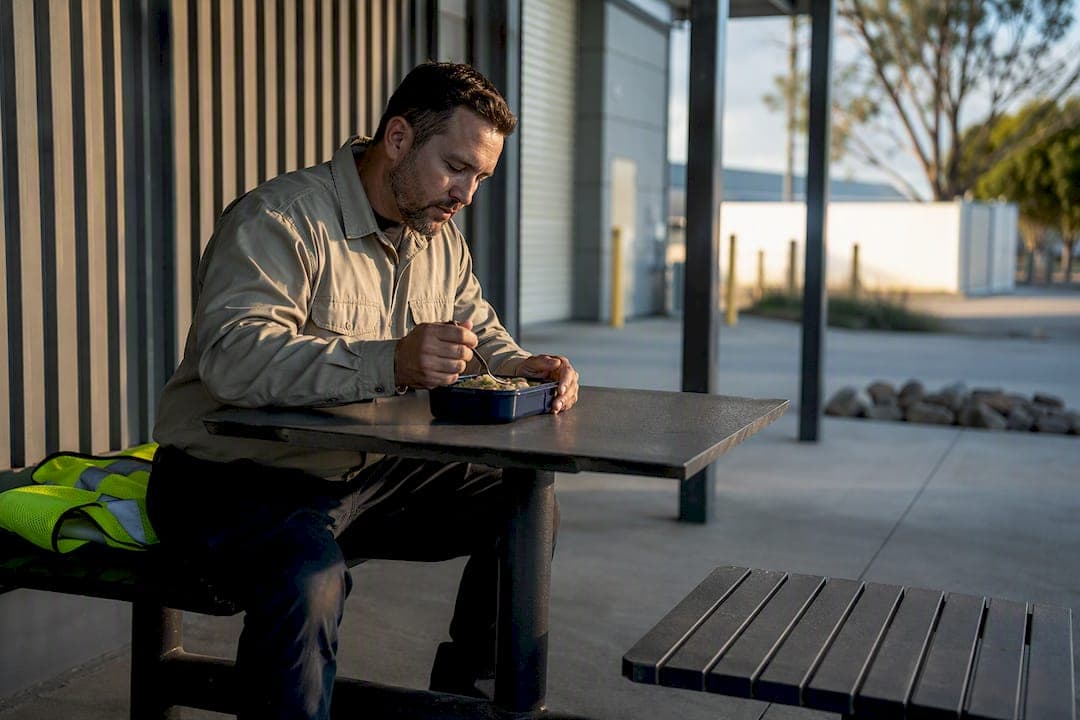
Nonexempt employees in California earn an unpaid, duty-free meal break once they work more than five hours, a second meal break for longer shifts, and paid rest breaks for every several hours worked as required by law. Miss any of these breaks, and the employer owes an additional hour of pay at the employee's regular rate for each violation, per day, up to two premiums daily. That's the whole rule in one breath. Everything below explains how it plays out on an actual timesheet.
TL;DR:
- Employers must precisely verify that employees are relieved of all duties during meal breaks, including not being on call or obligated to work, to avoid penalties.
- Penalties for missed breaks can total up to two hours of pay per violation, with premiums calculated at the employee’s full regular rate, including nondiscretionary bonuses.
- Accurate documentation, such as GPS-verified clock-ins and detailed shift records, is critical to prove breaks were genuinely provided and prevent costly claims.
- Typical scheduling errors, like underestimating total hours worked across split shifts or overtime, often trigger unintended second meal requirements and Associated penalties.
- State law mandates that off-duty meal and rest periods, not just offering policies, be actively provided and properly recorded, especially for field and mobile workers.
Table of Contents
- What Are California's Meal Break Rules?
- When Can Meal and Rest Breaks Be Waived?
- When Is an On-Duty Meal Period Legal?
- How Much Does a Missed Break Actually Cost an Employer?
- What Must Employers Do to Prove Breaks Were Provided?
- How Do Employees File a Complaint Over Missed Breaks?
- Quick Compliance Checklist for Both Sides
- Do Break Rules Differ by Industry or Job Type?
- Have Recent Court Rulings Changed the Rules?
- How Do State Break Rules Interact With Federal Law?
- What Do Employers Get Wrong Most Often?
- What Changes When Overtime or Double Shifts Are Involved?
- Why Field Teams Need Tighter Break Controls
- See How Clock-Me Documents Every Break
- Sources
What Are California's Meal Break Rules?
Start with the statute itself. Labor Code § 512 says an employer cannot let a nonexempt employee work more than five hours in a day without providing a 30-minute meal period. Cross the ten-hour mark and a second 30-minute meal period kicks in. The DLSE's meal period guidance spells this out plainly: the break has to be uninterrupted, duty-free, and it has to actually happen, not just get offered in theory.
"Duty-free" is the part employers get wrong most often. It means the employee is relieved of all work duties, free to leave the worksite, and not on call. A construction supervisor who eats a sandwich in his truck while monitoring a radio for dispatch calls is not on a real break, even if his time card says "lunch." The same goes for a retail worker who's told to keep her phone on "just in case." If there's an expectation of availability, the break isn't duty-free, and the meal period is unpaid only when that duty-free condition is actually met.
Rest breaks work differently. Under the DLSE's rest and meal period rules, employees get a paid 10-minute rest break for every four hours worked, or "major fraction" of four hours (anything over two hours counts). Rest time counts as hours worked, so it stays on the clock and gets paid at the employee's regular rate. Unlike meal breaks, rest periods don't need to be uninterrupted by policy, but the employer still has to actually let the employee stop working and step away.
Here's how the math plays out across common shift lengths:
- For shifts exceeding five hours, one meal break is required along with paid rest breaks.
- Longer shifts require additional rest breaks and possibly a second meal break once work exceeds ten hours.
- Rest breaks scale roughly with four-hour increments of work.
Notice the pattern: rest breaks scale with total hours in fairly predictable four-hour blocks, while meal breaks trigger at two fixed thresholds, five hours and ten hours. A common employer mistake is assuming one lunch break covers any shift under 12 hours. It doesn't. Once you cross ten hours, the law requires a second meal period regardless of how long the first one was.
When Can Meal and Rest Breaks Be Waived?
The waiver rules are narrower than most employers assume, and getting them wrong is one of the fastest ways to rack up penalties. Labor Code § 512 allows exactly two waiver scenarios, and both require mutual, documented consent.
- Six-hour shift waiver. If the total workday doesn't exceed six hours, the employee and employer can mutually agree to skip the meal break entirely. This has to be a genuine agreement, not a boilerplate line buried in an offer letter, and it should be revocable by the employee at any time.
- Second-meal waiver. When a workday totals no more than 12 hours and the employee already took the first meal break, the second meal period can be waived by mutual consent, as long as the first break wasn't itself waived.
- Major fraction placement for rest breaks. The rest break tied to a four-hour increment should generally fall in the middle of that work period, so far as practical. On an 8-hour shift, that typically means one rest break in the first half and one in the second, bookending the lunch period rather than stacking both breaks near the end of the day.
The most common scheduling pitfall isn't malice, it's math. Managers build shift templates around round numbers (an 8-hour day, a 10-hour day) without accounting for early clock-ins, late clock-outs, or unpaid overtime that pushes a shift from 9.9 hours to 10.1 hours. That extra six minutes triggers a second meal obligation the schedule never planned for. Field crews are especially exposed here because drive time, load-in, and site delays routinely blow past the numbers on the dispatch sheet.
When Is an On-Duty Meal Period Legal?
On-duty paid meal periods are the exception, not a workaround, and the bar is high. The DLSE applies an objective "nature of the work" test: the job itself has to prevent relief from all duty, not just make it inconvenient. A single security guard covering an isolated site overnight, a sole worker at a remote monitoring station, or an employee whose absence would shut down an entire process are the classic examples the DLSE and courts recognize.
Even when the nature-of-work test is met, the employer needs a signed written agreement authorizing the on-duty meal period, and that agreement must be revocable by the employee at any time, for any reason. There's no verbal version of this that holds up.
Employers who label a break "on-duty" simply because staffing is thin, rather than because the job truly requires it, create direct liability. That mislabeling is one of the more common violations DLSE investigators flag. A few industries carry narrower statutory exceptions, most notably certain motion picture industry employees and specific health care worker categories, where wage orders modify the standard meal-waiver framework. Those carve-outs are occupation-specific and don't extend to general staffing shortages in other industries.
How Much Does a Missed Break Actually Cost an Employer?
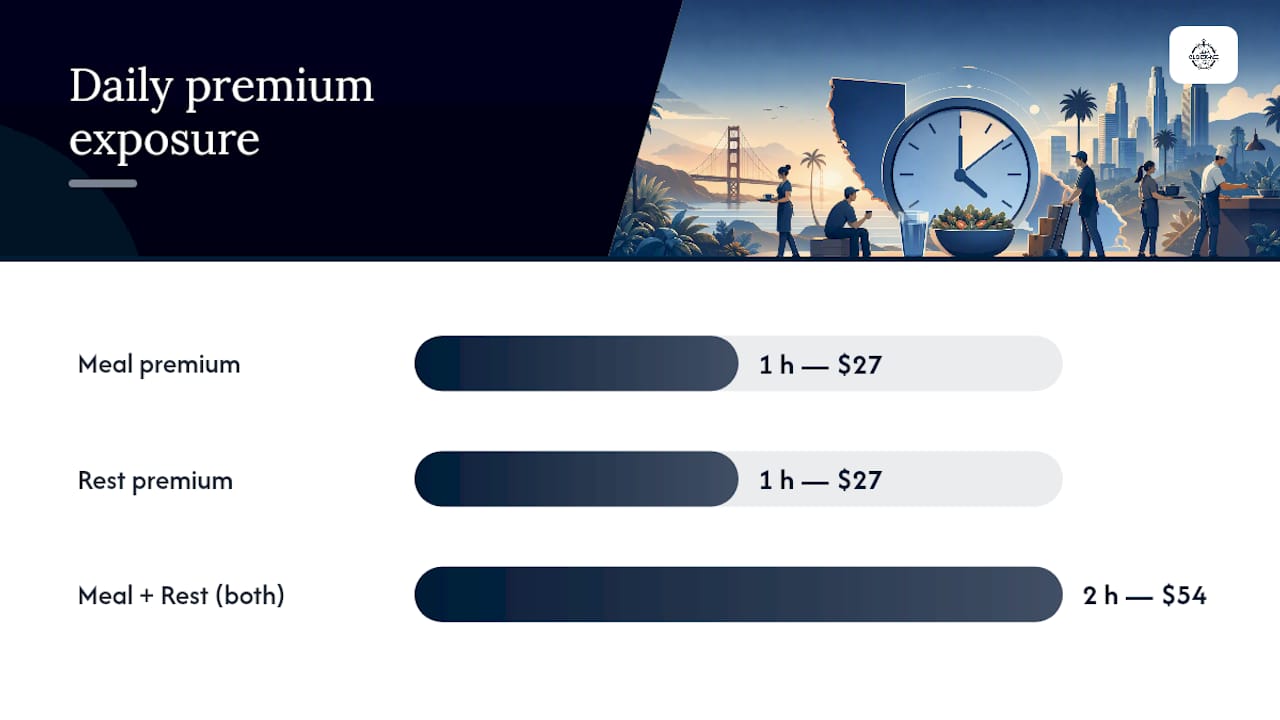
The penalty is simple to state and easy to underestimate: one additional hour of pay at the employee's regular rate for each workday a meal period is missed, and a separate one-hour premium for each workday a rest period is missed, per the DLSE's rest and meal period guidance. That's a potential two hours of premium pay per employee, per day, on top of hours actually worked.
The regular rate includes more than base pay. In Ferra v. Loews Hollywood Hotel, the California Supreme Court ruled that the "regular rate of compensation" used to calculate meal and rest break premiums has to mirror the "regular rate of pay" used for overtime, which means nondiscretionary bonuses, commissions, and shift differentials all factor into the calculation. Employers who paid break premiums at straight base pay before this decision were, in many cases, underpaying without knowing it.
A worked example. Say a field technician earns $22 an hour and also receives a $200 nondiscretionary weekly production bonus for a 40-hour week. That bonus works out to $5 an hour when spread across the workweek. If she misses her meal break on a Tuesday, the premium isn't $22, it's $27, because the bonus has to be folded into the regular rate for that pay period. Miss both a meal and a rest break the same day, and the employer owes two premiums at $27 each, or $54, for one day's violation on top of her regular wages.
The math compounds fast. A 20-person field crew missing even one meal premium a week, calculated at an average regular rate around $25 to $30 once nondiscretionary pay is factored in, adds up to real exposure over a year, and that's before considering rest break premiums or a multi-year lookback if a claim surfaces.
That lookback exposure is the part that catches employers off guard. Wage claims in California typically reach back three or four years, depending on the legal theory. If a company mishandled the regular-rate calculation for that entire period, payroll teams often need to recalculate premiums retroactively once they discover the error, and that recalculation applies to every affected pay period, not just the current one.
What Must Employers Do to Prove Breaks Were Provided?
The California Supreme Court's Brinker decision set the standard employers still live under today: an employer's job is to relieve the employee of all duty, relinquish control over their activities, and give a real, reasonable opportunity to take an uninterrupted break. The employer doesn't have to police whether the employee actually eats lunch, but it can't pressure, discourage, or structure work so that taking the break becomes practically impossible.
That distinction, between providing a break and merely not preventing one, is where most litigation lives. Courts and the DLSE look for evidence the employer's practices, not just its written policy, actually gave employees a fair shot at breaking away from work.
Solid documentation includes:
- Time punches showing actual break start and stop times, not just scheduled break windows
- Written meal-waiver agreements, signed and dated, for six-hour shifts and second-meal waivers
- On-duty meal period agreements where applicable, with revocation language intact
- Manager logs noting any operational reason a break was delayed or interrupted
- Shift schedules or templates showing planned break placement in advance
Pro Tip: Don't rely on a paper timesheet where employees self-report break times after the fact. A signature on a form that says "I took my break" is weak evidence next to a GPS-verified punch showing the exact minute someone clocked out and back in at a specific location.
This is where field teams carry unusual risk. A supervisor managing a crew across three job sites can't physically verify that every technician stepped away from work for 30 uninterrupted minutes. Automated timekeeping with location-verified punches closes that gap by creating an objective, timestamped record instead of a manager's best guess. Tools that pair geofencing with clock-in verification make it far harder for a missed break to slip through unnoticed, and far easier to produce a clean record if a wage claim ever surfaces.
If a claim does come in, the priority is preservation, not persuasion. Pull the time records and schedules for the relevant period immediately, gather any manager notes about that shift, and get statements from supervisors while memories are fresh. Retain records for at least four years; that covers the outer edge of most wage claim lookback periods.
How Do Employees File a Complaint Over Missed Breaks?
Employees who believe they've been denied meal or rest breaks have two main paths. The first is a wage claim filed directly with the DLSE, which investigates individual claims and can order an employer to pay owed premiums, penalties, and sometimes attorneys' fees. Bring pay stubs, time records if you have access to them, and a written log of the specific dates breaks were missed or interrupted.
The second path is the Private Attorneys General Act, or PAGA, which lets an employee sue on behalf of the state and other similarly situated employees for labor code violations, including break violations. PAGA claims tend to cover groups of workers rather than a single individual, and penalties can scale quickly across a workforce with a systemic scheduling problem.
Typical remedies include the one-hour premium per violation, wage statement penalties if the violations weren't accurately reflected on pay stubs, and waiting-time penalties if an employee separated from the company while premiums remained unpaid. Statute of limitations generally runs three years for the underlying labor code claim, four years if pursued under the state's unfair competition law. Employees should document missed breaks the same day they happen, in writing, even if it's just a note to themselves with a date and time.
Quick Compliance Checklist for Both Sides
Neither side needs a law degree to reduce risk here. A short list of habits closes most of the gap.
- Employers: Publish a written break policy every employee acknowledges in writing.
- Employers: Require actual time punches for meal breaks, not scheduled defaults, and store them for at least four years.
- Employers: Use waiver forms only when the shift length and conditions genuinely qualify, and audit schedules weekly for shifts creeping past five or ten hours.
- Employees: Note the date and time immediately anytime a break is missed, shortened, or interrupted by work duties.
- Employees: Keep copies of pay stubs and any available time records; raise the issue with HR in writing before escalating.
- Employees: File a DLSE complaint if the issue goes unresolved after a reasonable internal attempt to fix it.
Do Break Rules Differ by Industry or Job Type?
Most nonexempt employees fall under the general meal and rest break framework, but a handful of industries operate under modified wage order provisions. Health care workers, for example, can voluntarily waive a second meal period on shifts over eight hours under certain conditions, a carve-out unique to that sector because of patient-coverage realities. Motion picture industry employees fall under separate wage order language that adjusts timing in recognition of production schedules that don't map cleanly to a standard workday.
Union employees covered by a valid collective bargaining agreement can see meal and rest break terms modified through that agreement, but only within limits; the CBA has to provide comparable protections, including premium pay provisions, and can't simply waive break rights outright. This is a narrower exception than many employers assume, and it doesn't apply just because a workforce is unionized, it applies only when the specific CBA language qualifies under the labor code.
Field-based industries, construction, landscaping, delivery, and similar mobile work, don't get a different set of break rules. What differs is enforcement difficulty. A restaurant manager can visually confirm a server stepped off the floor. A construction foreman overseeing four sites can't watch every crew member clock out for lunch. The rules are identical; the practical challenge of proving compliance is not, which is exactly why documentation matters more, not less, for distributed teams.
Have Recent Court Rulings Changed the Rules?
Ferra v. Loews Hollywood Hotel remains the most consequential recent shift, and its effects are still working through payroll systems years later. Before Ferra, many employers calculated break premiums using straight base hourly pay. After the ruling, nondiscretionary compensation has to be folded into that calculation, which quietly increased the dollar exposure of every missed break for any employee earning bonuses, commissions, or shift differentials.
The practical fallout has been retroactive. Employers who underpaid premiums for years under the old base-rate method face exposure for that entire lookback period once an audit or claim surfaces, and payroll teams have had to build new processes to properly allocate nondiscretionary pay across the workweek before calculating any premium.
Brinker Restaurant Corp. v. Superior Court, decided earlier, still sets the operative standard for what "providing" a break means: relieve of duty, relinquish control, offer a reasonable opportunity. Every meal-break dispute since has essentially been an argument over whether an employer met that bar in practice, not just on paper. Together, these two decisions form the backbone of how California courts evaluate meal and rest break compliance today, and neither shows signs of being revisited soon.
How Do State Break Rules Interact With Federal Law?
Federal law, specifically the Fair Labor Standards Act, doesn't require meal or rest breaks at all. The FLSA only regulates how breaks are paid if an employer chooses to offer them, generally requiring that short breaks under 20 minutes be paid as work time. California's rules go considerably further, mandating the breaks themselves, not just how to pay for them if offered.
When state and federal law overlap on a related issue, like whether rest break time counts toward overtime calculations, California's more protective standard controls. Employers can't point to FLSA silence on meal breaks as a defense; the labor code fills that gap entirely for nonexempt employees working in the state, regardless of where the company is headquartered.
Multistate employers sometimes assume a single national break policy is enough. It isn't. A company operating in Texas, Nevada, and California needs a California-specific break policy layered on top of whatever it does elsewhere, because California's meal and rest break requirements have no federal equivalent to satisfy them. Trying to apply a lighter-touch, FLSA-compliant policy uniformly across states is a common and costly mistake for companies expanding into California without adjusting their handbook first.
What Do Employers Get Wrong Most Often?
The single biggest misconception is believing that offering a break policy satisfies the law. It doesn't. The obligation under Brinker is to actually relieve employees of duty and remove barriers to taking the break, not to print a policy and hope compliance follows.
A close second: assuming salaried employees are automatically exempt from break requirements. Exempt status depends on actual job duties and a minimum salary threshold, not a paycheck structure. Plenty of employers misclassify field supervisors or working leads as exempt when their day-to-day duties don't meet the legal test, which drags them, incorrectly, out of break-tracking systems entirely.
A third recurring violation involves rounding. Employers sometimes round break times to the nearest five or ten minutes on time records, which can shave real minutes off a legally required 30-minute meal period without anyone noticing until a wage claim reveals the pattern.
The fourth, and maybe most damaging in field operations specifically, is treating "available if needed" as compatible with duty-free status. A dispatcher who tells a crew to "keep radios on during lunch just in case" has converted a legally unpaid meal break into on-duty time, and probably owes premium pay for every instance, whether anyone actually got called or not.
What Changes When Overtime or Double Shifts Are Involved?
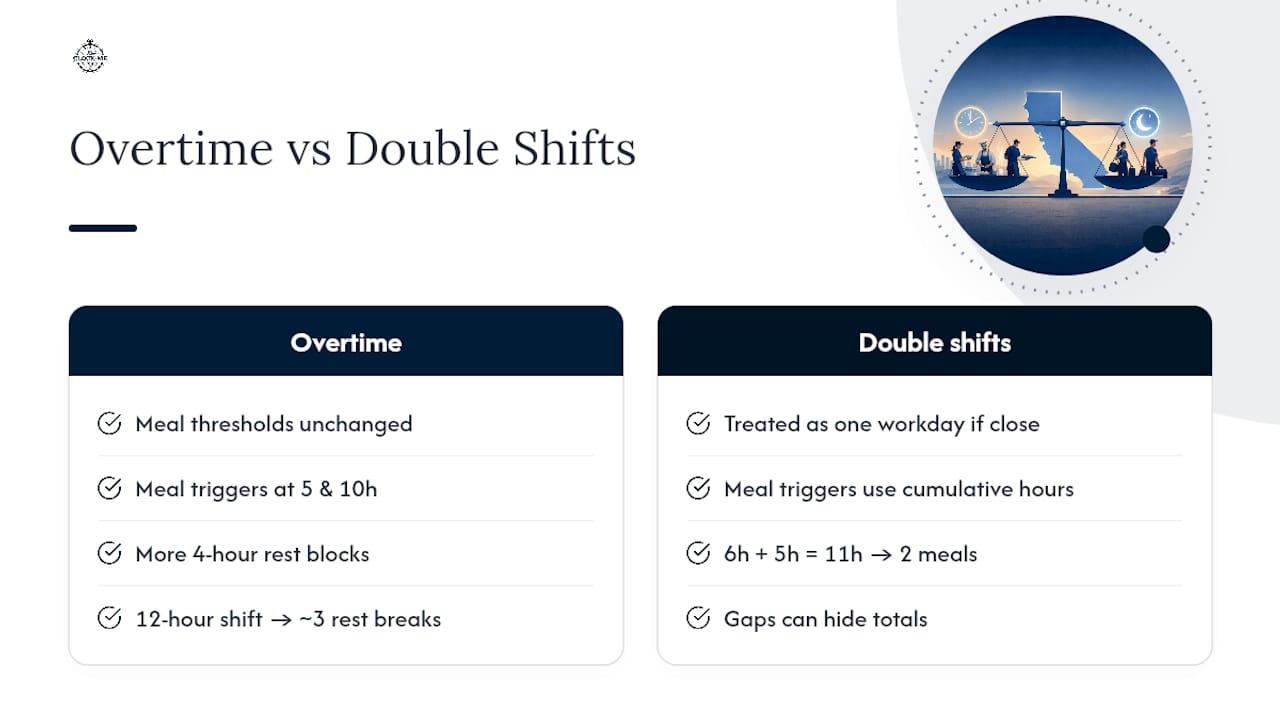
Overtime hours don't change the meal and rest break thresholds; they just make hitting them more likely. An employee working a 12-hour overtime shift still only needs two meal breaks (the standard trigger points at 5 and 10 hours), but that same employee accumulates more four-hour increments, meaning more rest breaks across the day, generally three for a 12-hour shift.
Double shifts, where an employee works two separate shifts in one day with a gap between them, require careful tracking because California generally treats them as a single workday for break-threshold purposes if the hours are continuous or closely spaced. An employee working a 6-hour morning shift and a 5-hour evening shift, totaling 11 hours in the same calendar day, likely triggers the second-meal requirement even though neither individual shift crossed ten hours on its own.
This is where scheduling software and manual spreadsheets both tend to fail. A shift template built around individual shift lengths misses cumulative daily totals unless someone actively checks the math across both shifts. Field operations running split shifts, common in landscaping, delivery, and event staffing, are particularly exposed here because the gap between shifts can obscure the fact that total daily hours have crossed a break threshold that neither shift alone would trigger.
Why Field Teams Need Tighter Break Controls
Break violations rarely start as bad faith. They start as blind spots, a supervisor juggling three sites, a paper timesheet filled in from memory, a "just keep your radio on" habit nobody flagged as a problem. Buddy punching and undocumented on-site time make the blind spot worse, because the record itself becomes unreliable before anyone even gets to the compliance question.
What actually closes the gap is objective evidence: verified GPS punches, geofenced job sites, and live dashboards that show a supervisor exactly who clocked out, where, and for how long. That's not a policy fix, it's an evidence fix, and it's the difference between guessing what happened on a given Tuesday and proving it.
A workable first step: pilot geofenced clock-ins on one crew this month, then review the break-timing data after two weeks before rolling it out further.
— Cristiano
See How Clock-Me Documents Every Break
Everything covered above points to one conclusion: employers win or lose meal and rest break disputes based on the quality of their records, not the quality of their intentions. Clock-Me was built specifically for that gap. GPS-verified punches, geofencing, and one-tap clock-in give field employers a timestamped, location-backed record of exactly when a break started and ended, the kind of evidence that satisfies the standard set by Brinker and supports accurate premium math under Ferra.
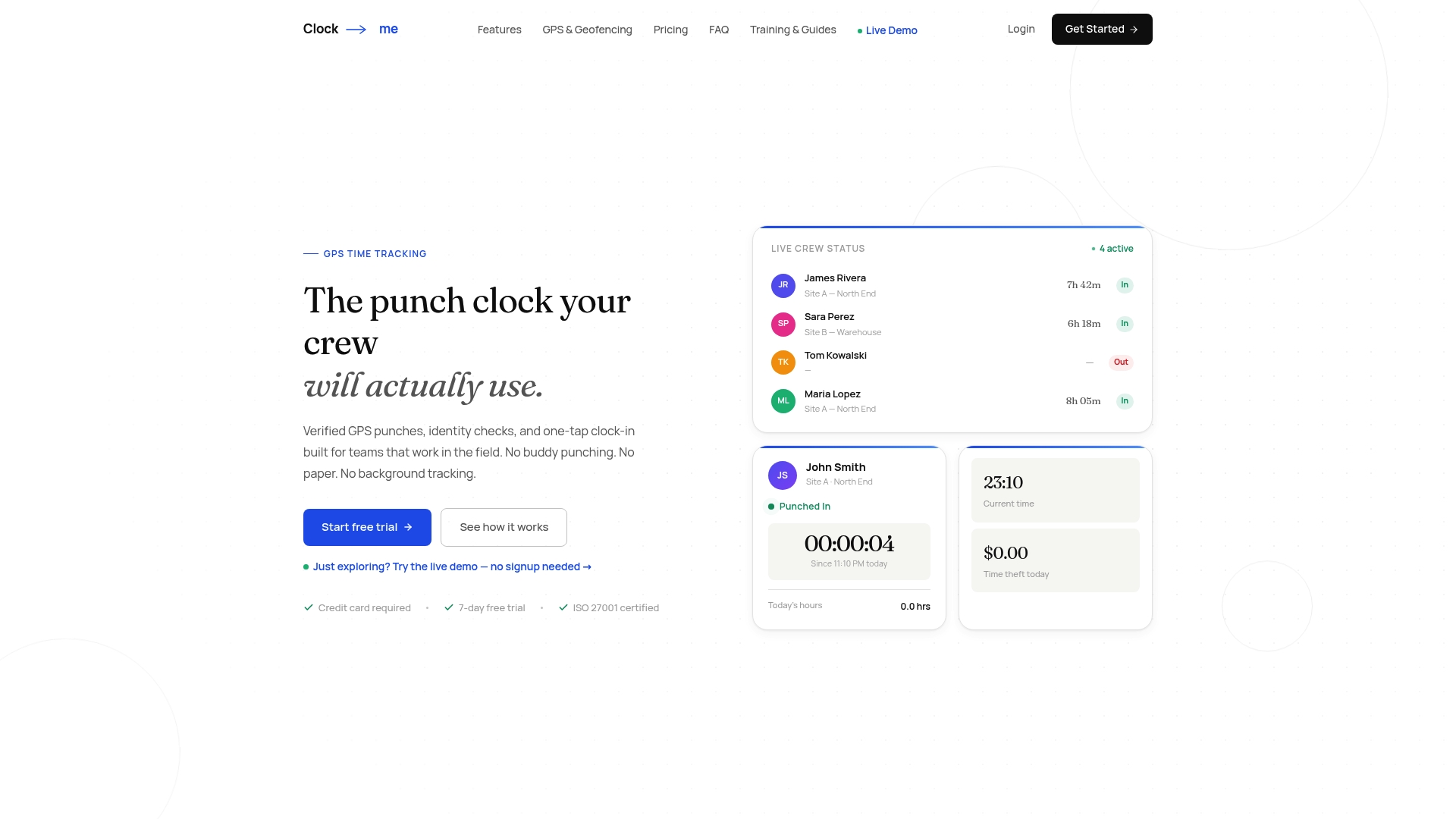
The feature set includes live dashboards for real-time attendance visibility and audit-ready logs that hold up if a wage claim ever surfaces, replacing paper timesheets and self-reported break times with objective data. Identity verification and geofencing also shut down buddy punching, so the record reflects who was actually on-site, not who someone said was there. If you manage a distributed crew and want to see how this looks in practice, start a live demo with no signup required and check whether it fits your current break-tracking gaps.
This article is general information, not a substitute for advice from a qualified lawyer. Consult a qualified legal professional about your own circumstances before acting on anything here.
Sources
- DLSE Frequently Asked Questions: Meal Periods
- California Labor Code § 512
- Special Alert: California Supreme Court Rules Meal and Rest Period Penalties Must be Paid at Regular Rate of Pay, Not Base Rate - Wilson Turner Kosmo LLP