

California law requires a duty-free 30-minute meal period no later than the end of the fifth hour worked, a second meal period after ten hours, and paid 10-minute rest breaks for every four hours or "major fraction" thereof. Violating either rule generally results in one additional hour of pay per missed break, per day, and the burden falls on you, the employer, to prove compliance with contemporaneous records. Your immediate priorities: audit current schedules against actual hours worked, confirm your timekeeping system captures break data automatically, and correct any unpaid premiums before an employee or the state finds them first.
TL;DR:
- To avoid wage claims, employers must audit actual hours worked against break policies and promptly correct any unpaid premiums within a three-year window.
- Proper documentation, including timestamped records, signed on-duty agreements, and payroll records, is essential to defend against compliance disputes.
- Scheduling must ensure meal periods start no later than the fifth hour and second meals by the tenth hour, with waivers only allowed under strict conditions.
- Automated digital tools with GPS verification and attestations improve record accuracy, making compliance evidence harder to dispute in legal proceedings.
Table of Contents
- HR Compliance Checklist: What to Verify This Week
- Statutes and Wage Orders Employers Must Follow
- Deadlines, Waivers, and the Narrow "On-Duty" Exception
- Rest Break Rules and Scheduling Guidance
- Financial and Enforcement Consequences Employers Face
- Audit-Ready Records: What to Keep and How Long
- 30 to 90 Day Operational Plan for Scheduling, Policy, and Audits
- How Workforce Time-Tracking Tools Help Build Defensible Records
- Documenting Meal Breaks During Overtime and Double Shifts
- Managing Employees Who Voluntarily Waive Breaks Beyond Statutory Allowances
- Remote and Mobile Work: Meal Break Policies That Actually Apply
- Federal FLSA Rules vs. California Meal and Rest Break Requirements
- Best Practices for Internal Audits and Compliance Reviews
- Clock-Me's Perspective: Practical Priorities for HR Teams
- Clock-Me: How to Get Started Building Audit-Ready Time Records
- Sources
- FAQ
HR Compliance Checklist: What to Verify This Week
Meal and rest break violations rarely come from bad intentions. They come from scheduling gaps, outdated policy language, and payroll systems that don't flag missed breaks in real time. Before you touch training materials or rewrite your handbook, run through the checks that catch the most common exposure points.
Start with the schedule-to-hours audit. Pull two weeks of actual clock data, not planned shifts, and compare it against your break policy.
- Flag every shift over five hours where no 30-minute meal period appears in the record
- Flag every shift over ten hours without a second documented meal period
- Cross-check rest break timing against the "major fraction of four hours" rule (detailed below)
- Identify employees who clock out for lunch, but clock back in under 30 minutes later
Next, review your on-duty meal agreements. These should be rare, not routine. If more than a handful of employees have signed on-duty meal waivers, ask why. The DLSE's guidance on meal periods treats the on-duty exception as narrow, meaning it applies only when the nature of the work genuinely prevents relief from all duty.
- Confirm every on-duty agreement is in writing and signed by the employee
- Confirm the agreement includes explicit revocation language the employee can invoke at any time
- Confirm the job actually meets the objective test (detailed in the next section) rather than just being convenient to schedule
- Remove any standing on-duty agreements for roles where coverage could reasonably be arranged
Then check your payroll for missed premium payments. This is where most exposure hides. If your time system shows a late or missed meal period but payroll shows no extra hour of pay, that's an unpaid wage claim sitting on your books right now. Run a report matching break exceptions against payroll codes for the premium, and correct any gaps going back through the statute of limitations window.
Finally, confirm your record retention. Timecards, schedule copies, break logs, and manager attestations all need to exist in a form you can produce quickly if a wage claim lands on your desk. A verbal assurance that "we always let people take lunch" carries no weight against a DLSE hearing officer. A dated, contemporaneous record does.
Statutes and Wage Orders Employers Must Follow
Everything in California meal break law traces back to one statute and a set of industry-specific wage orders that layer on top of it. Get familiar with both, because relying on general knowledge of "the meal break law" without knowing which wage order governs your industry is how employers end up defending avoidable claims.
Labor Code §512 is the foundation. It requires a 30-minute meal period for any employee who works more than five hours in a day, and a second 30-minute meal period for any shift over ten hours. The statute also permits limited waivers, covered in the next section, but the default rule is mandatory, not optional.
The Industrial Welfare Commission wage orders add the operational detail the statute doesn't spell out. There are 17 wage orders covering different industries, and Wage Order 4 (professional, technical, clerical, and similar occupations) is a common reference point, but manufacturing, transportation, healthcare, and other sectors have their own orders with variations worth checking against your specific workforce. The wage orders define what "on-duty" means, when a written on-duty agreement is enforceable, and how rest periods should be counted.
Key terms every HR professional should be able to define without hesitation:
- Duty-free meal period: the employee is relieved of all work duties, free to leave the premises, and not required to remain on call
- On-duty meal period: the employee remains on duty during the meal, which is only lawful under a narrow objective test and a signed written agreement
- Major fraction of four hours: generally interpreted as anything more than two hours, which triggers a second rest break entitlement
- Provide vs. ensure: the employer's duty is to make breaks available and unimpeded, not to police whether the employee actually takes them
That last distinction matters more than most HR teams realize, and it comes straight from the California Supreme Court's 2012 decision in Brinker Restaurant Corp. v. Superior Court. The court held that employers must provide meal periods, meaning they must relieve employees of duty and not impede or discourage them from taking breaks. Employers are not required to police employees to confirm they actually sat down and ate. But "provide" is an active obligation, not a passive one. Scheduling that makes a break practically impossible, understaffing that pressures employees to skip lunch, or a culture that rewards working through breaks all violate the duty to provide, even if no manager explicitly told anyone to skip a meal.
CalChamber's guidance reinforces this point directly: employers need policies and staffing levels that make breaks realistically available, not just technically permitted on paper. A handbook line that says "employees may take a 30-minute lunch" means nothing if the schedule leaves no coverage gap for anyone to actually leave their post.
Deadlines, Waivers, and the Narrow "On-Duty" Exception
Timing is where most meal break violations actually occur, not policy language. The rule is precise: the first meal period must begin no later than the end of the employee's fifth hour of work. If someone clocks in at 8:00 AM, their meal period needs to start by 1:00 PM, not 1:05 PM. A five-minute miss is still a miss, and it still triggers the one-hour premium.
The second meal period follows the same logic at the ten-hour mark. An employee who starts at 7:00 AM and works a ten-hour shift needs their second meal to begin no later than 5:00 PM, unless a valid waiver applies.
Waivers exist, but they're conditional, not automatic.
- The first meal period can be waived only if the total shift is six hours or less, and both employer and employee agree
- The second meal period can be waived only if the shift is 12 hours or less, the first meal period was not itself waived, and both parties agree
- Waivers should be documented, even though the law doesn't always require them in writing for the first meal, because an undocumented waiver is nearly impossible to defend in a dispute
The on-duty meal exception is where employers get into the most trouble. California law allows a paid on-duty meal period only when the nature of the work genuinely prevents the employee from being relieved of all duty, and only with a signed written agreement that includes the employee's right to revoke it at any time. This is an objective test tied to the job itself, not a subjective convenience for scheduling. A solo security guard monitoring a remote site overnight might qualify. A retail cashier who "can't leave the register because we're short-staffed" does not; understaffing is a scheduling problem, not a job-function justification.
Pro Tip: Review every on-duty meal agreement annually, not just at hire. Job duties change, staffing improves, and an agreement that was defensible two years ago may not hold up under today's operations. If you can't articulate exactly why the role prevents relief from duty, the agreement likely won't survive a challenge.
Common misapplications to watch for: blanket on-duty agreements applied to an entire job title regardless of individual shift conditions, on-duty agreements used as a workaround for chronic understaffing, and agreements missing the required revocation clause. Any of these turns a narrow, lawful exception into a systemic violation across your entire workforce.
Rest Break Rules and Scheduling Guidance
Rest breaks get less attention than meal periods, but they follow their own precise formula and generate the same one-hour penalty when missed. The rule, per DLSE guidance, is 10 paid minutes of rest for every four hours worked or "major fraction" of four hours.
In practice, workers are generally entitled to a paid 10-minute rest break for every four hours worked or major fraction thereof, with at least one rest break during shifts over 3.5 hours and additional breaks for longer shifts.
Rest breaks should fall, "insofar as practicable," in the middle of each work period. That phrase gives you some scheduling flexibility, but it's not a blank check. If an employee's four-hour block routinely gets no midpoint break because of coverage demands, that's a pattern worth fixing before it becomes a wage claim.
A detail HR teams frequently miss: rest breaks are paid time, and they're not the same obligation as meal breaks, which are unpaid and duty-free. An employee cannot combine two rest breaks into one 20-minute break, and rest breaks cannot be used to shorten or replace the 30-minute meal period. Each entitlement stands on its own.
Payroll treatment for missed rest breaks mirrors the meal break penalty. One missed rest break equals one additional hour of pay at the employee's regular rate, capped at one premium payment per workday for meal violations and one premium payment per workday for rest break violations, for a potential maximum of two extra hours of pay per day if both are missed. Your time-tracking system should flag rest break gaps the same way it flags meal break gaps, because if you're only auditing for meal violations, you're catching half the exposure.
Financial and Enforcement Consequences Employers Face
The penalty structure is simple to state and easy to underestimate: one additional hour of pay at the employee's regular rate of compensation for each workday a meal period is not provided, and a separate additional hour of pay for each workday a rest period is not provided. That's a potential two hours of premium pay per employee, per day, if both violations occur, capped at one premium per category per day regardless of how many breaks were missed within that category.
Calculate the regular rate carefully. It's not always just the hourly wage. If an employee earns non-discretionary bonuses or shift differentials, the regular rate used for the premium calculation needs to reflect that, the same way it would for overtime calculations. Getting this wrong on a large scale, across hundreds of employees over months, is how a manageable correction turns into a six-figure back-pay problem.
The premium is legally classified as a wage, not a penalty, which matters enormously for enforcement timing. Because it's a wage, DLSE guidance and court interpretations point to a three-year statute of limitations for recovery, longer than the one-year window that applies to many other Labor Code penalties. That three-year lookback is exactly why a systemic scheduling gap can generate a large aggregate claim once an employee, a former employee, or a class action attorney starts calculating what's owed.
Employees have two enforcement paths. They can file a wage claim directly with the DLSE, which investigates and can issue a citation or hold a hearing, or they can pursue a civil lawsuit, sometimes as a class action if the violation pattern affected many employees similarly. Multi-employee claims are where the exposure escalates quickly, since a scheduling flaw affecting one department can suddenly apply to a hundred employees over a three-year window.
To defend against a claim, you need more than a policy statement. You need contemporaneous evidence: timestamped records showing when breaks started and ended, documentation of any valid waivers, and payroll records showing premium payments where breaks were missed. Courts and the DLSE tend to assume a violation occurred unless the employer produces records proving otherwise, according to legal analysis of recent court interpretations. The absence of a record is treated as evidence against you, not a neutral gap.
Audit-Ready Records: What to Keep and How Long
If a wage claim ever lands on your desk, the question won't be whether your policy was compliant on paper. It will be whether you can prove, with dated records, that breaks were actually provided on the days in question. That's the entire game, and it's why recordkeeping deserves its own line item in your compliance budget, not an afterthought bolted onto payroll software you already had.
Records worth keeping, at minimum:
- Time-stamped clock-in and clock-out data for shifts, meal periods, and rest breaks
- Manager attestations confirming breaks were offered and taken (or documenting why not)
- Signed copies of any on-duty meal waivers, including the revocation clause
- Weekly schedule copies showing planned break windows
- Payroll records showing premium payments tied to specific missed-break dates
Handwritten logs and verbal manager confirmations are better than nothing, but they're weak evidence compared to automated, timestamped digital records. A manager's memory of "I'm pretty sure everyone took lunch that week" doesn't hold up against a plaintiff's attorney asking for the exact minute a break started. GPS-verified digital records, where relevant to field or mobile staff, add a layer of specificity that's difficult to dispute later.
| Record type | Minimum retention | Why it matters |
|---|---|---|
| Timecards and break logs | 3 years | Matches the statute of limitations on premium pay wage claims |
| Signed on-duty meal waivers | Duration of employment plus 3 years | Needed to defend any on-duty agreement if challenged |
| Payroll records showing premium payments | 3 years | Required to prove corrections were made when breaks were missed |
| Manager attestations | 3 years | Supports the employer's burden of proof in disputes |
Log premium payments with a clear, identifiable payroll code, not folded into a generic "miscellaneous pay" line. When you're pulling records for an audit or a DLSE inquiry two years from now, you want to run one report and see exactly which employees received premium pay, on which dates, and for which violation type. That level of organization is the difference between a same-day response to an inquiry and a frantic weeks-long records reconstruction project.
30 to 90 Day Operational Plan for Scheduling, Policy, and Audits
Fixing meal and rest break compliance isn't a one-time project. It's a rollout with a clear sequence, and skipping ahead to automation before you've fixed your policy language usually just automates the wrong process faster.
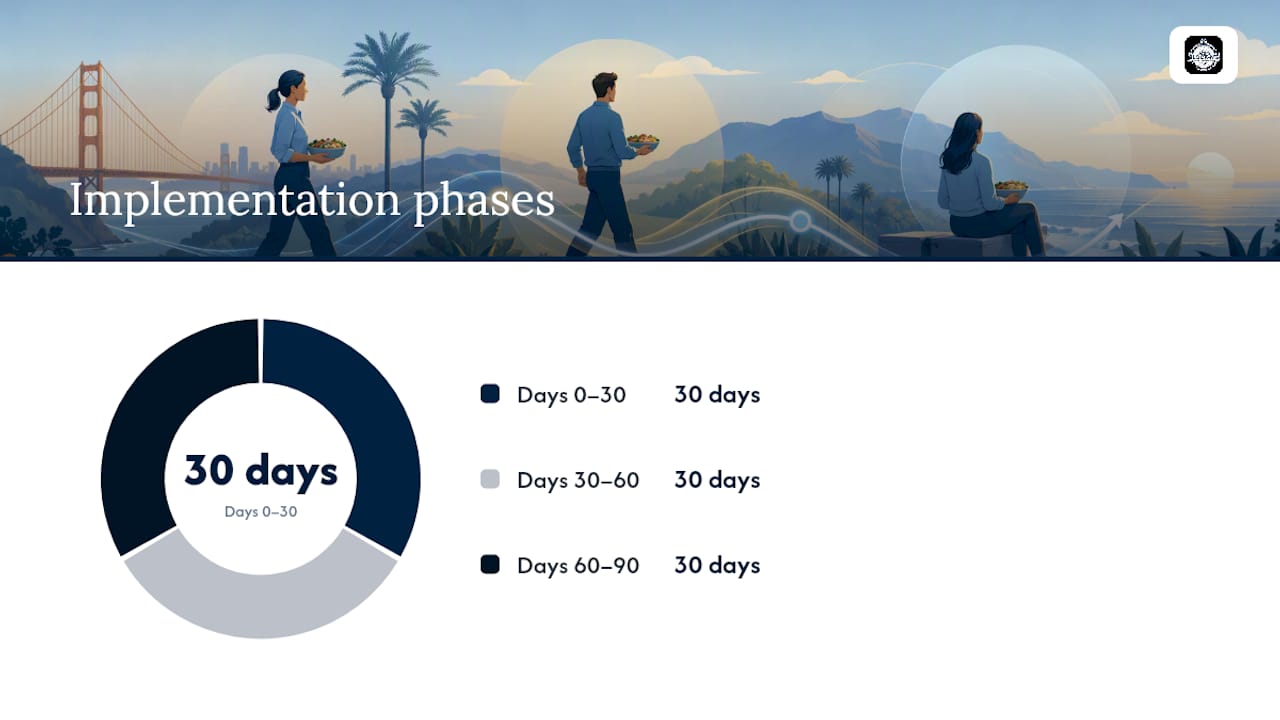
Days 0 to 30: Stop the bleeding.
- Run the schedule-to-hours audit described earlier across every department and shift pattern
- Correct any unpaid premiums immediately, going back through your three-year exposure window if the gap is systemic
- Update handbook language so it authorizes and affirmatively permits breaks, rather than passively stating employees "may" take them
- Suspend any on-duty meal agreements that don't clearly meet the objective necessity test
Sample policy language that holds up better than the vague version most handbooks use: "Employees will be relieved of all duties and scheduled for an uninterrupted 30-minute meal period no later than the end of their fifth hour of work. Supervisors are responsible for ensuring adequate coverage to make this break realistically available." That phrasing puts the operational burden where it belongs, on scheduling, not on the employee's initiative.
Days 30 to 60: Train the people making daily scheduling decisions.
Frontline managers, not HR, make the real-time calls that create or prevent violations. Train them specifically on the fifth-hour and ten-hour deadlines, on what qualifies as "relieved of all duty," and on the narrow standard for on-duty agreements. Pair training with clear escalation paths for chronic understaffing that makes breaks impractical, since that's a staffing problem HR needs visibility into, not something a manager should quietly work around.
Days 60 to 90: Automate and set a review cadence.
Manual tracking works until it doesn't, usually right around the point where a manager forgets to log a late lunch during a busy week. Automated recordkeeping tools remove that failure point, and a partner resource like Optio Station's guide to time tracking software is worth reviewing if you're comparing platform options before committing. Set a monthly, not annual, audit cadence, because monthly spot-checks catch drift before it becomes a three-year liability.
Pro Tip: Build your exceptions log now, before you need it. Every time a break is delayed, modified, or waived for a legitimate business reason, document the reason and get manager sign-off within 24 to 72 hours. That log becomes your best defense if a pattern gets questioned later.
How Workforce Time-Tracking Tools Help Build Defensible Records
The strongest defense against a meal or rest break claim is a record that was created the moment the break happened, not reconstructed afterward from memory. That's the practical argument for moving away from paper timecards and toward verified digital tracking, particularly for field and mobile teams where a supervisor can't always visually confirm every break in real time.
Modern time-tracking platforms, including Clock-Me, combine several features that map directly onto what courts and the DLSE expect to see: GPS-verified clock-ins that confirm where and when an employee started and ended a shift or break, identity verification that rules out buddy punching, geofencing that flags clock-ins outside authorized job sites, and timecard attestation that captures an employee's own confirmation that a break was or wasn't taken.
An auditable break record, built correctly, includes a specific set of fields. At minimum:
- Timestamp for break start and end
- GPS coordinates confirming location, for field-based staff
- Employee ID and attestation toggle confirming the break was taken as recorded
- Manager sign-off logged within 24 to 72 hours of the shift
The gap between a compliant break policy and a defensible one is almost always the record. A handbook can say all the right things, but if a wage claim comes in and the only proof you have is a manager's recollection, you're already behind. A time-stamped, location-verified record shifts that burden back where it belongs.
None of this replaces sound policy or trained managers, and no software claims to guarantee legal compliance on its own. But a system that captures GPS-verified clock-ins, geofenced job sites, and attestations at the moment they happen gives you something a paper log never can: a contemporaneous, hard-to-dispute record for the exact days a claim might target. If you're setting this up for the first time, Clock-Me's GPS time tracking setup guide walks through configuring these fields for your specific shift patterns.
Documenting Meal Breaks During Overtime and Double Shifts
Overtime and double shifts don't change the underlying meal break rules, but they multiply the number of deadlines you need to track in a single day. An employee working a 12-hour shift still owes a first meal by the end of hour five and a second meal by the end of hour ten, regardless of whether the extra hours count as overtime.
The documentation challenge grows with shift length. A double shift, where an employee stays on for a second consecutive shift, effectively resets nothing legally; the hour count is cumulative from the original clock-in, not from the start of the "second" shift as your scheduling software might label it. Track total hours worked continuously, not by shift label, or you risk missing a second meal deadline because your system treated it as two separate five-hour blocks.
Practical steps for overtime-heavy operations:
- Set automated alerts at the four-hour-thirty-minute and nine-hour-thirty-minute marks to flag approaching meal deadlines
- Require attestation entries specifically noting break timing on any shift exceeding ten hours
- Audit double-shift employees weekly, since these are the highest-risk group for missed second meal periods
Payroll should treat any missed break during overtime the same as any other missed break: one additional hour at the regular rate, calculated to include applicable overtime differentials where relevant.
Managing Employees Who Voluntarily Waive Breaks Beyond Statutory Allowances
Some employees, especially those paid well above minimum wage or working in fast-paced commission environments, will actively push back against taking breaks, viewing them as lost earning time. That preference doesn't change your legal obligation.
Waivers beyond the statutory first and second meal exceptions have no legal basis. An employee cannot waive a rest break entirely as a standing practice, and an employer cannot honor a request to "just skip lunch every day" even if the employee initiates it. The Labor Code's waiver provisions are narrow and shift-specific, not a general opt-out an employee can invoke indefinitely.
If an employee repeatedly declines breaks, treat it as a scheduling and coaching issue, not a paperwork shortcut.
- Document each instance in your exceptions log, including the employee's stated reason
- Reiterate the policy in writing and require the employee to confirm understanding
- Escalate to a manager conversation if the pattern continues, since repeated voluntary skipping still exposes the company to premium pay liability and potential DLSE scrutiny
Employers remain responsible for providing the break, regardless of an employee's personal preference to skip it. If the record shows breaks were available and offered but declined, document that clearly. Silence in the record, on the other hand, gets read against you.
Remote and Mobile Work: Meal Break Policies That Actually Apply
Meal and rest break rules apply to remote and mobile employees exactly as they apply to on-site staff. Working from a home office, a delivery vehicle, or a client site doesn't create an exception, though it does create real challenges for verifying compliance without a supervisor physically present.
Field and mobile teams present the highest documentation risk because there's no manager watching the clock. This is where GPS-verified, geofenced time tracking earns its keep: it confirms an employee actually stopped working at a location consistent with a break, rather than relying solely on a self-reported timestamp that could be entered after the fact.
Recommended policies for remote and mobile employees:
- Require the same attestation process used for on-site staff, adapted to mobile app clock-ins
- Set geofencing alerts for extended stops that could indicate an unlogged break, prompting a follow-up attestation
- Train remote managers to review break compliance data weekly, since they can't observe it directly
Home-based remote employees present a subtler risk: the always-available nature of remote work can blur meal period boundaries, with employees "grabbing lunch at their desk while still answering messages." That's an on-duty meal period by definition, and unless a valid written on-duty agreement exists, it needs to be paid. Clear policy language telling remote employees to fully log off during meal periods, paired with attestation prompts in your time-tracking app, closes this gap.
Federal FLSA Rules vs. California Meal and Rest Break Requirements
The federal Fair Labor Standards Act does not require meal or rest breaks at all. It only regulates how short breaks, when an employer chooses to offer them, must be paid, generally requiring that breaks of 20 minutes or less be compensated as work time.
California law goes considerably further, mandating specific meal and rest periods with exact timing deadlines and a premium-pay remedy that has no federal equivalent. Where the two laws overlap, the rule of thumb is straightforward: whichever standard gives the employee greater protection applies. Since California's requirements are stricter across the board, California employers should treat FLSA compliance as a floor, not a ceiling, and build their break policies entirely around the state standard.
This matters for multi-state employers who might import a break policy written for FLSA-only states into their California operations. A policy compliant in Texas or Florida, where no meal break is legally required at all, will fall dramatically short of California's requirements. If your HR team manages locations across multiple states, California needs its own explicit policy section, not a shared national handbook with California treated as a minor variation. Any payroll or scheduling system used company-wide should be configured to apply California-specific rules to California employees automatically, rather than relying on managers to remember which state's rules govern which location.
Best Practices for Internal Audits and Compliance Reviews
Catching a violation pattern internally, before an employee or the DLSE does, is the entire point of an audit program. The best audits are frequent and narrow, not annual and exhaustive.
Run a monthly spot-check rather than a once-a-year deep audit. Pull a sample of shifts, roughly 10 to 15 per department, and check meal timing against the fifth and tenth hour deadlines, rest break frequency against the major fraction rule, and payroll premium payments against any flagged exceptions.
Effective audit reviews typically include:
- A random sample across shifts, departments, and shift lengths, not just the departments with known past issues
- Cross-referencing time records against payroll to confirm every flagged violation resulted in premium pay
- A review of on-duty meal agreements to confirm they still meet the objective necessity test given current staffing
- Manager interviews for any department showing a pattern of late or missed breaks, to identify staffing or scheduling root causes
Treat every audit finding as a scheduling problem to fix, not just a payroll correction to process. If the same department shows repeated violations month over month, the root cause is almost always understaffing or a shift structure that doesn't accommodate a midpoint break, not a training gap. Fixing the schedule prevents the next violation; paying the premium only cleans up the last one.
Clock-Me's Perspective: Practical Priorities for HR Teams
The employers who get burned on meal and rest breaks usually aren't the ones with bad policies. They're the ones with fine policies and no proof. California's system assumes a violation happened unless you can show otherwise, which flips the usual compliance logic: writing a good handbook is necessary but nowhere near sufficient.
Our view is that HR teams overinvest in policy language and underinvest in the unglamorous work of scheduling design and contemporaneous documentation. A perfectly worded meal break policy means nothing if the schedule leaves no realistic window for a break to happen, or if there's no record showing it did.
Prevention beats correction every time, and prevention here means three things working together: schedules built around the fifth and tenth hour deadlines from the start, manager training that treats "provide" as an active duty rather than a passive one, and technology that captures the record automatically instead of relying on someone remembering to write it down. Run small audits often. A monthly ten-shift sample catches drift a year later never will.
— Clock-me
Clock-Me: How to Get Started Building Audit-Ready Time Records
Clock-Me gives field-based teams a faster path to the contemporaneous records this guide keeps coming back to, without the paperwork trail that makes most compliance efforts fall apart under pressure. GPS-verified clock-ins confirm where and when a shift or break actually started, identity verification rules out buddy punching, and geofencing flags activity outside authorized job sites automatically.
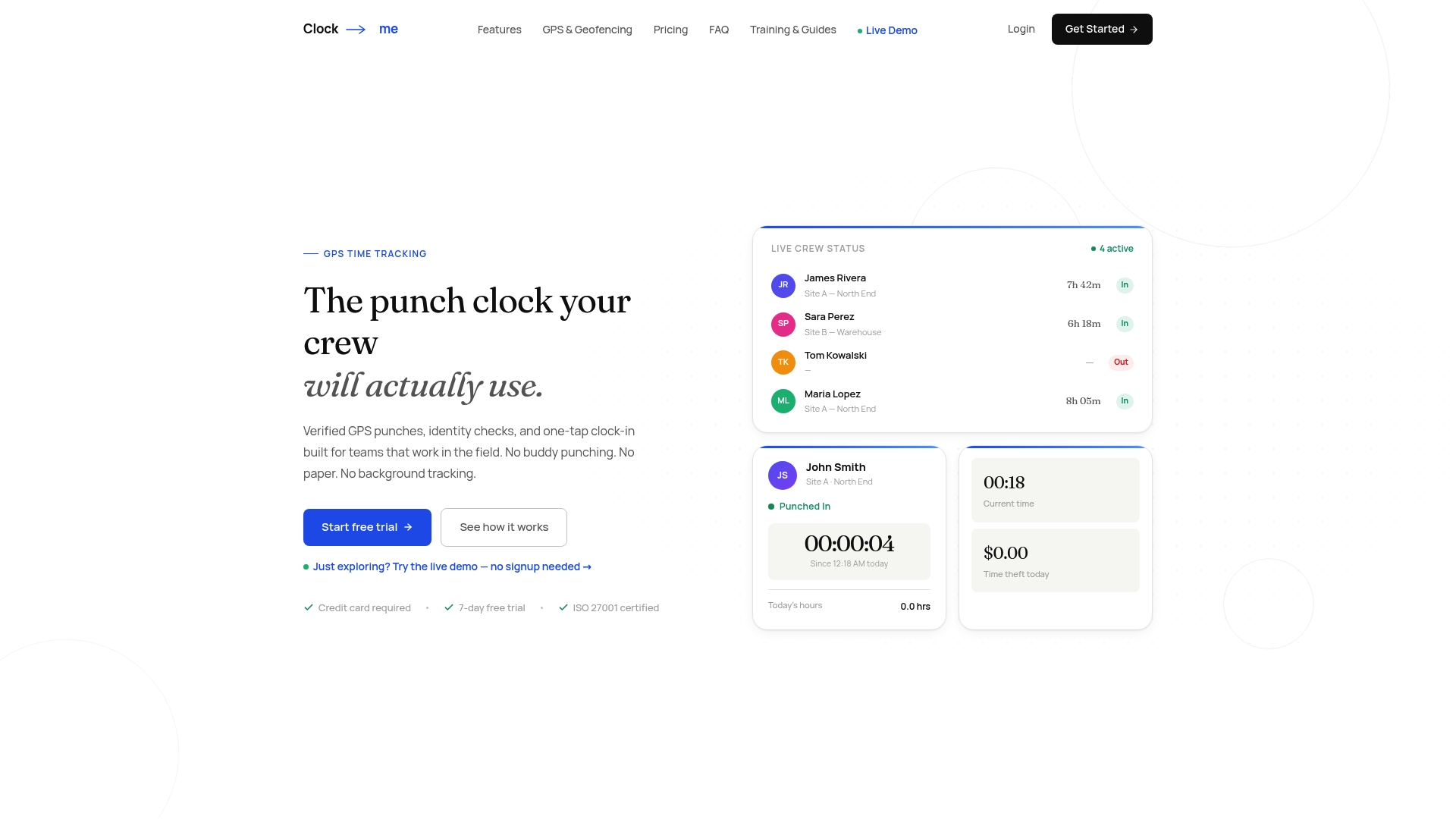
For HR teams managing multiple locations or a mobile workforce, timecard attestations and payroll export features turn the recordkeeping requirements covered above into a routine part of the workday rather than a separate compliance project. Managers get live dashboards showing break patterns as they happen, not a spreadsheet reconstructed weeks later during a dispute.
Clock-Me works alongside your written policies and manager training, not as a replacement for either. If you're ready to see how GPS-verified clock-ins and attestation records fit into your current payroll workflow, the GPS time tracking setup guide walks through configuration in minutes, and the solutions overview breaks down which features map to your specific compliance gaps.
Sources
For questions specific to your industry or workforce, the underlying statutes and agency guidance are the most reliable starting point, and legal counsel should weigh in on any ambiguous on-duty agreement or industry-specific wage order question before you finalize policy language.
- California Labor Code §512
- Meal periods - Division of Labor Standards Enforcement (DLSE) FAQ
- California Chamber of Commerce — Meal and rest break guidance
FAQ
Can I work five hours in California without a lunch break?
No. Labor Code §512 requires a 30-minute duty-free meal period once an employee works more than five hours, and it must begin by the end of the fifth hour, not sometime after.
Can a company deduct 30 minutes from my pay if I didn't take lunch?
No. Employers cannot deduct time for a meal period that wasn't actually taken; doing so while also failing to provide the break compounds the violation and can trigger both a wage claim for unpaid time and the one-hour meal premium.
How many breaks do I get in California for a seven-hour shift?
A seven-hour shift entitles the employee to one 30-minute unpaid meal period, since it's under the ten-hour threshold for a second meal, plus one paid 10-minute rest break under the major fraction rule, since seven hours falls in the six-to-ten-hour rest break band described above.
What are the changes to California's meal break rules going into 2026?
The core framework, the fifth-hour meal deadline, the ten-hour second meal trigger, and the one-hour premium remedy, remains governed by Labor Code §512 and DLSE guidance without a fundamental statutory overhaul; employers should still monitor DLSE publications and IWC wage order updates for industry-specific adjustments that could affect their sector.
How does automated time tracking help with meal break compliance?
Tools like Clock-Me create timestamped, GPS-verified records of clock-ins and break attestations, giving employers the contemporaneous documentation that DLSE and courts expect when evaluating whether a break was actually provided.